

Director: Curry Barker
Stars: Inde Navarrette, Michael Johnston, Megan Lawless
Be wary of sensitive boys with myopic crushes. I say this from shameful past experience and the benefit of age and wisdom. Still, at least my memories amount to little more than a handful of personal embarrassments and no harm done. Nothing even in the neighbourhood of the dark devastation wrought by Curry Barker’s perma-bedraggled-looking protagonist Bear (Michael Johnston). If this is the horror success it seems mooted to be, make no mistake, Bear is the genre’s debutante villain, and I beseech anyone who comes away from this identifying with him to seek professional help immediately. Therapy exists.
Giving the appearance of an unassuming teen horror with a “careful what you wish for” lesson, Obsession reveals itself to be something far more disturbing; an unrelenting nightmare on the dark heartlessness of an abusive, controlling relationship. Meet Bear, a directionless young man working in retail at a musical instrument store in nowheresville America. He lives in a house he inherited from his recently deceased grandma, and he’s done little to improve on the place’s dour interiors. His dreams amount to a hazy, romanticised (and even fairly idiotic) notion of becoming a food critic; something he’s made no effort to actualise. No, all of his attention is on co-worker Nikki (Inde Navarrette), who he has turned into his ultimate Obscure Object of Desire. The opening scene offers us our first red flag. Practicing a speech to ask her our, it seems Bear’s friends know Nikki far better than he does. Bear loves the idea of Nikki.
Happenstance leads Bear into the path of a One Wish Willow; a cutely conjured nostalgia toy that you break and discard having made your one true wish. Except, of course, it’s real and irreversible. In a moment of desperation (actually his default mode) Bear wishes for Nikki’s undying love, but the sudden sharp changes in her personality confuse and overwhelm him. Nevertheless, instead of trying to help her, he tries to force his dream to work. In spite of erratic behaviour, manic self-harm and evident distress, he still sleeps with her, naturally. His friends – co-workers Ian (Cooper Tomlinson) and Sarah (Megan Lawless) – express their concern, but Bear beseeches repeatedly and against all evidence that Everything Is Fine.
This funhouse mirror of a stable relationship belies Bear’s inexperience. The movie is wholly from his point of view (and sorely lacks for a female perspective) but that tunnel vision is part of Barker’s intensely realised vision. We’re kept clouded from objectivity. It’s like we’re watching from within Jordan Peele’s Sunken Place. Get Out even receives a bold homage that verges on theft, while the slightly boxy aspect ratio literally narrows our view. Barker’s antics to other Nikki are supremely effective and Navarrette’s performance incredible. But it’s a fakeout. She isn’t the monster here.
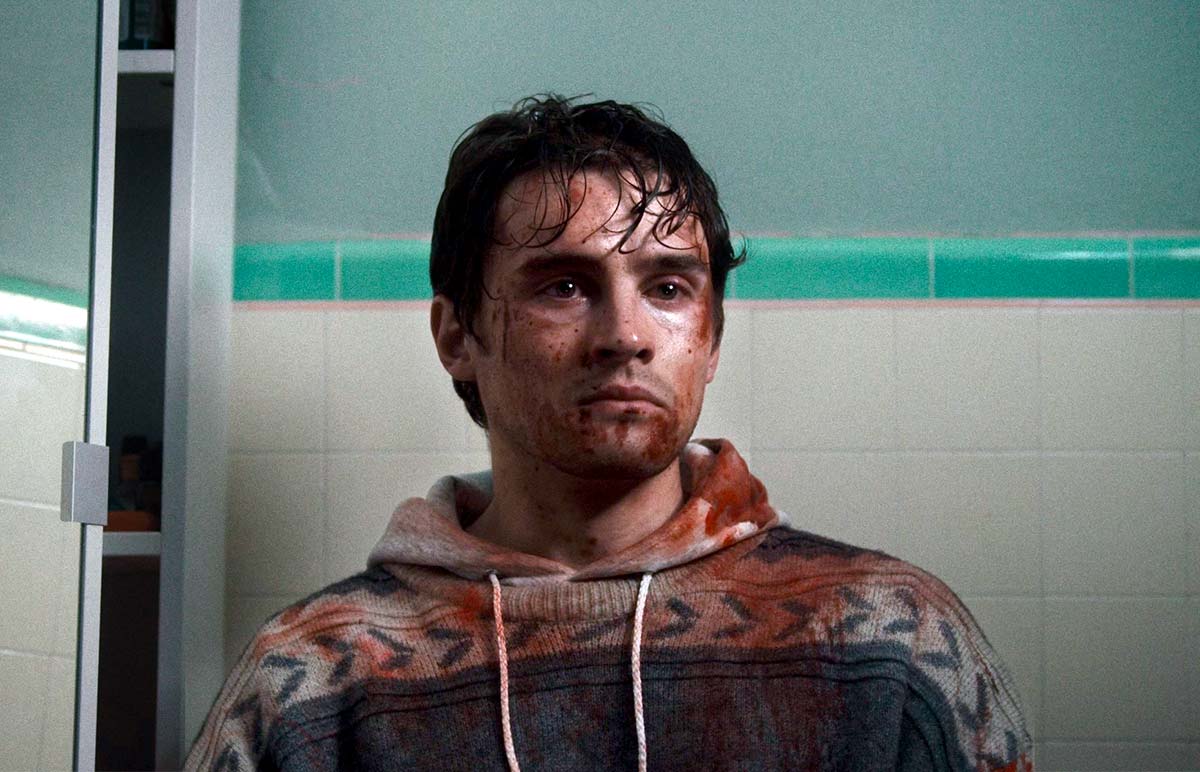
As things progress and escalate, Bear’s selfishness reveals itself all the more, and this manifests in a number of Barker’s choices. Tellingly, in her first appearance (at Barker’s Pub – natch), Nikki doesn’t receive any form of typical introduction. In fact, she’s marginalised within the scene for a good minute or two. Throughout what follows, as she and Bear grow inseparable, he frequently encounters her in teasingly low light. Barker expertly mines the threat of her appearing as something else. Who’s features are hiding in the dark? But it’s a visual representation of her depersonalisation. Bear’s growing perception is that Nikki’s unhealthy attachment to him makes her the insufferably controlling element in the relationship. But it’s a warped, self-negating view. He. Is. Literally. Controlling. Her.
People call Bear a closed book, but throughout Obsession his inaction is most revealing. It’s a good hour or more before he even comes to the notion of trying to undo his wish, and every indication suggests this is for his own benefit and not Nikki’s. He’s a mire of self-pity. When he cries at his failed girlfriend, “I want you to act like Nikki!”, the operative word is “act”. His priority is not to end her suffering, but to mollify his conscience.
Barker weaponises queasy, inappropriate-feeling humour throughout Obsession the way other directors wield a jump scare. He keeps the movie on a knife-edge of delirium and hysteria, occasionally using a cut to darkly comic effect. There’ll probably not be a better door reveal all year. It helps offset the incredibly portentous, oppressive atmosphere conjured by his mixture of doggedly low lighting and the wooziness of Rock Burwell’s score. And, naturally, by the two lead performances. Johnston’s sallow twitchiness is levelled by Navarette’s striking self-control and poise (somewhat ironic given the true nature of the character, which is teased at with just enough worrying lore).
There are troubling aspects to Obsession. The gendered direction of the graphic violence. The deliberately narrow field of vision. One might argue the overall decision to present the victim as the threat, nestling us deeply within a warped perspective. Barker leaves himself greatly open to challenge here. But it furthers such an acute point, it’d be a shame if it was misconstrued. The worst thing that could happen would be if Obsession became a torch-bearing movie for virginal young men who feel isolated. In fact, this is the just the set of viewers who ought to learn from Bear’s mistakes. Even if some of the creative choices may seem questionable, the actualisation is assured and commanding. Barker represents another YouTuber bursting out into the cinematic world with unnerving confidence. Be afraid.



4 thoughts on “Review: Obsession (2025)”