

Director: Kane Parsons
Stars: Renate Reinsve, Chiwetel Ejiofor, Mark Duplass
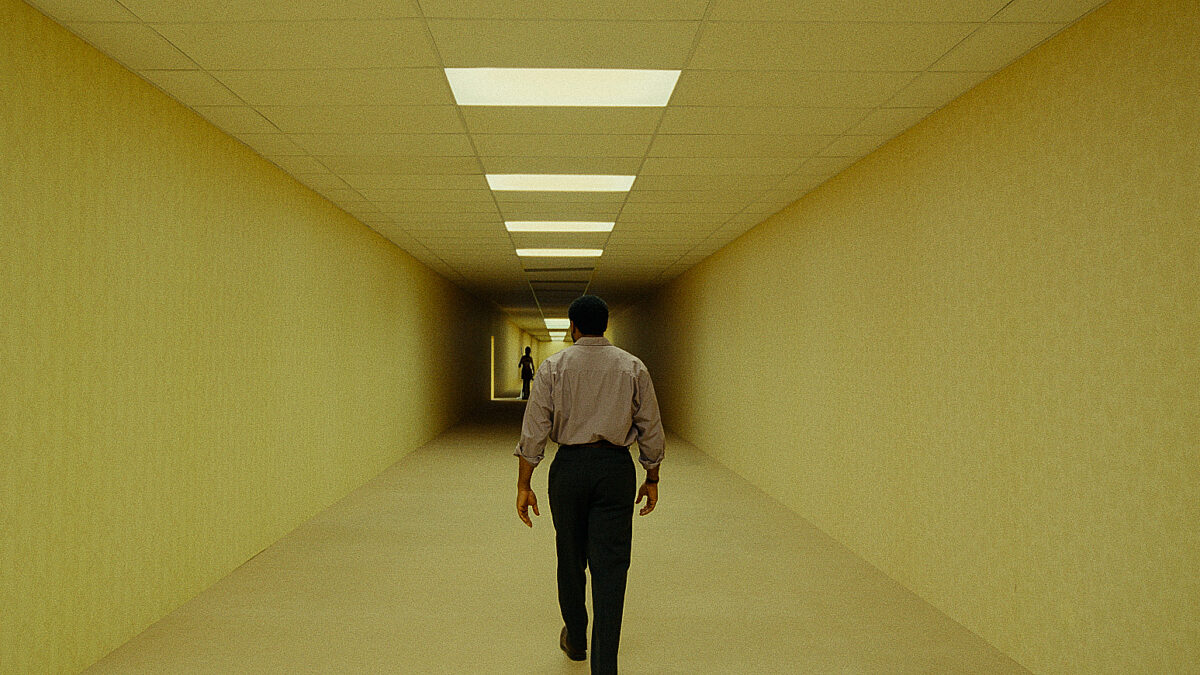
Born from a cult of interest surrounding an eerie, yellow-toned office space picture posted on 4chan, multiple online creators have toyed with ‘the Backrooms’; a notion of an adjacent dimension of impossibly vast interiors existing a hair’s breadth from our own reality. An endless inside. There are scores of shorts – including YouTube wunderkid Kane Parsons’ own exemplary 18-part series – and even indie video games that explore the concept, most of which seem to culminate with a monster at the end.
Parsons’ own first short – the one part of his series you can currently log on Letterboxd – also played the conceit of a beast in the maze, minotaur-style, but to his credit his subsequent expansion displayed a confident yet coy approach to myth-making, and amounts to some of the finest mystery world-building I’ve seen since the glory days of LOST. Now, with the assistance of A24, Parsons (somewhat sickeningly born in 2005) continues his work for cinema audiences, expanding on his series but not at the expense of his wealth of new audience members. Having supposedly mapped out his own lore in a chonky 70 page document, he here approaches the notion from the opposite end, if you will. For the Backrooms’ cryptic genesis you’ll have to default to his online series. This is the phenomena as experienced by a handful of unwitting and wholly unprepared people, whose fragile psychology only further distorts their through-the-looking-glass discovery.
Clark (Chiwetel Ejiofor) is the disgruntled, workaholic manager of a Santa Clara furniture store, Cap’n Clark’s Ottoman Empire, with unrealised dreams of becoming an architect. A divorcee with a drinking habit who has taken to sleeping in his own showroom, Clark at least has the self-awareness to have sought professional help from psychotherapist Dr. Mary Kline (Renate Reinsve), who has her own nagging history with feeling displaced from a family home. One night while trying to root out the cause of electronic discrepancies at the store, Clark discovers an entry point into the so-called ‘Backrooms’. Aghast and fascinated, he tentatively begins exploring the network of interconnected rooms, many of which feature remnants of his own store stuck into the walls and ceilings, as though someone – or something – fumbled an uncertain copy/paste job. From these architectural anomalies alone, Parsons starts inferring something significant. That a place – any place – is to some degree imprinted with the identity of its inhabitants. Wherever you go, that’s where you are.
The uncanny and inexplicable is built into the core notion of the Backrooms as something horrific, and you can sense Parsons and his more experienced screenwriter Will Soodik wrestling with this in the text. How to define the indefinable? Should you even attempt it? Explain something scary and you rob it of it’s power and mystique. Present it too opaquely, and what have you even done? As Clark says to Mary – which Mary later repeats to a key third party – it’s like describing a dog to someone who’s never seen one and then asking them to draw it. The least interesting thing Backrooms could do at this point is show you the dog.
In a manner similar to his YouTube series, Parsons does and he doesn’t. Backpocketing some information for future instalments, he uses this feature to add an extra dimension of uncertainty, and the extended running time presents an opportunity to reframe the core concept through character work. Enlisting Ejiofor and Reinsve – two of the best in the business – is a smart play, and they round out what may otherwise have presented as Parsons’ weaker material. He’s clearly more comfortable inside his beloved maze. Intriguingly, the story he’s chosen to tell acknowledges and even interrogates this comfort. In this way Backrooms makes Clark an example of urban alienation, presenting a wider dissatisfaction with the difficulties of the real world. He prefers objects and furniture to people – they’re less challenging – something disturbingly evoked in a stunningly realised dinner scene. Much like Curry Barker’s Obsession, Backrooms picks away at a wary male protagonist who’d rather live inside his own head.
Mercifully disinterested in the jump scare, Parsons and Soodik mostly play to pre-established strengths, mining the disquiet of what’s lurking around the next corner and the primal terror of getting chased. The clean, detailed, widescreen photography allows us an unprecedented look at these Backrooms, rendered gorgeously by the production design team, but the movie is arguably most effective when it defers back to the series’ analog found footage origins. Easter eggs are dropped in for the initiated (sun paintings! that looping music!), but never at the expense of the here and now. It’s a steadily paced feature, but with passages – or corridors – of breathlessly perpetuated terror. Parsons may have done for pirates what Jaws did for sharks.
This isn’t an end or culmination. Parsons has been very clear in interviews about his ambitions to keep going with this idea, and there are scenes here that feel conspicuously like one half of a conversation. The jigsaw isn’t completed. Nor should it be, at this juncture. If anything, Backrooms has expanded the borders of what was already presented. We need to find more edge pieces again before we can work on the bigger picture. As mainstream entertainment, this is wildly creative, and feels kindred in scope and originality to something like Spike Jonze’s Being John Malkovich, even down to a motif of avatars or puppets. Places, like people, can have bad wiring. The conundrum – a pivotal and world-shattering one for Mary – is when you admit defeat, and what it means if some places, or people, can’t be fixed.


1 thought on “Review: Backrooms”