
Director: Sang-il Lee
Stars: Ryo Yoshizawa, Ryusei Yokohama, Ken Watanabe
Sometimes it takes an outsider to show you who you are. For South Korean filmmaker Sang-il Lee, his journey across the sea to make a film on the Japanese tradition of kabuki theatre generated the most profitable live action movie release in Japanese history. Now, thanks to Vue Cinemas’ own Vue Lumière distribution strand, UK viewers get to see what all the fuss is about.
Chopping down Shuichi Yoshida’s 800 page historical novel into something for the screen is something of a tall order, and reports suggest the delivered Kokuho (which roughly translates as “national treasure”) was trimmed from over 4 hours to it’s standing running time of a little under 3. It’s still a chunk of movie to ingest, but it has the feel of a novel cliff-noted as much as any life-spanning biopic based on real events.
For the uninitiated in kabuki, some on-screen text at the beginning teaches us that the 17th century shogunate banned women from performing female roles in theatre, citing decency concerns. For that reason the tradition grew of men taking on such roles (something mirrored to an extent in the west) but from that trend a specifically Japanese artform grew – onnagata – a mannered and stylised form of performance venerated and handed down generationally. Kabuki has gone in and out of fashion over time but, for a certain intelligentsia, has always retained a certain level of class and esteem.
Kokuho concerns the life story of Kikuo Tachibana (Soya Kurokawa, later Ryo Yoshizawa) who we meet aged 15 in 1964 in Nagasaki, where his performance of Barrier Gate catches the attention of famed kabuki star Hanjiro Hanai (Ken Watanabe). When Kikuo’s own father (Masatoshi Nagase) is murdered in a yakuza hit, expectation falls on the shoulders of Kikuo to avenge the act. Instead he is taken in by Hanai and raised as though he were the man’s own son, growing up in the arts alongside his new step-brother Shunsuke (Keitatsu Koshiyama, later Ryusei Yokohama). While the two boys bond, Kikuo’s illegitimacy becomes a contentious, fragmenting point in their relationship, and in the eyes of society, particularly once Kikuo’s superior ability in the art overshadows that of Shunsuke. When Hanai names the outsider as his successor the rift becomes severe.
Prior to his father’s death at the beginning of the story, Kikuo is tattooed in the style of the street gangs he’s been brought up around, a striking owl emblazoned across his back. This marking will prove to be the lasting stain of his roots, but it also sets in motion his tolerance for pain, discipline and signifies the artistry of storytelling that will define the rest of his life. The abusive tutelage from both Hanai and his prior master Mangiku (Min Tanaka) are part and parcel of the road to excellence, and the film generally takes this view also; that to become a master, one has to weather tribulations and pain. But Kokuho presents something else, also; the notion that acting is not a vocation or act of volition, but an all-consuming compulsion. A state of being.
In this Lee cagily investigates the story’s unquestionably pertinent potentiality as a trans allegory. Something you just are.
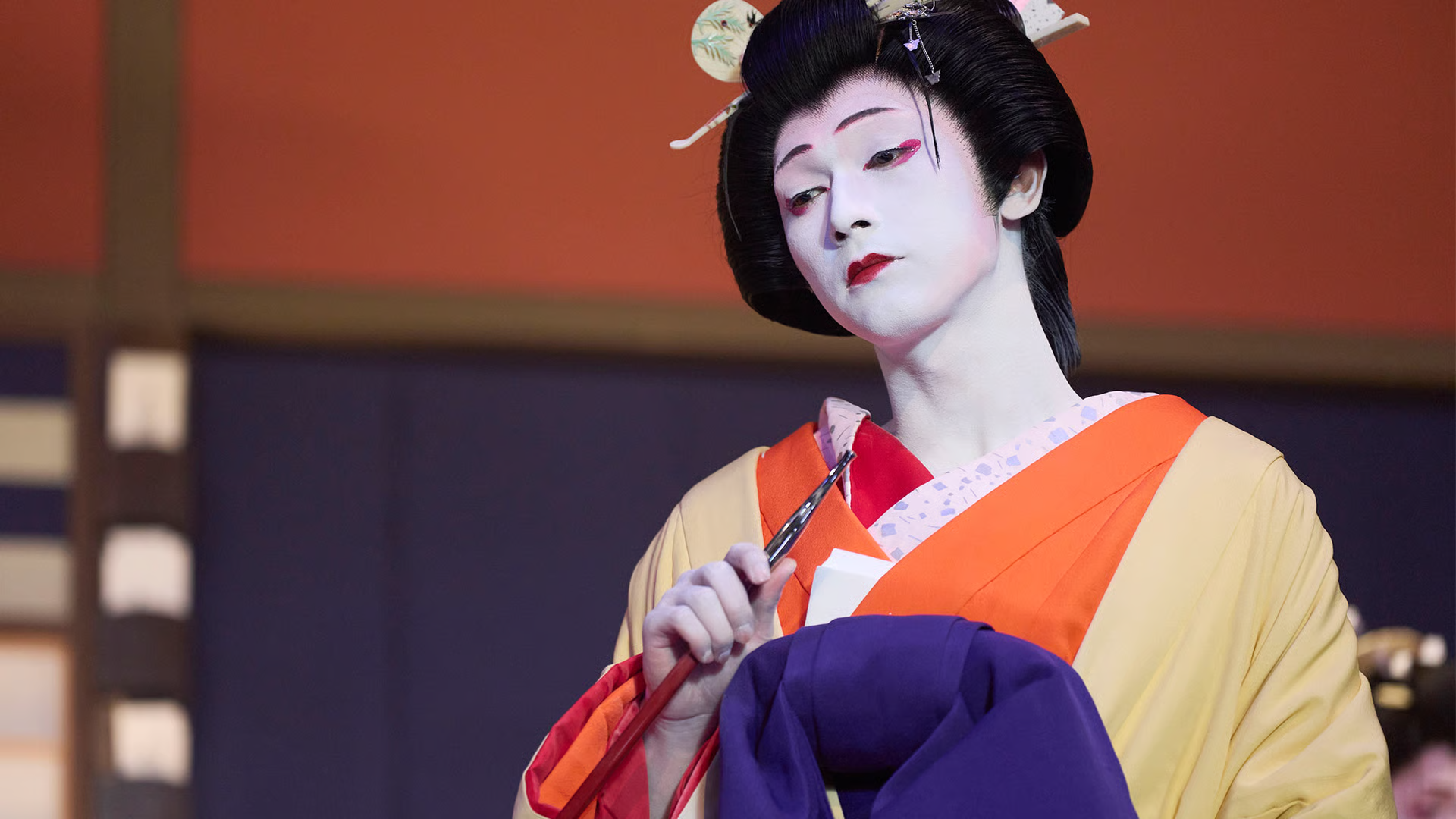
Broadly, neither Kikuo nor Shunsuke’s gender or sexuality are brought into question. The peripheral dramas of their lives paint them as heteronormative males, with wives, geishas, and ultimately families of their own. But the need to perform as women in onnagata is fundamental to them as well, an intensely moving act of transformation that is expressed as the ultimate venerable tribute to women, and the pinnacle of their craft. In particular, the personal stakes are immense for performing the female role in Love Suicide, for which anything is worth the cost. It reads as an incredibly powerful love of the feminine that a conservative society will laudibly accept from men because it is displayed within this hyper-specific set of circumstances. It’s both fascinating and achingly beautiful. For Kikuo, one senses, there are two sides. His yakuza past (masculine) and the all-consuming expression of onnagata (feminine).
When the boundaries are blurred off of the theatre stage, as when an adoring fan attempts to meet Kikuo, things descend into more typically predictable confusion, hate and violence. But Kokuho isn’t so much about challenging binaries or investigating their limits, as much as it a paean for the art that evokes it. Oscar nominated for hair and make-up, the excellence extends to costume and production design, particularly when we are asked to immerse ourselves in the stage work of these characters. In these heightened passages, Lee’s film is without question the most gorgeous offering of the year.
Outside of this, what strikes most is how un-Japanese the film feels. As intimated above, the template appears more keenly to be the prestigious yet unsatisfying sweep of the American biopic, and the by-numbers cataloguing of episodes spanning 50 years has the effect of reducing passages of Kokuho to something more boilerplate than it’s more transcendent moments. For all the wondrous make-up, Yoshiwaza and Yokohama never particularly convince as older men in the film’s back-half, though their performances are, in a sense, ageless. Many of the film’s most moving sequences are between these two during an unlikely ’90s revival of their act with roles reversed. Here the art of performance pushes bodily limitations, further suggestive of a need to transcend our cages in order to become our true selves. The play they perform becomes entangled in the complexities of their brotherly bond. This and Yoshiwaza’s show-stopping finale are the creative and emotional peaks that will be remembered when much of the rest is forgotten.


