

Director: Ken Russell
Stars: Oliver Reed, Vanessa Redgrave, Gemma Jones
With its twin targets of religion and politics, there’s little wonder that Ken Russell’s wildly explicit and gleefully sacreligious The Devils fell foul of the censors both in the UK and the US, created a public furore and, in some territories, was banned for many years. These institutions don’t take kindly to criticism and even less so to mockery, and Russell’s period horror film purporting up front to be based on real events didn’t hold back on either front. The director’s cut has been restored following the requested/demanded trims all those years ago, and a faithful 4K remaster means that Russell’s 1971 hit can now be viewed as it was always intended. As is deserving of the film, a reverent cinema re-release has occurred; the perfect venue to experience the film’s giddy takedown of all that is (supposedly) sacred.
The year is 1634 and we’re in Loudon, France, where the governor has recently died, passing stewardship of the town to his trusted priest Urbain Grandier (Oliver Reed), a barrel-chested, fallible man of evident lusts, who in turn is lusted after by the nuns of the local Ursuline convent. Much as The Devils‘ early stretches lambast his vanity and pridefulness, they also paint a portrait of a preternaturally charismatic man taking advantage of his position of trust. We’re inclined to assume that Grandier is the film’s antagonist, only for this position in the narrative to be thoroughly usurped by the sadistic hypocrites higher up the social and political spectrum.
King Louis XIII (Graham Armitage) is portrayed as a whimsical, taciturn jester, whose follies are both tolerated and exploited by his underlings, particularly the Baron de Laubardemont (Dudley Sutton), Father-Canon Jean Mignon (Murray Melvin) and the king’s resident witch-hunter Father Pierre Barre (Michael Gothard). Near to the film’s opening the marriage of church and state is praised, but the two hours that follow reveal the inherent bias and abuses of power that such entanglement generates. Grandier’s localised influence is too threatening, so any opportunity to cut him down to size is seized upon. Such an opportunity presents itself when Sister Jeanne des Anges (Vanessa Redgrave) – literally crooked thanks to a body-distorting hunchback that she fantasizes/remembers manifesting during her first, miraculous encounter with Grandier – asserts that he is plagued by devils and responsible for numerous sexual abuses. She is moved by avarice, as Grandier – the object of her sinful desires – has married Madeleine de Brou (Gemma Jones).
The grotesque carnival that de Laubardemont unleashes on Loudon is the cause of much of The Devils‘ controversy, as Russell parades the tyrannical, misogynistic and sadistic torture methods of the Catholic church before the camera, whipping up a frenzy of religious fervour in the nuns of the town while dismantling Grandier’s authority and reputation and putting him through a rigged trial with bone-crunching punishments. Incited by Jeanne and her claims of possession, the nuns run riot, stripping off their clothes and writhing upon fallen statues of Jesus on the cross. The mid-section of The Devils is an orgy of excesses. An heretical jamboree of hysterical bedlam wrought with a decidedly comic eye. Russell asks us to laugh at the naughty goings on, and understand perfectly the intentional myopia of Grandier’s accusers. For all his sins – and he is a sinful man – Grandier becomes a beacon of integrity in the face of such galling hypocrisy.
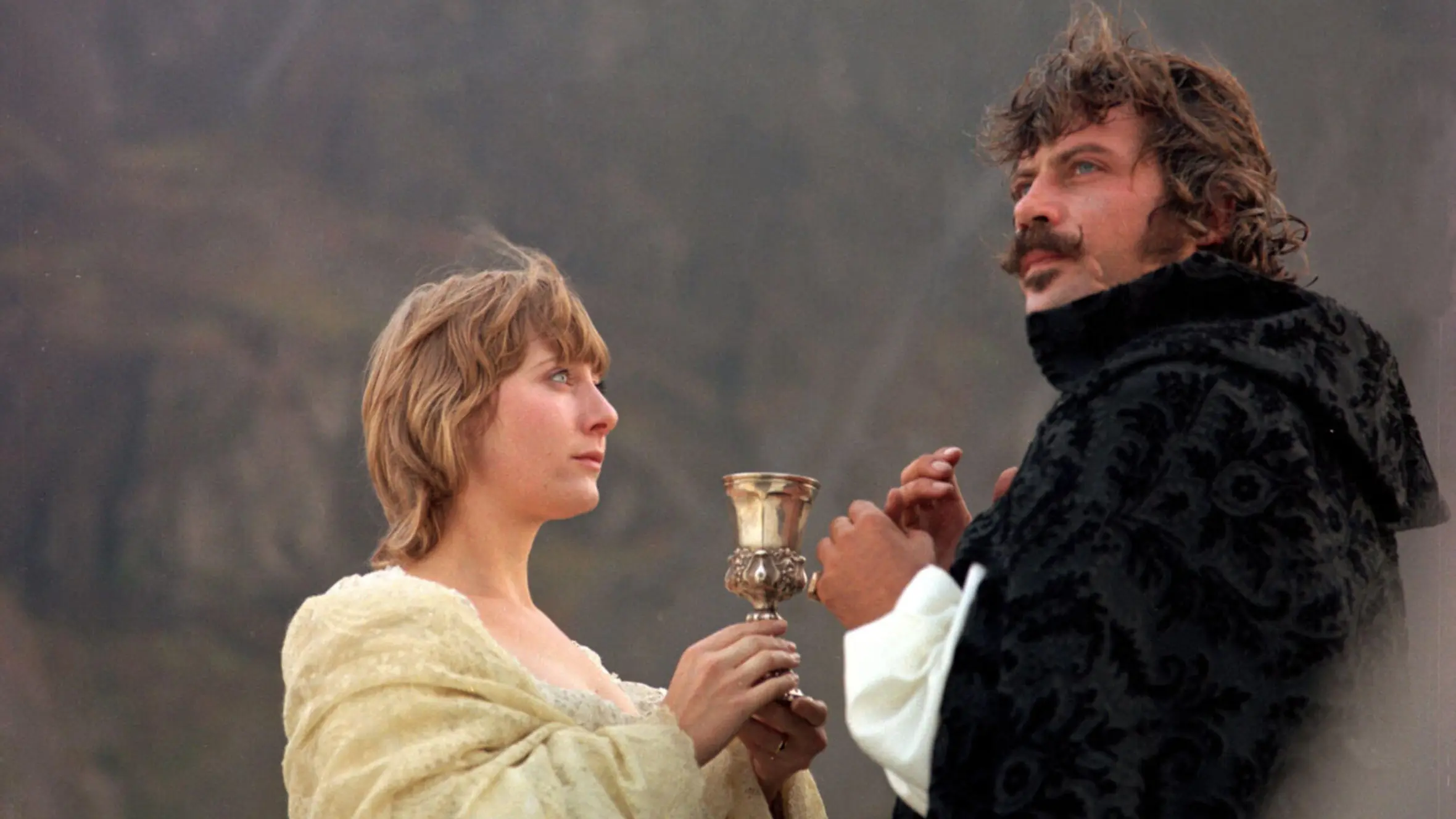
One might argue that Grandier’s examples encourage the derangement that unfolds in his brief absence, that he is the victim of his own excesses, multiplied many times over. But The Devils leaves us with no misgivings about where evil truly lies. Performances are uniformly unhinged, walking up to a precipice. But Russell keeps things just on the right side of delirium, for the most part. Reed is perfectly cast, whipping up his blowhard method work into something utterly compelling. His face goes so red in the notorious scene in which Grandier’s legs are pulverised, one fears that the actor might blow a gasket. Redgrave is equally intense, as are Sutton and Gothard as the sadists frothing at the mouth for their chance to defile and destroy.
The re-release of The Devils now feels acutely timed to both reflect and mock the galling lies presented by far-right parties on both sides of the Atlantic. Trump and his cronies are the modern day equivalent of King Louis XIII and his conniving minions. Nigel Farage and his UK cavalcade of ill-qualified mercenaries their British counterparts. And the church? The last hundred years of scandals are evidence enough that their abuses of power go on (relatively) unchecked. In depicting one man at the mercy of the institutions, with only his own (dirty) moral compass for guidance, The Devils is rendered dismally timeless.
It’s also rendered with impeccable, disarming artistry. Derek Jarman’s sets take one’s breath away, prefiguring the surreal wonders of Alejandro Jodorowsky’s The Holy Mountain, while the carnal indulgence feels in lockstep with Stanley Kubrick’s satirical depictions in A Clockwork Orange, which caused its own stir in the same year as The Devils. The humour – decidedly British – feels redolent at times of Monty Python, and its usage distorts the film’s unflinching horrors and eroticised reveries into the darkly wicked and kinkily desirous. With the dappled psychedelia rendered upon scenes through stained glass windows, it takes on the vibe of a happening that has fallen foul of man’s inability to exercise restraint. Repression uncorked and uncontrollable. A reflection, perhaps, of the death of the ’60s at the hands of Charles Manson.
In the end, The Devils is about conviction. Conviction of performance. Conviction of artistic integrity. And of the notion that one’s own integrity may not be enough in the face of true wickedness. It is incredibly good to have the polished article on display again, where new generations can be awed and scandalised.


