

Director: Martin McDonagh
Stars: John Malkovich, Mariana di Girolamo, Sam Rockwell
Chris (John Malkovich) is quite understandably preoccupied with death, and what happens after. Having been given six moths to live six months ago, the 72-year-old CIA agent is finding this mind slipping away and, with finite time ahead of him, is seeking to appraise his life against a set of Catholic values he appears to have otherwise abandoned. Chris has helped topple democracies. He’s helped topple presidents. All without a qualm. But with the end in sight his score with his God is making him uneasy. If a good dinosaur or a heroic Nazi might get into heaven, couldn’t he?
It’s 1973. Chris and his partner Lee (Sam Rockwell) are in Santiago, Chile, working on deposing the country’s first democratically elected president, Salvador Allende, in favour of fascist dictator Pinochet. The gears are in motion. So much so that their supervisory agent MJ (Steve Buscemi) has granted them leave to visit Rapa Nui (commonly known as Easter Island), to sate Chris’ desire to tour the sacred, majestic moai statues that have made the island so famous. It’s a shame that Chris’ memory is failing. He can’t quite remember why they’re going, or why he wanted to see those statues in the first place.
The answer might well lie in his approaching demise. The moai are monuments to the dead. Symbols of legacy, ultimately; a topic weighing heavy on Chris’ mind as he tries, with some confusion, to write his memoirs. Understandably, an agent penning a tell-all is of some concern to MJ. Lee’s task on the island is a grave one, but at whose behest? Welcome to the latest buddy comedy from Martin McDonagh.
In a sense we’ve been here a few times now with McDonagh, and the bickering banter of Wild Horse Nine is strongly reminiscent of prior audience favourites In Bruges and The Banshees of Inisherin. This excursion seemed so reminiscent of those past glories from the marketing materials that the movie they’re a part of sort of blind-sided me. The deeply-rooted melancholia of the piece wasn’t the surprise (have you seen Banshees?), rather the tenacity with which McDonagh takes the amoral to task, and how gorgeously he uses his chosen, remote setting to stage a ratchetingly suspenseful political pot-boiler. I’ve broadly enjoyed his work over the years, but never had one truly click until now. Granted, there’s more than a touch of the Coens about it all, and not just because Carter Burwell provides subtle underscore. But of all the great pretenders to their mantel, McDonagh might be getting closest. Aided unseen by the wit of his partner Phoebe Waller-Bridge, I’d imagine, Wild Horse Nine is narratively tight and surprisingly angry.
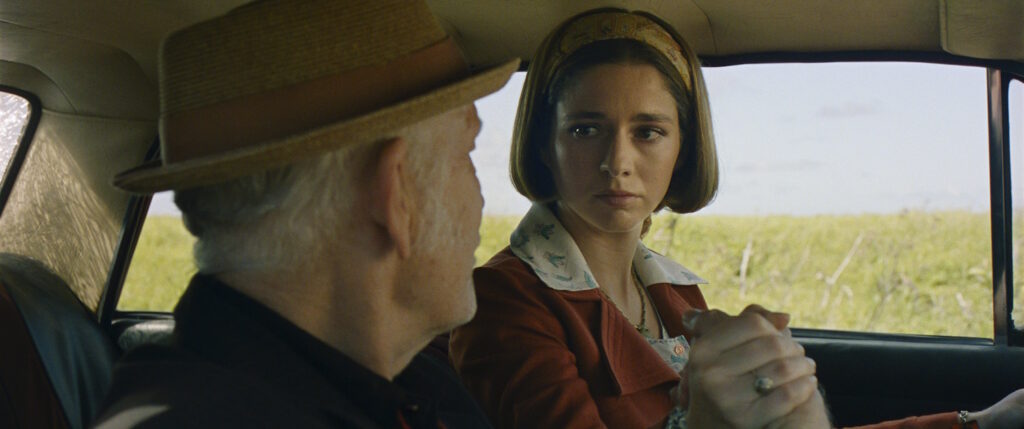
The cast are uniformly excellent. It might be time that the Academy gave Malkovich his laurels for his work here as Chris; a doddering wolf in sheep’s clothing, who so disarms us with his bumbling, forgetfulness and droll tongue that when he candidly turns – as in a body-freezing bar scene – the effect is extraordinary. Rockwell, for his part, loosely hands off one of his best turns in years as Lee; a working man handed a shitty job, loyal in ways the CIA never imagined. He does sterling rotary phone work here that almost counts as choreography, and no actor can do flabbergasted quite so comedically. Best of all, perhaps, is the welcome return to our screens of Mariana di Girolamo, star of Pablo Larraín’s Ema a few years ago, who reminded me so completely why her performance there was my favourite of that year. Here she plays Monica, innocuously holidaying from Santiago, the movie’s liberal conscience whose world is decimated by Chris’ pragmatic, pessimistic evil.
And Chris is evil. To a degree what McDonagh is doing here is a sympathy-for-the-devil routine, painting in the person behind the atrocities, showing us his fears and frailty, but never does he excuse him of his sins. There’s no absolution here. All three of the core agents presented have methods of self-medicating. Yes, Chris’ morphin is to combat the effects of his cancer, but it distances him from other pains, soo. MJ has his own cocktails of escapism. Even Lee seems to find solace in all the junk food he packs away. Solace for acts that can’t be remedied.
Wild Horse Nine scrutinises America in the wake of JFK’s assassination. Its relationship with the gun and how Dealey Plaza complicated and fetishised that. And, more broadly, the idea that a country built on evils only lost its innocence when one was played out so brazenly on home soil, captured by Zapruda on Super 8 – a medium which McDonagh dallies with at points throughout his movie to make it feel like some kind of kindred document. Lee roams Rapa Nui with his own handheld camera as though unwittingly waiting to capture some other act of violence. McDonagh indicts the lies that imperialist nations tell themselves, about the ‘greater good’, that long-standing pretense for corrupting acts. Wild Horse Nine doesn’t have the answers, exactly. We don’t visit the beyond and the pearly gates. That we don’t perhaps is an answer in itself, as pessimistic as any of Chris’ rhetoric. If there is no judgment waiting for us. If nothing is waiting for us, maybe what we accomplish – or commit – here is rendered even more important.
This and more in a breezy looking buddy comedy about two civil servants on holiday. Enjoy your visit.


