
Director: Takashi Yamazaki
Stars: Minami Hamabe, Hidetaka Yoshioka, Min Tanaka
Show, don’t tell. That’s the famed advice given to aspiring filmmakers. Use the medium, the language of cinema to convey through action. That this is the better way. But it isn’t always true. The finale of the phenomenal HBO series The Leftovers hangs on a pivotal, dialogue-heavy scene which flips the idiom to Tell, don’t show. And it’s one of the best endings because of it. So even the most commonly held notions about visual storytelling can be bent, if not broken.
Takashi Yamazaki’s low-budget live action sensation Godzilla Minus One has a pivotal scene around the end of the second act/beginning of the third. In it, wavy-haired scientist Kenji Noda (Hidetaka Yoshioka) lays out his plan to take down the raging kaiju that has devastated Ginza. He has examples to better illustrate the mechanics of his plan, but every part of it is presented to his audience, and us. Then, with a few hiccups of course, the movie does exactly what it told us it would. And it’s still thrilling.
Godzilla Minus Zero often sticks to the rules of Show, don’t tell. Plans are made in the cuts. One relatively early sequence even jumps the explanation awkwardly, as though there ought to be a “Scene Missing” intertitle. This time the reveals are cagy, and the results suffer somewhat. The long climactic battle in the ruins of Ginza is ultimately less engaging than the seabound finale of Minus One because, well, stuff just happens. Huge efforts of human construction and planning just… appear. The emphasis on collaborative effort to overcome challenges is less so than before. Indeed the entire human element feels distracted this time out, and not in a good way.
The movie opens with an earth-rattling promise of immediacy that it doesn’t follow-up on. It’s 1949, two years after the events of Minus One and Matsumoto City is under attack. Not from Godzilla – still presumed dead at the bottom of the ocean – but from giant mutated space dragon Ghidorah (yay!). Godzilla was bad enough for the Japanese proletariat, but this fucker can fly, and has the nasty habit of levitating entire buildings only to unceremoniously drop them to the ground (these terrifically rendered sequences sent me straight back to reading the manga of Akira, awed at skyscrapers falling from the sky and colliding with others). Mr. Noda is now head of the Disaster Response Bureau at the Central Meteorological Observatory, and it’s battle stations time. He calls on his old kamikaze pilot pal Koichi Shikishima (Ryunosuke Kamiki) to help them out in the skies, but Koichi is reticent now that he’s a committed family man with Noriko (Minami Hamabe) and young Akiko (Sae Nagatani – still cute-as-a-button).
Noriko, as you’ll surely remember, was thought dead but survived the Ginza attack by Godzilla, albeit with a mysterious infection that ended Minus One on a disconcerting note. That thread is pulled here, but in ways that one might not expect, as Minus Zero foregrounds a new character; mad scientist Kanji Murakami (Min Tanaka) who, along with plucky meteorologist Aoyama (Masami Nagasawa), bring fresh blood into the heroes’ conclave. Murakami harbours a deep seated grudge against the Americans for the devastation at Hiroshima, and one of Minus Zero‘s better threads is its preoccupation with the fallout of war – the wounded and the orphaned. Yamazaki is grimly explicit in this regard, and scenes of his film recall such mid-20th-century classics as Hideo Sekigawa’s Hiroshima reenactment, or Yasuzō Masumura’s unflinching Red Angel. The toll of kaiju attacks has rarely been so underscored.
There’s also something to be said – or something struggling to be said – about reusable energies over other, more volatile and dangerous sources. This is the role that Aoyama plays in the picture; coming up with alternatives that often prove beneficial to the enterprising crew. Or, if not beneficial, they at least forward the evolution of the plot, such as it is.
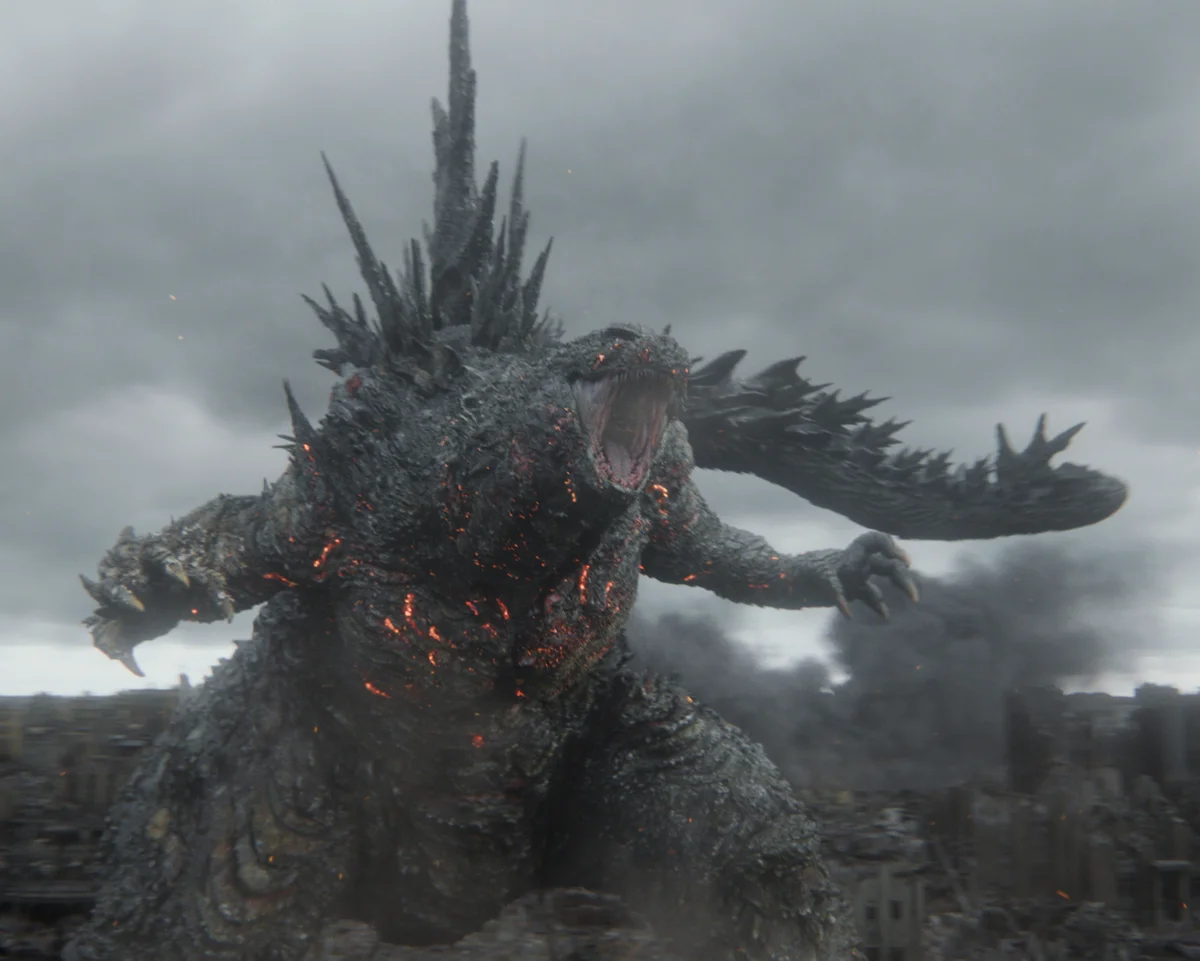
When the action comes it’s as spectacular as you want. Plucky pilots engaging in a dogfight with Ghidorah set an early benchmark, but the pacing of the film is far less confident than Minus One and it feels like a long time between set-pieces, with Godzilla’s inevitable return pushed to around an hour into the picture. The amount of Godzilla in your Godzilla movie isn’t always a benchmark for how great it us. You can do a lot with a little. But Minus Zero fills the space between the monsters with scenes of increasingly overplayed, highly-strung melodrama and sentimentality, mainly from Koichi and Noriko as they endlessly wring their hands over the choices that need to be made. Koichi particularly becomes tiresome. The third act delivers plenty of what the audience has been yearning for by this point, as Murakami’s plan to have the two monsters fight one another finally comes together, but the drab setting of demolished Ginza renders it a long, colourless affair, save for the neon energy beams of the battling beasts.
Yamazaki’s VFX are great again (save for some rubber-looking crows). He is in his element when emphasising the scale and weight of Godzilla and Ghidorah, and their skirmishes are top-of-class efforts in a series that’s entered it’s eighth decade. You’ll get what you came for. But the getting there is more of a labored struggle, and the aftermath home to one of the most pained and irritating farewells to have hit cinema screens in a long, long time. Yamazaki is on much firmer ground getting us hot under the collar for giant monsters than he is prodding us to weep for the weeping. When it comes to these scenes, I’d much rather have been told than shown.


