
Director: Boots Riley
Stars: Taylour Paige, Naomi Ackie, Keke Palmer
Hot on the heels of Paweł Pawlikowski and Lee Chang-dong who also have new films in (select) cinemas, so Boots Riley also ends an eight year hiatus between features, returning here with his first effort since cult favourite Sorry to Bother You caused such a word-of-mouth stir. The US has had the privilege of I Love Boosters for five months now, making it’s limp to UK shores during an uncomfortably crammed autumn release schedule both long overdue and a bit poorly timed. But, for those overjoyed by Sorry to Bother You‘s satirical surrealism, the extra wait will have been worth it.
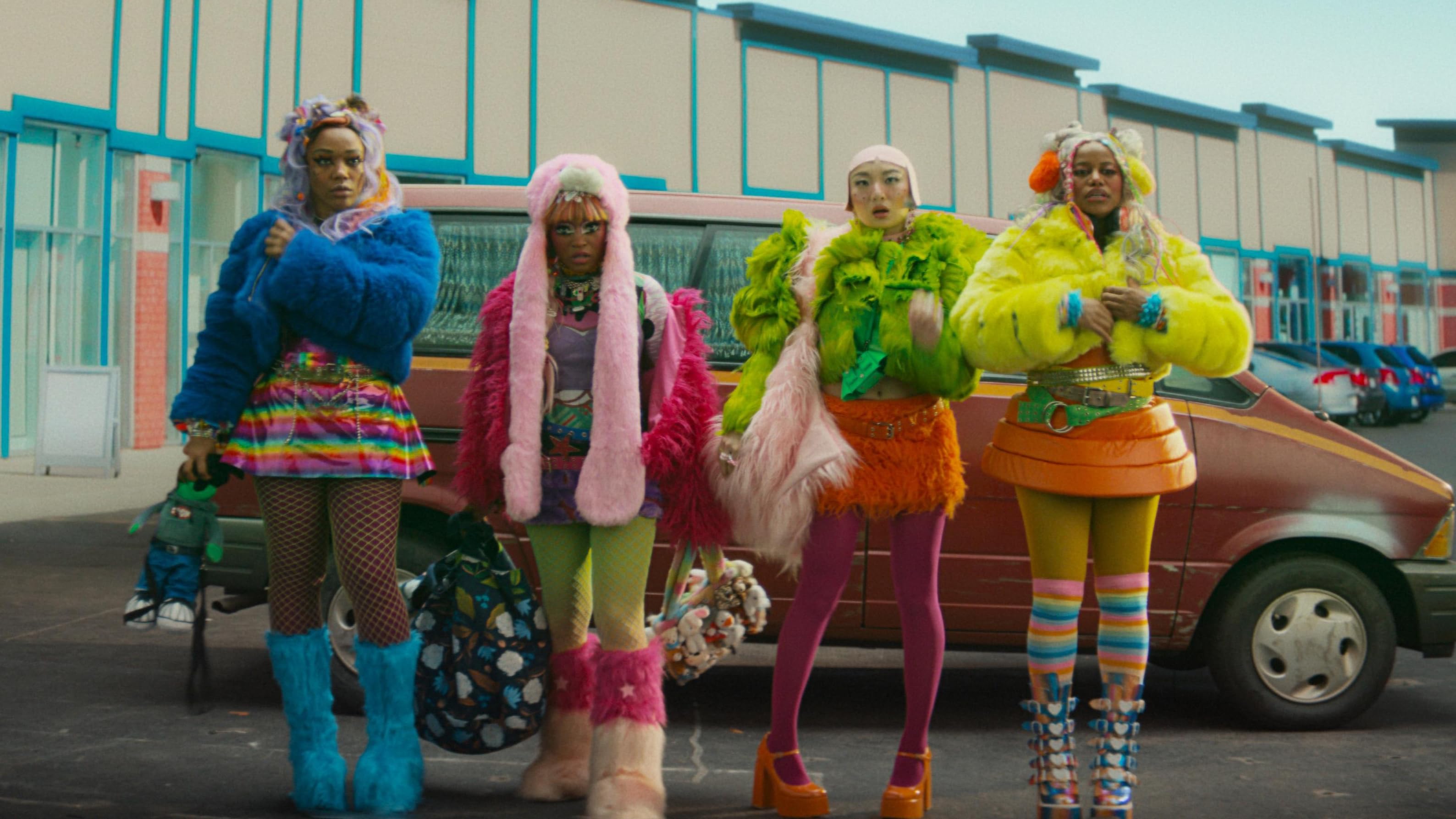
Wearing producer, writer and director hats again, Riley introduces us to his collective of ‘boosters’, The Velvet Gang, an all-female brigade of shoplifters robbing high-end retail outlets for designer fashions that they hock at discount for profit. Corvette (Keke Palmer) is squatting with Mariah (Taylour Paige) in a disused fast food outlet and, along with their friend Sade (Naomi Ackie), they trawl outlets, brazenly pilfering from the racks, stuffing their oversized outfits, while Corvette hallucinates Katamari balls of overdue rent notices. They are students of outlaw pyramid scheme operator Dr. Jack (Don Cheadle), creator of a system supposedly designed to beat the system.
In spite of the women’s desire to damage and even deconstruct the fast fashion business of buzzy designer Christie Smith (Demi Moore), they are all enamoured with the aspirational ‘wearable art’ that she peddles. Fashion magazines are strewn around with love heart post-its stuck in them. Corvette covets Christie’s position of privilege, but there’s someone that takes over her very body chemistry and worldview; the hazy orbital presence of LaKeith Stanfield’s soul-sucking ‘Pinky Ring Guy’. While flat-screen TV screens at Christie’s MetroDesigner stores ubiquitously spit catastrophising news stories, primary coloured fashion seasons consume everyone’s attention. The boosters’ hustle is a 24/7 preoccupation, indicative of our collective exhaustion at just keeping our heads above water.
Things get stranger when the central trio encounter Jianhu (Poppy Liu), a Chinese textile factory worker who claims to have arrived in California via a teleporter concealed in a handbag. Her story highlights harmful overseas working conditions and the difficulties of unionising, but also the industriousness of a collective committed to resistance and activism. For all it’s zaniness and pretty colours, Riley’s work is attuned to global concerns of exploitation, but also acts as a surprisingly rousing call-to-arms at the proletariat level. His targets are rather obvious, amounting to a kind of leftism 101, but the energy is infectious.
Jianhu’s teleporter isn’t just a teleporter. It also operates as a device that can deconstruct anything it is aimed at back to its component parts. A wish-fulfillment gizmo for re-ordering the world by undoing its travesties. Or, in ‘situational accelerator ‘ mode, the ability to obliterate subtext. In effect it’s a cinema machine, contorting the world into walking, talking allegories, or weaponsing the present by revealing the past beneath it. But that’s not the limit of Riley’s hurdy-gurdy ambition. A late second-act discovery somehow outdoes even this strangeness, creating a dizzying level of dissonance that amounts to a make-or-break moment. I went with it.
The oompah oompah music of Tune-Yards overscores Riley’s willfully odd creation, woozily complimenting the many visual absurdities and surprises. Riley doubles down on the eccentricities presented in Sorry to Bother You. I Love Boosters is an exaggeration of style akin to the ways that each ensuing Wes Anderson picture feels like a condensation and enhancement of what came before. In Riley’s loopy world, Mariah can pass as a well-do-to white woman simply by holding her breath, while Christie’s work studio is a palatial pop-art apartment in a skyscraper on a 30 degree slant. Riley’s world is literally askew, operating like a live-action Saturday morning cartoon. And it’s about as hyperactive and colourful, too.
As such mileage may vary depending on your willingness to surrender to his particular brand of whimsy. I’m often deeply skeptical of the whacky, finding forced eccentricity tough to stomach and overcome. But, on this occasion, Riley’s approach retains the ability to charm. There’s a ton of political discourse happening within the text of any given scene as he contends with society’s ever-growing gulfs of class and race (white people are weaponised by Corvette and co. as tactical distractions, while the notion of Black people as perennial thieves itself toys with the tropes of white, racist paranoia). That Riley has gathered such a superb roster of players is a testament to the draw of his singular vision, pulling in the likes of Will Poulter and Viggo Mortensen for relatively minor, even unseen roles. Riley hasn’t yet reached Wes Anderson’s over-stuffed roster, where the star cameos feel performative and claustrophobic. He’s still in the sweet spot and that’s very much in his (and our) favour.
“Now is not the time for nuance!” Corvette bellows. This is maximalist filmmaking, substantive but played for pure enjoyment. Riley’s manifesto is to couch his often-times broad political messaging by conveying it as colourfully and goofily as possible. Bright, sexy, funny and weird as hell. Here’s hoping it doesn’t take another eight years for his next puckish salvo, and that he can remain on the right(eous) side of the absurd.