
Year: 1973
Director: Chantal Akerman
At the time of writing it is May 2026, and Kane Parsons’ directorial debut Backrooms is on the horizon – a film which may well see the liminal horrors that have gained cult momentum in deep corners of the internet break out into mainstream consciousness. The trend is simple, and can be found in exceedingly effective independent video games such as Exit 8 (itself already adapted into a film) or Dreamcore; the seeming innocuousness of between-spaces that we take for granted – staff corridors in shopping malls, public swimming pools, even your own home’s staircase or hallways – turned uncanny and threatening through their inexplicable extension. What if such otherwise benign, blank architectural places became a labyrinth working against you? It’s a tension that’s surfaced increasingly at the movies of late, from Lorcan Finegan’s Vivarium to Kyle Edward Ball’s Skinamarink, but it isn’t a new idea by any stretch. Even flying back beyond Vincenzo Natali’s 1998 sci-fi horror Cube, Belgian auteur Chantal Akerman conjured just this notion of eeriness with her experimental hour-long 1973 documentary Hotel Monterey.
Filmed within the titular Manhattan hotel circa 1972, the film pre-dates Akerman’s first narrative feature (the incredible Je Tu Il Elle), and finds her contemplating frames and spaces. It feels like a living, breathing act of professional realisation, and something of a trial run for a number of themes that would come to dominate her feature work, in which interiors amount to prisons for various protagonists, not least the titular Jeanne Dielman of her celebrated 1975 masterwork.
That Akerman recorded these experiments without sound only manages to make what unfolds more uncanny, and amounts to the first dislocation from a trustworthy or comforting experience. Our modern world has become overrun with CCTV, and Hotel Monterey can feel like some eerie feed from the past. Textured with the gorgeous grain of 16mm stock, the images themselves have a thickness, evoking a lost time as much as the hotel’s often lurid decor. Carpets and ceilings and wallpapered corridors suggest an aura of stale cigarette smoke, and we’re trapped within dingy colour palettes of green, taupe and brown.
The first image of the film is of two men trapped inside an inexplicable rectangle high up a wall of patterned wallpaper. They seem utterly incongruous, as though we’re looking not at a scene, but a collage. Are they reflected, or are they in a flimsy-looking window? Ultimately the passing shadows and reflections of guests reassure us that, yes, this is a mirror, reflecting their off-screen presence. But in this one opening salvo Akerman conjures a sense of deeply unreliable space.
Guests haunt the hotel lobby which, with a row of three identical phone booths (an incongruity by modern eyes) takes on the aura of some copy/paste error. A glitch in the matrix, so to speak. These silent figures – some of whom care enough to glance at the camera, some of whom don’t – further a connection to horror cinema. It’s hard not to think of, for instance, The Overlook Hotel as envisaged by Stanley Kubrick and a lingering shot, later on, of a man sitting stock still in an armchair furthers this sense of limbo existence. He seems at ease, but ever-so still, as though sitting for a portrait. There’s no sense of time within the film. We’re rarely completely sure whether it is day or night. And so the guests all feel like entities haunting this place, accustomed to their lot, passive and somnambulist. A shot soon after the man finds a door swinging lightly in some unidentifiable breeze. It’s as subtly uncomfortable as anything from a Paranormal Activity film.
Most shots are static, so gauging the extent and shape of the hotel is impossible for the viewer. Disembodied arms move around in the gloom of an elevator and the fortuitous porthole window allows us a sense of travel. Floors appear and disappear, though we remain static. It is as though the hotel is rearranging itself outside. We understand what is happening, of course, but it is within touching distance of the magical if we allow our imaginations out. Watching the elevators from outside later in the film inverts our gaze but doesn’t undo the sense of the strange. Green and amber lights interchange, flashing on and off as though communicating in a kind of Morse Code we’re not familiar with.
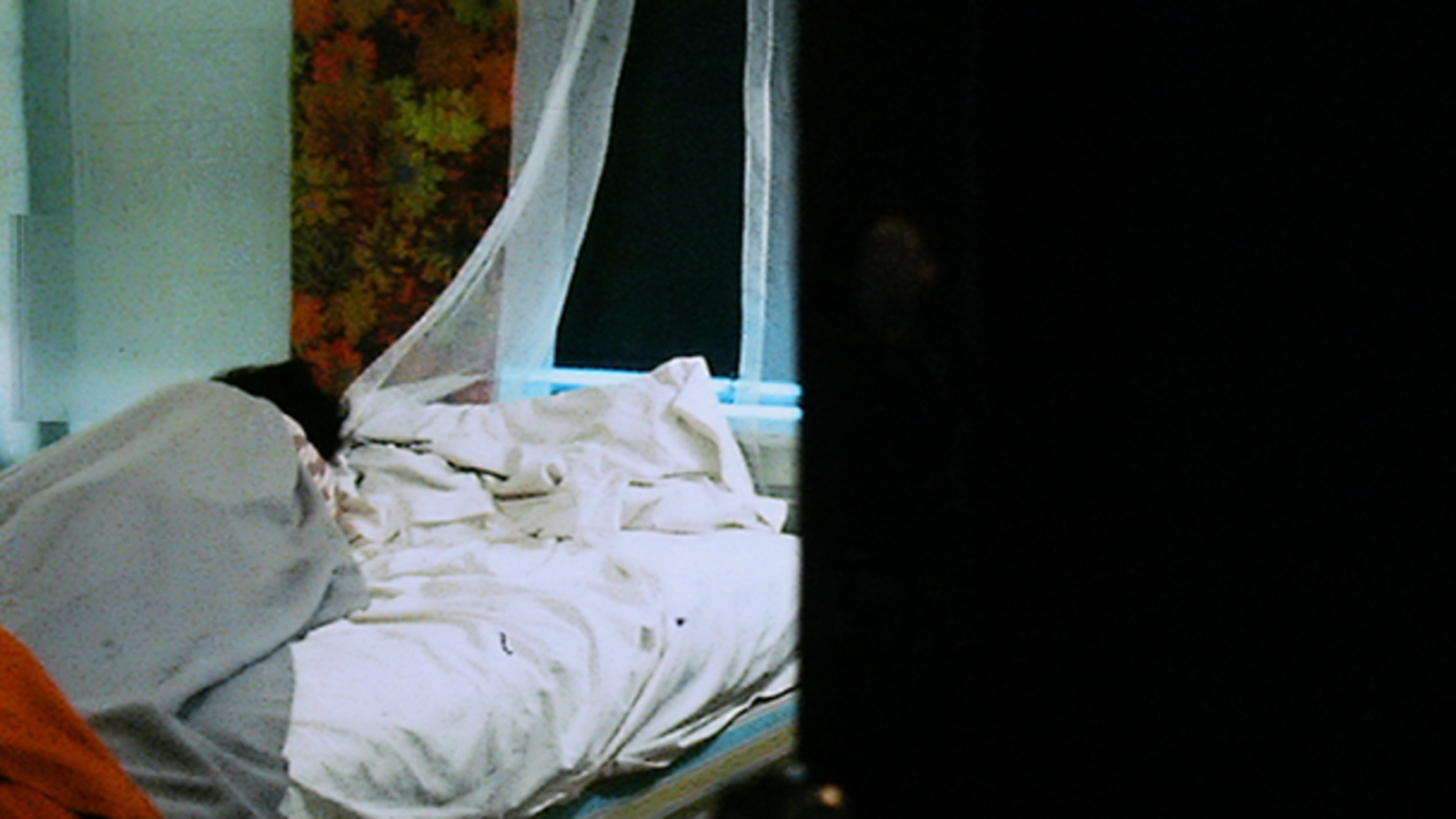
Akerman’s camera – controlled by her DP Babette Mangolte – errs on the voyeuristic. There’s a prevailing sense of peeking, of peeping. That ‘we’ are some mostly unseen observer. But, occasionally, we grow too bold, are spotted, noticed. Views through doorways have a preternatural sense of invaded privacy. A shot of someone sleeping from through a doorway feels like an intrusion. A toilet visible from a corridor feels in someway taboo or unseemly; a scene that requires intervention or attendance. Most shocking of all is perhaps the hotel’s most worrying architectural feature, a claustrophobic corridor which leads to twin doors at near right angles to one another. It feels like a warping of the regular. An image out of Escher. Then, suddenly, someone peeks out from one of the doors. It’s nightmarish.
Then there are the moving shots.
In the final third of the piece Akerman and Mangolte gradually glide the camera down corridors, steady but slightly uneven, marking out the human factor. This isn’t the glacial purity of Steadycam. Not quite. Not yet. A tilt here. A judder there. It adds immensely to the feel of human travel. Corners at the end of hallways become apprehensive unknowns. Threats. Exposed areas of uneasy potential. Then, often, we’ll retract, retreating. But safety doesn’t feel guaranteed, because the dimensions of the maze are unknown. These are among the most effective shots of the whole experiment.
Eventually skylines and open space offer some respite, even if black railings still present us as ineffably caged. Reverse shots of the hotel’s upper exterior alleyways show disarray and dishevelment, reminding us that inside is a dark inevitability. The roof is an oasis, but the hotel – and others like it – await.
Multiple water tanks across various opposing roof spaces have the look of castle turrets, briefly aligning ’70s Manhattan with the kingdoms of old, suggestive of architectural history and the way civilisations reinvent themselves. They’re both modern and old at the same time. A tilt from them up to the blankness of a grey sky offers a slight, muted optimism and a sense or promise of ascendancy. That we’ve managed to endure the hotel’s limbo.
The tilt back down may deny us our euphoria, but it also allows us to see the world anew, refreshed and maybe free of Hotel Monterey’s prior sinister associations. Associations that, inevitably, we have imprinted upon it. The hotel as presented by Akerman is a matter-of-fact place. The shots selected and their assembly together may forward an intention toward a mood or a feeling, but as much of that is brought to the hotel by us.
We are the guest, and we make our stay as comfortable or uneasy as we like.
As liminal horror movies line up to remind us of the threat of these innocuous spaces, it’s worth remembering that Akerman set the benchmark over half a century ago.

