

Director: Genki Kawamura
Stars: Kazunari Ninomiya, Yamato Kochi, Nana Komatsu
Liminal spaces are coming to the fore as arenas for our collective anxieties this year at the movies. Genki Kawamura’s smartly realised video game adaptation Exit 8 arrives just weeks ahead of Kane Parsons’ forthcoming expansion of his own YouTube miniseries The Backrooms. Are we starting to become conscious of the alienating, depersonalised architecture of our urban landscapes? Evocative, perhaps, of a spiritual bankruptcy?
In the Kotake Create indie game of the same name, the player is forced to traverse a repeating set of subway corridors, only advancing toward the titular exit upon determining if any anomalies have – or haven’t – occurred. Devoid of context, character or even narrative, it’s a smart choice for adaptation with plenty of scope for expansion, and a striking and clean set of (over)familiar aesthetics. Kawamura even apes the game’s first person perspective for the film’s opening stretch as our anonymous protagonist, The Lost Man (Kazunari Ninomiya), wanders from a cramped train car across a platform and unwittingly into this trap. Effective as this is, the first cut to an outside – or third person – perspective feels like a moment of significant evolution, and it’s often the efforts by Kawamura and fellow screenwriter Kentaro Hirase to expand the borders of this minimalist hit that yield the most engaging results.
That’s something of a knife-edge to walk when most of the effectiveness of Exit 8 as a horror generator is the lack of knowledge or understanding. Anomalies in the cursed corridor have a habit of announcing themselves with plenty of gusto; cacophonous and threatening deviations like tidal waves of dirty water or legions of genetically deformed rats (among this adaptation’s less successful additions). When they can be as subtle as a repositioned doorknob, however, it’s not just threats to life The Lost Man has to contend with but paranoia that he’s overlooked something. This is the space that the Kotake Create game puts you in; second guessing whether to attempt progression or not.
It’s a lesson in attentiveness, and Kawamura goes down this rabbit hole. At the film’s beginning, aboard the subway train car, virtually all passengers are locked into their smartphones. A sea of copies. The Lost Man witnesses a man screaming at a woman for not quieting her baby, but does nothing. This before immediately learning that his girlfriend (Nana Komatsu) is pregnant. Even this small context generates a sense of purpose for the Exit 8 corridor. Knowing as little as this, the inexplicable puzzle – which has printed rules, implying planning and construction; a maker – comes to feel like a tool of retribution. Are ‘players’ chosen and, by extension, punished for their inaction? Does their own sense of guilt provide the key to entry that also locks them inside? And don’t we all remonstrate with ourselves over little, forgivable failings, trapping ourselves in mentally constructed loops? Teasing out these threads expands Exit 8 from a simple and eerie spot the difference game.
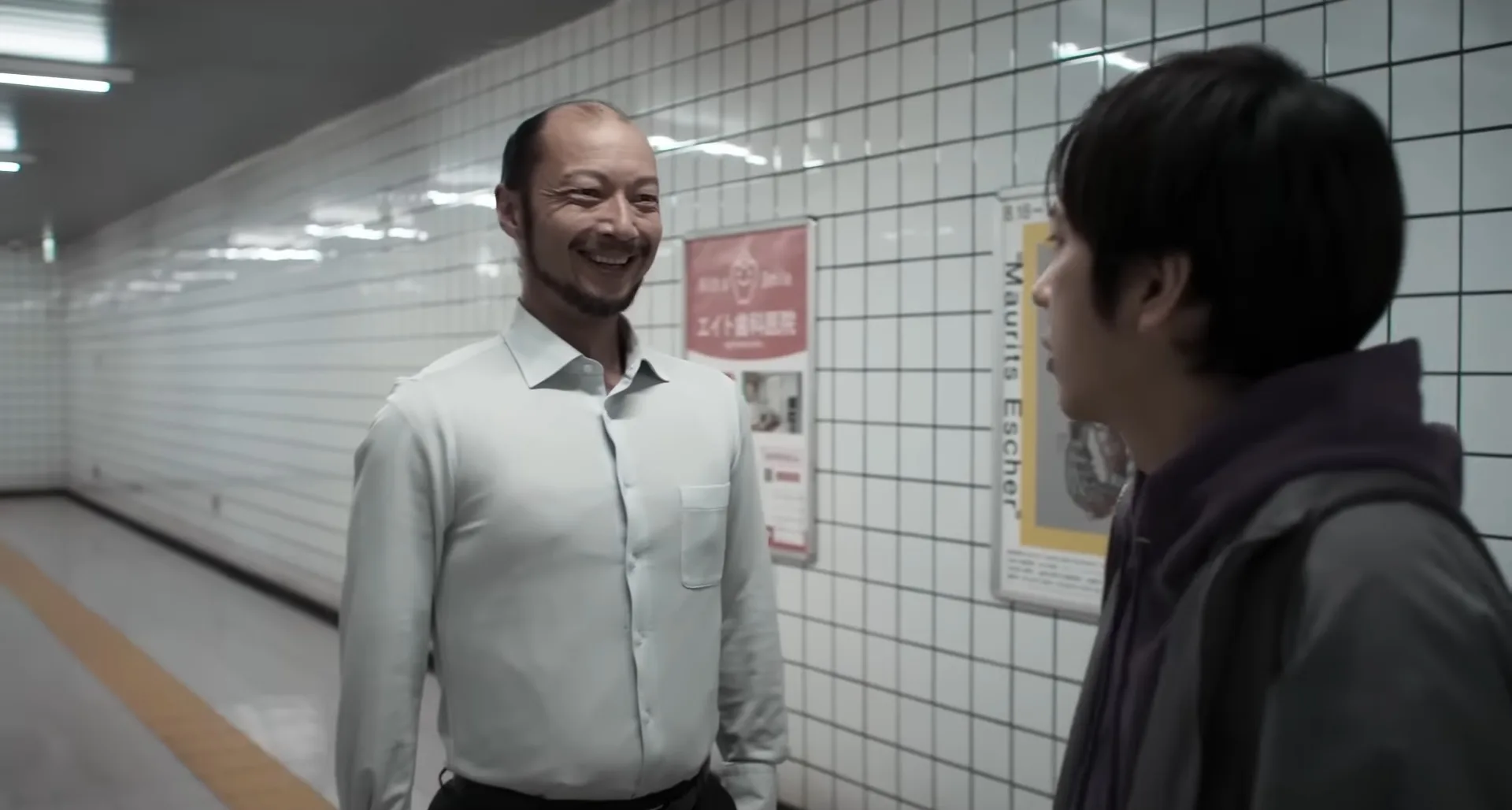
The production design does an impressive job of recreating the simple set where the majority of this mystery takes place, so fans are likely to be sated, and even the odd additions make sense for the environment. In the game there’s one other character, a perpetually looping Walking Man with a passive expression (most of the time…), who only adds the potential for further variables. Yamato Kochi splendidly recreates his eeriness, but it is the decision from Kawamura and Hirase to switch perspectives from our Lost Man to the Walking Man which really shakes up the thin narrative and exposes the sense of modest ambition here. Exit 8 plays with not just space, but time, and the decision to replace one of the game’s signature posters with an ad for an Escher exhibit feels wryly appropriate. Even if you have to give the film’s expanding set of characters a bit of leeway for their panicked decision making, these narrative ‘anomalies’ extend the idea’s lifespan to feature running time.
There’s something to be said, also, for the effect of adding just a handful more characters to the concept. Interaction is dangerous. Is the person you’ve just encountered also trapped, or are they a soulless – and potentially deadly – construct of the damned corridor? Much like the sea of depersonalised, identikit smartphone junkies aboard the train, this plays into a notion of disconnection from humanity. The risk of other people, when your own bubble provides relative safety. The online fascination with liminal spaces also stems from ideas of alienation, and so Exit 8 becomes a question about where we are as people in relation to one another, almost as provocative as something like Pulse from Kiyoshi Kurosawa. The irony of this emanating from a video game isn’t lost.
Some choices are less successful. The impending fatherhood angle allows a through-line for the Lost Man, and particularly adds weight to his decisions with another NPC, but it’s also a fertile (pun intended) ground for a murky pro-life reading of the film, especially given Japan’s newsworthy diminishing birthrates. Giving our Lost Man asthma may also have seemed like an easy route to free tension, but it’s leaned on heavily, testing patience and leaving a narrative strand fluttering in a draught. But, overall – and especially given the average success rate from game to screen – this is a stylishly realised move between mediums, even if it is guilty of tilting to a few genre tropes to sustain itself.
Rarely has a score felt so appropriate:



2 thoughts on “Review: Exit 8”