
Director: Mark Jenkin
Stars: Callum Turner, Rosalind Eleazar, George MacKay
Cornish filmmaker Mark Jenkin’s an odd yet affable sort; happy to make life hard on himself by deferring to antiquated technology, trusting that it will cultivate the earthen, nostalgic aesthetic he so desires. It’s an affectation that has worked for him well so far, at least on a superficial level. Bait garnered just praise as a UK debut that dared to colour (albeit monochromatically) outside the lines of our dismally uninspired norms, while Enys Men found Jenkin doubling-down; a rugged but often impenetrable work. When I saw that film with Jenkin in attendance, he coyly asked us to be vocal if we liked it to help promote it’s limited theatrical run. If not, keep schtum please. He seemed like such a nice guy that I kept my frustrations to myself.
So I arrived at Rose of Nevada with some apprehension and muted expectations. For all the praise circling the film, I’d butted up against Jenkin’s cinema once already. The good news for anyone similarly deterred by Enys Men is that Jenkin has cleaved closer to a cinematic concept we can recognise and navigate. Returning again to his trusty hand-cranked 16mm Bolex, he brings utterly gorgeous saturated colours to the Cornish coastline for a tale of fishermen – and indeed a livelihood – lost in time. But newcomers beware, his aversion to conventional resolution remains steadfast.
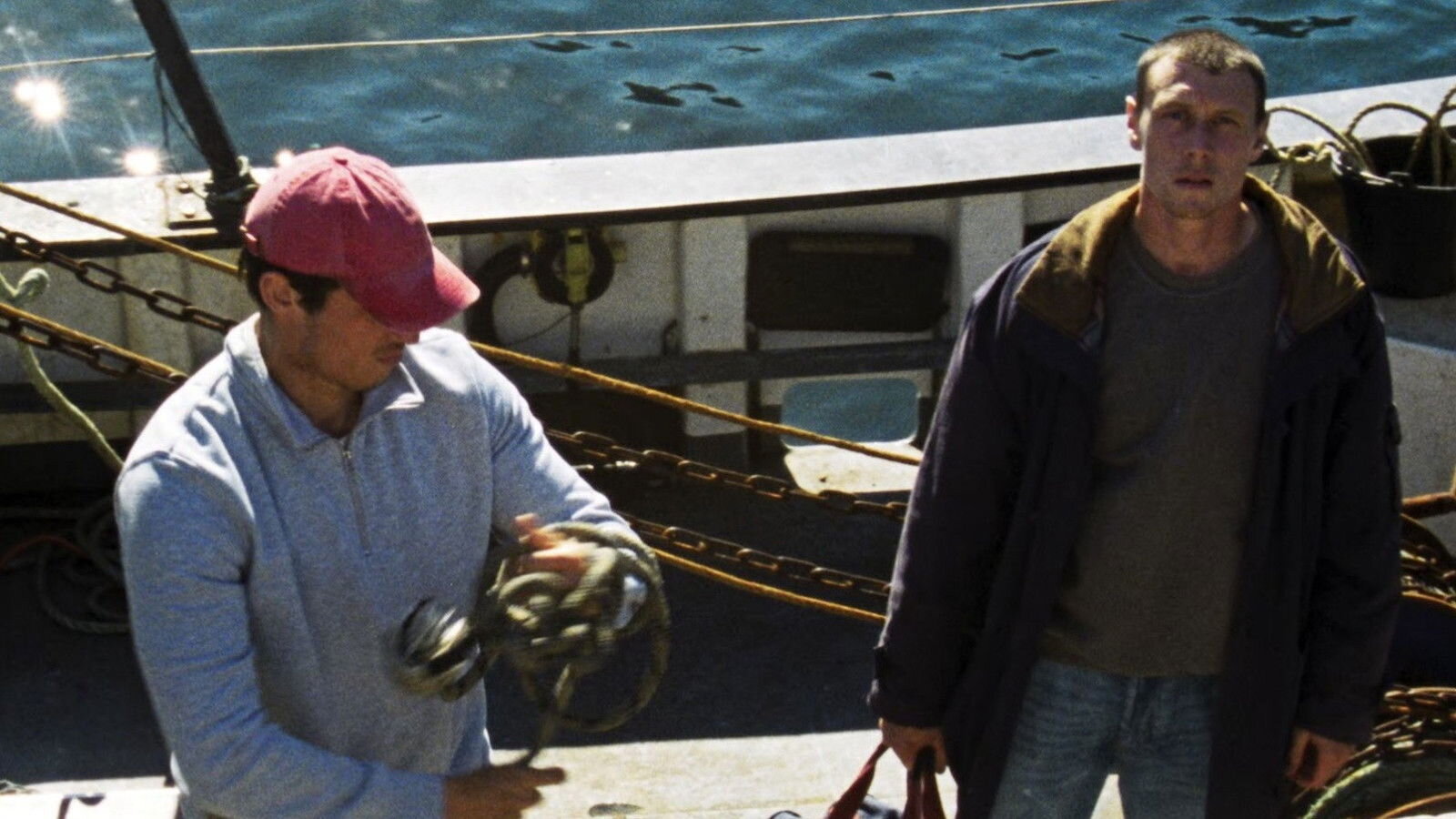
The titular fishing vessel rocks up at a much-diminished seaside fishing village sans crew, having seemingly been lost at sea for many years. It’s eternal skipper (Francis Magee) and manager Mike (Edward Rowe) waste no time preparing her to go out once more, but they need deckhands. In step Nick (George MacKay), a family man looking to raise funds to repair a leaking roof, and Liam (Callum Turner), a more enigmatic stranger who mostly seems preoccupied with chasing skirts. Following a night out on the waves hauling in catches that pleasingly evokes experimental doc Leviathan, the Rose returns to shore, but Nick is flummoxed to discover that they seem to have travelled 30 years back in time. The jetty is teeming with commerce once more and the local pub (The Ship, obviously) is a hive of activity. The locals assume these young men are known inhabitants of the town. As disquieting is Liam’s stoic acceptance of his place in this milieu, pointedly opposing Nick’s apoplexia.
Jenkin shows an evident appreciation for the analogue processes aboard the fishing vessel and, as one might well expect, Rose of Nevada is as much about textures as it is about story machinations, be it the coarse weave of a rope or the soft short hairs at the nape of a young woman’s neck. Occasionally the camera will flare red-hot colours, evoking an artefact itself beamed through time. Rose of Nevada feels as though it has many cross-media touchstones, from the music of Boards of Canada to old telly staples like The Prisoner. All this in a film that is, at heart, about how we look back at things. It’s a persistent human tendency to romanticise the past – just as Jenkin is want to do – but here he places himself on trial, interrogating the truth of such desires. For Nick, being divorced from his loved ones and living out of time amounts to a nightmare he can’t escape from. As Liam inserts himself into a family, Nick grows infuriated on moral grounds, but he’s also resentful because he’s adrift from his own loved ones. Liam receives with complacency what he himself has been denied.
It’s curious that David Cronenberg’s The Dead Zone features prominently within one scene; a film with an overtly bisected narrative – an appreciative, multi-level nod from Jenkin perhaps? Rose of Nevada‘s halves aren’t nearly as equal as Cronenberg’s, but the opening act in the present is felt keenly throughout the voyage that follows it. Both the emotional through-line for Nick, and Jenkin’s lingering looks at rust, lichen and weather-beaten roofs. There’s a canny edit early on that helps pre-empt the story, to seed it in our subconscious. Nick and Liam seem to look at one another in a cross-cut across space, and maybe even time, a good while before they meet for the first(?) time. While Nick’s otherwise vacant mum (Mary Woodvine) seeing him off with a portentous “see you soon, m’darlin'” gets us guessing at what’s coming just before it arrives, making us feel like time travelers who already know this story.
While this village does show telltale signs of corrosion and wear across 30 years, Rose of Nevada also nails the timelessness of small coastal villages in the Westcountry (an environment I’m very, very familiar with). Nick convinces himself that the only way home is to keep going out on the boat; it brought him here, surely it must take him back. In this Jenkin taps into something of the proletariat struggle. Just keep going at it. Keep working. And maybe you’ll improve your situation. But beyond this Nick theorises that the community – and even time itself – is dependent on their continued toil, evoking the duty and self-sacrifice of a life of work.
Thanks to Jenkin’s own clipped, razor-sharp editing, time itself gets lost. The world he cultivates is richly rewarding, so much so that his sudden, jarring dead-end feels a tad cruel, depriving us of something after lulling us to a certain rhythm. It created for this viewer a sense of resentment akin to that felt at the end of Sirāt. Thematically rich and texturally resplendent, Rose of Nevada gives so much only to deny, and Jenkin reminds us, craftily, that he’s still staunchly averse to mainstream thinking. I admire him for that but, having gotten us so far, I can’t help but feel left as adrift as poor Nick.
Maybe that is entirely the point.


