
Director: Lee Cronin
Stars: Natalie Grace, May Calamawy, Jack Raynor
Having put the fear of cheese graters into us with his blackly spirited franchise extension Evil Dead Rise, Irish horror filmmaker Lee Cronin here returns with his own spin on the old Universal staple (the major studio isn’t involved, which perhaps helps to explain Cronin’s name appearing in the title; a clarification rather than a matter of ego…). Once again he’s upsetting the apple cart of familial status quo. Where last time he pitted a mother against her brood, this time it’s a child turned monstrous before a pair of powerless parents.
Watching Cronin’s flick it’s a bit of a puzzler why he severed ties with the Evil Dead franchise when he’s gone to such laborious lengths to simply reconstitute it here. And laborious is right. Flitting between moods of sweeping grandiosity and cartoonish anarchy, his Mummy sprawls over the two hour mark, moving at a lumbering, unruly gate that one might well imagine being adopted by Boris Karloff. If name-dropping the ’30s horror staple sounds like a compliment, it isn’t one in this instance. Cronin’s over-complicated trans-Atlantic narrative searches for puzzle box mystique, but only feels irkingly unfocused. Forever needing to explain itself, it crucially – and fatally – takes it’s eye off of two key components; character and (by extension) why we ought to care at all.
Gawping TV newscaster Charlie Cannon (Jack Raynor) lives in Cairo with his pregnant wife Larissa (Laia Costa) and their young kids Seb (Dean Allen Williams) and Katie (Emily Mitchell). One day Katie is lured out of their luxurious garden by a nefarious local woman (ahh! scary locals!) who we, the audience, already know is up to some decidedly shady shit involving the top of a buried pyramid and a black sarcophagus. The police’s missing persons department seems to be run more like a corpse recovery division, so it’s grimly no surprise at all that we flashforward eight years. Charlie and family have relocated to Albuquerque, New Mexico (swapping one desert for another, natch), made a shrine to Katie at their expansive farmhouse property and all but given up hope. That is, until she’s found in the wreckage of a downed plane in Egypt, bound in ceremonial dressings, scarred to ribbons and non-verbal from “thermal trauma”.
There’s a fine through-line for much of Cronin’s film exploring things that can’t be spoken out loud. Before she’s whisked away, young Katie is shown proficient in Morse Code, which will come up again later to utter the unutterable. But there are also barriers of language, muted VHS tapes, cursive scrawls in a dead language and hand-written confessionals all expressing things that catch in the throat for one reason or another. And that’s long before we’ve gotten to a tracheotomy by scorpion (don’t ask). It all speaks (ironically) to notions of trauma so horrifying that, in all our complexity, we’re at a loss to articulate.
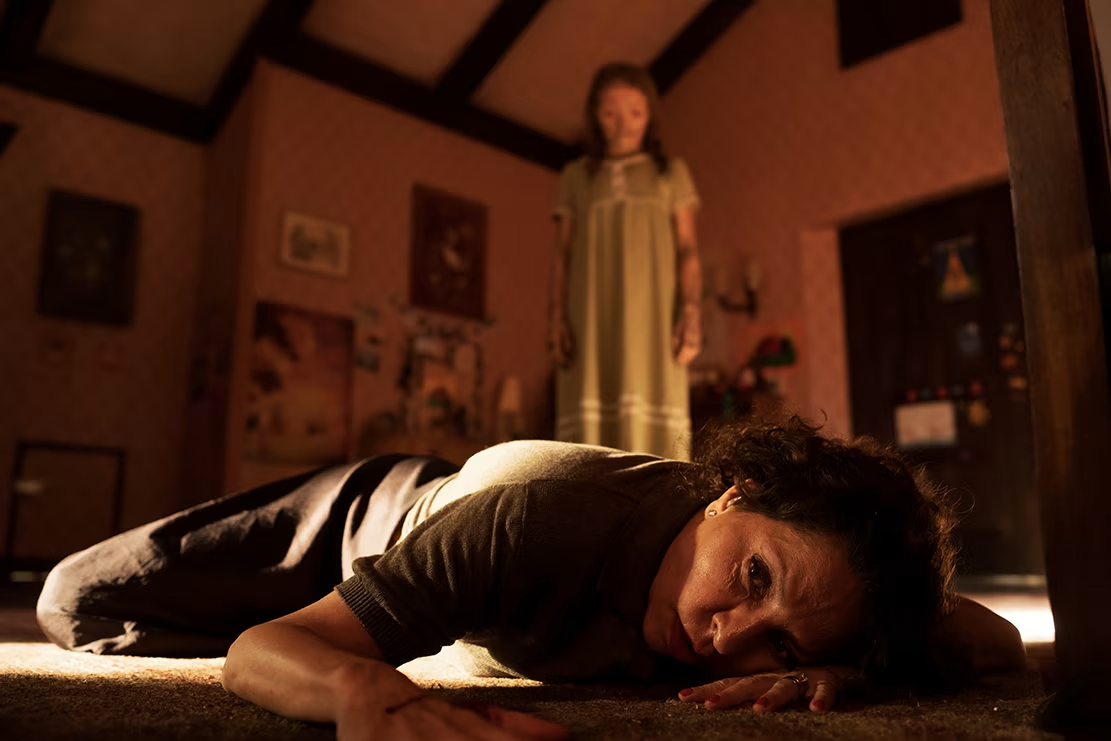
Sadly this is as nourishing as the film gets, as Cronin piles on the goo, grue and Sam Raimi-aping violence in increasingly chaotic and ultimately pointless variations. His The Mummy gets locked into a rapidly tiring loop of escalating insanity that resets to sense-defying business as usual. The histrionics of family life with a demon-possessed child turned into a wearying Groundhog Day-esque cycle. If Cronin were going for a so-called ‘elevated’ vibe this might have presented as a more joyless allegory for the day-to-day heartache of caring for a special needs child. Perhaps we should be thankful, then, that he shows no real interest in presenting a point of view at all.
It doesn’t help either that his characters are so thinly drawn. We have no real sense of Larissa at all, or the kids, while Raynor’s Charlie is a loathsome brew of narcissistic arrogance and misdirected aggression. Larissa’s omnipresent mother Carmen (Veronica Falcón) feels like a caricaturish hodgepodge of ‘exotic’ tics, which only strengthens the amorphous vibe of xenophobia that hangs around the picture like a fug. Indeed, bringing Katie (now Natalie Grace) back to the States itself furthers a notion of an America literally infected by dastardly overseas influences.
Cronin has a good crack at making this fun, but the picture is too stodgy for it to really work. Grace gets to stutter about the place over and over again like Linda Blair’s Regan MacNeil on crack, scuttling around the Cannon family’s frankly insane, labyrinthine crawlspaces, but her rickety efforts feel like a direct, beat-for-beat retreat of Evil Dead Rise as she turns family members evil, one-by-one. Where that film felt the gut-punch of consequences, The Mummy really doesn’t have any, which sort of pulls the rug out from under all it’s gloopy splatter. A calamitous funeral scene that gives new meaning to the term “devilled eggs” ought to be a raucous highlight. Instead it’s just more cacophony.
May Calamawy fairs better with her sidelined investigative material as guilt-ridden Egyptian police detective Dalie Zaki. Whenever we cut away from the Cannon home to her exploits, things feel markedly sharper, more focused, and she fleetingly gives us someone to give a shit about, too. But once the two halves of the story collide in the third act, The Mummy pushes the limits of the ridiculous, finally outstaying its welcome. What comes out the other end is like Hereditary remixed by Cassetteboy. Quirky, funny in fits, but ultimately more annoying than memorable and unlikely to warrant a replay.


