
Director: Brian Duffield
Stars: Austin Abrams, Jane Levy, Josh Brolin
Jonah… Pinocchio… We’re all familiar with how easy it is to get swallowed whole by a whale. I’m even writing this from inside a whale. It’s cramped, sure, but I’ve grown comfortable with it. Little fleshy shelf for my laptop and flask of coffee. Accepted my lot so to speak. Pressing F7 to make the keyboard light up really helps. Austin Abrams – recently seen haplessly fighting for his life against the infected of Resident Evil – is having another incredibly bad day here as Jay, the latest unlucky fella to venture into the ocean only to end up lunch for an aquatic mammal the size of a branchline train.
Based on the book by Daniel Kraus – who here co-writes his own adaptation with director Brian Duffield – Whalefall takes the one-location survival thriller to absurd and horrifically squidgy new extremes. But first a bit of set-up and, of course, a grief narrative. Jay is returning from college in Iowa to his family home on the Monterey coastline of California in the aftermath of his fisherman father Mitt’s (Josh Brolin) suicide in the face of terminal illness. No need to blanch at a spoiler; Mitt dives to his death in the film’s opening scene. Having had a storied, tempestuous relationship with his boisterous, disapproving, anti-establishment old man, Jay is a bundle of mixed emotions. But he is moved to dig out his old scuba gear to secretly head to the shores in search of his dad’s sunken remains. With an hour or so of air in the tank, it is during this endeavour that he gets… stuck.
As ludicrous a proposition as the promotional ads made this seem (a real “wait… what?” premise, selectively teased), Whalefall is something of a technical marvel while it’s in the water or inside the whale. Jay’s first forays back into the shallows perfectly sell the unrelenting forces of the sea, T-ing up the natural world’s grand indifference to a single man. The close encounter with a giant squid that leads to Jay’s dizzying and traumatic misadventure is impressively realised. A gripping depiction of a fight against inevitability that only occasionally suffers the murky obfuscation of the dark setting and quick cutting. It’s a mighty sequence, but one largely trumped by the claustrophobic rendering of what lies in store.
The interior of the whale would surely delight David Cronenberg. I’m reminded of Jeremy Irons playing Elliot Mantle in Dead Ringers, parroting an old quote of Cronenberg’s, that “there should be beauty contests for the insides of bodies”. Jay’s whale might not be a prize-winner for looks, but their insides make for one of recent cinema’s most original, absurd but grimly believable settings. There’s a terrible weight and squishiness to the flesh walls that become Jay’s claustrophobic prison, amply aided by a compellingly cavernous sound design. In a dark cinema setting, it’s hard not to succumb to the suggestion that you’re in there with him, wincing and panicking as every muscle contraction changes the amount of space Jay can occupy. The effect is intense. A very different kind of body horror (and Whalefall surely qualifies). That originality marks Duffield’s film out as the year’s gnarliest one-off.
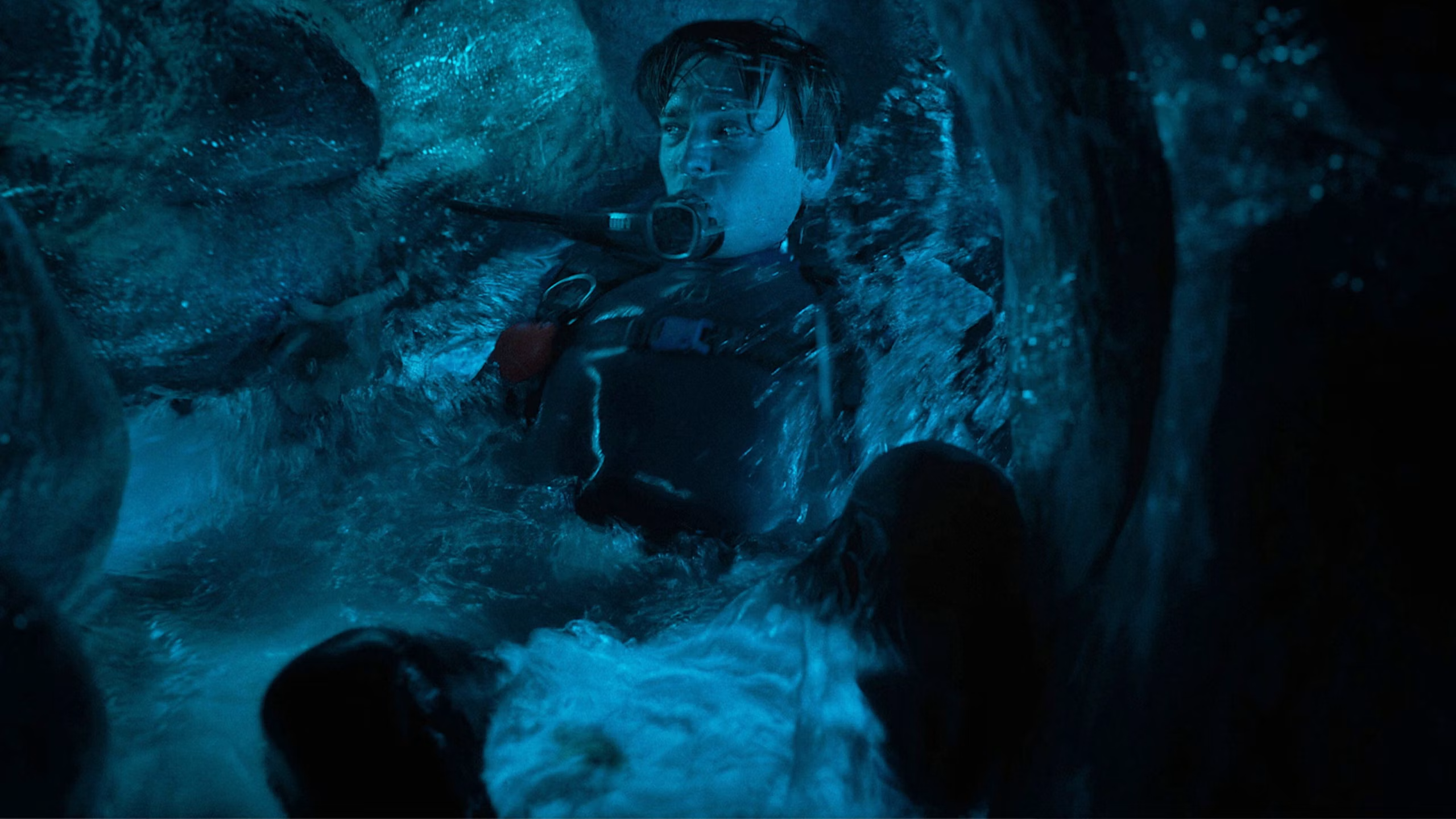
As one might well imagine, there’s a certain level of disbelief to be surrendered. Of course, it’s questionable whether this could ever happen in the first place, but it’s awfully handy how much bioluminescence there is inside to provide us with practical light sources. There’s good-silly and bad-silly here. A cute glowy little jellyfish becomes Jay’s buddy, a bit like Wilson the volleyball from Castaway, and they have a little adventure together. That’s in the good-silly column. Jay climbing way back up the whale’s throat to yell at a passing tourboat, “Help me, I’m here, I’m in the whale”? That’s a tough line for anyone to sell. For the record though, Abrams is great here, particularly in the movie’s present, hampered by the clunky breathing apparatus and effectively left to sell this experience single-handedly in the modes of a silent (or slightly mumbly) movie star.
Whalefall beaches whenever it returns to dry land, however, either in the rather pedestrian staging of the set-up sequences, or during the many heavy-handed flashbacks that pock the film. Here the acting mode – mostly between Abrams and Brolin – is big and blustery. Each serves a too-convenient purpose; a memory that’ll aid Jay in the next step of his survival, but the earnestness of these troubled family scenes pounds hard, repeatedly pushing the film toward the melodramatic and mawkish. Between these sequences and a wildly ambitious (to put it kindly) subplot involving orcas vying with the sperm whale’s wider family in the present, it’s hard to say which element is hokily closest to James Cameron style sentimentality. When the film’s title is lumpenly defined in one of Mitt’s meaningful monologues it feels as though we’ve sunk dead-weight to the ocean floor. The dialogue is often the film’s weakest element (exhibit A: “Death sucks”).
In this effortful attempt to convey the processes of grief and acceptance, Whalefall unexpectedly mirrors Alfonso Cuarón’s rollercoaster hit Gravity. Outer space or the belly of a sperm whale? Both deeply inhospitable environs where man has no sensible business venturing. Both isolating vacuums where the only company is one’s own scarred interiority. Whalefall ends on similar sentiments, and the peace of its coda is well-earned. But the bite of the film is the physicality and technical marvels of the improbable central thrillride. Much like Gravity.
Now, where did I leave my other oxygen canister…