

Director: Nicolas Winding Refn
Stars: Sophie Thatcher, Charles Melton, Havana Rose Liu
When Nicolas Winding Refn’s Drive came out, when it exploded into the public consciousness along with it’s iconic soundtrack album, I thought it was pretty good. I wasn’t changed by it. I didn’t need it. But I liked it well enough. But sat in the same darkness two years later in front of his pricklier, reactionary follow-up Only God Forgives I was transported. That flick felt like an artist working without compromise and unabashedly, indulgently stepping further down a dark path of his own discovery. Walking away from us. Undoubtedly and understandably, that alienated many. But I sat there worried about how much I wanted to follow him.
All of which is to say that I’ve taken on what Refn’s put down since his signature hit (though since cancelling Netflix I’ve not seen his Copenhagen Cowboy miniseries). The path he started on back then reached both a maximalist and minimalist zenith with somnambulist Amazon series Too Old to Die Young. There, wilfully, you could feel Refn stretching things out to within their breaking point. The thrilling tension of taut elastic warning you that it’s about to snap. As frustrating, as pompous as the man could be in interview, I’ve been a sucker for the work.
All of which leads to Her Private Hell, his latest and most quickly-reviled offering, a full decade after his last feature film, The Neon Demon. With mass walk-outs at Cannes the film has rolled out with a gloomy reputation and the vitriol has only been revived with it’s limited domestic cinema release via MUBI. Empire Magazine – who will give the shoddiest superhero slop a spineless 3 stars – slammed it with a rare 1 star rating, dismissing it as “a load of old bollocks”. And for the majority that’s probably a fair assessment. But for those of us who wanted to see what was down that road of his, this is a puzzlesome new chapter of delirious, self-aware indulgences.
Having survived a near-death experience, Refn was spurred to make this; a sci-fi giallo fairy tale set in an imagined Japan flung out of time and turned into an endless and empty cloud city by a permanent, roiling mist. Frequently lit like the Do Lung Bridge sequence from Apocalypse Now but in Refn’s already-established bipartite colour scheme of blue and pink, it is the setting for hollow movie star Elle’s (Sophie Thatcher) next shoot; a Barbarella-esque comic book adaptation called Candyfloss. The aptly-named Tower Hotel is one of the many turrets that poke out of the clouds of Refn’s imagined kingdom where a glowing eyed killer monikered The Leatherman is bloodily murdering young women. Out to avenge his own daughter’s killing is US military grunt Private K (Charles Melton), who clashes with the cagy police (an underutilised Hidetoshi Nishijima) and the yakuza in his pursuit of the movie’s phantasmagorical villain. Elle’s entourage of models, actors and stylists whisper about The Leatherman like he’s the devil himself, but it is heavily inferred that he might just be Elle’s own father, Johnny Thunders (Dougray Scott).
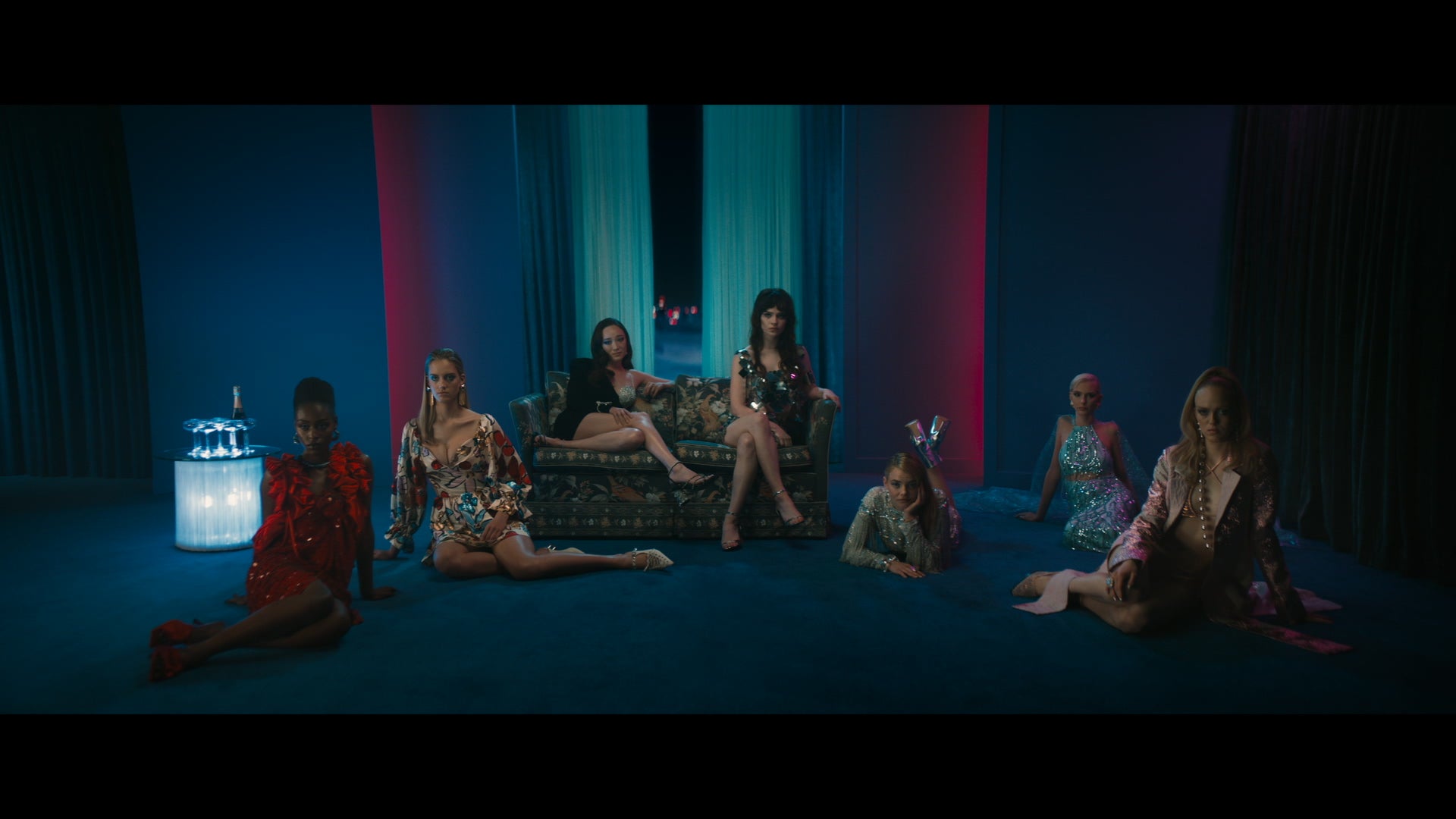
This would be quite fitting given the grotesquery of Elle’s family dynamics. Her former best friend Dominique (Havan Rose Liu) is now her new step-mother, and much time is devoted to contorting their relationship. Refn and co-writer Esti Giordani tilt knowingly back to the incestuous trappings of his last overt tangle with Asian exoticism Only God Forgives. The same accusations can be levelled against Her Private Hell, but one senses that Refn is playing provocateur by returning to the well. Each new project is, after all, an opportunity to goad his detractors.
And Her Private Hell relishes in perversities. Feels like Refn knowingly corralling his own fetishes into new combinations. Possessive father figures. Hands. Luxurious sofas. Iconic jackets. That colour schematic. And a continuing and increasing disinterest in narrative. It’s another concerted push away from us in search of whatever it is at the centre of this man’s madness. In spite of this effort the movie is dripping in cinematic touchstones. With it’s infantalised women trapped in immaculate, lavishly wallpapered lairs, Her Private Hell readily echoes Suspiria. See also the recurrence of murders happening voyeuristically against windows. Deeply Argento-coded. His misty depopulated streets are like foggy misremembrances of Wong Kar-Wai, Bi Gan and Blade Runner, depopulated and partially erased, while the leather kink and preoccupation with bodies (particularly Melton’s) itches with the queer interests of Kenneth Anger.
The whole thing feels like a dream, embellished upon gorgeously by Pino Donaggio’s absurdly operatic score. While it isn’t as testingly slow as passages of Too Old to Die Young, there’s a similar woozy gait to it all, as though we’re sleepwalking through a story. There are no extras. Even a furtive club excursion for ‘Uniform Night’ evidences a complete lack of NPCs. Instead rooms are sparsely inhabited by mannequins and statues, while often the characters struggle to appear any more effectual. Elle’s privilege and brattiness isn’t pleasant, but it’s preferable to the manner with which the appropriately-named Hunter (Kristine Forseth) insinuates herself into the orbit of her stardom. Maybe the closest Refn comes to real-world commentary, on the hunger for the limelight in influencer culture. But Elle needs her darker edge to sell the dark destiny that ends the movie on a coquettish cliffhanger.
Era is cannily non-specific. There are smart phones and modern, superficial ditz, but also antique televisions, while Private K’s presence haunts this version of Japan, conflating it with the post-war era of occupation that throws us back to the mid 20th century… and the Italian giallo boom itself. On that front Refn’s modus operandi is similar to that of Belgian independent filmmakers Hélène Cattet and Bruno Forzani (Amer, The Strange Colour of Your Body’s Tears). He slices the iconography out of the genre and splatters it onto his own canvas in impressionistic ways. There’s a kind of dreamstate alchemy at work. Refn himself probably doesn’t quite understand what he’s gesturing toward. It’s the clouded horizon of that endless road he’s walking down.
This really wouldn’t work at all if he didn’t have a sense of humour about it, but he does. He’s very clear with his audience that this is a fantasy, working with fairy tale logic. Dominique even says to Elle, “I will always be your evil stepmother” in case this intention was at all ambiguous. Elsewhere, Her Private Hell is by turns risibly arch (the barking scene) or deliberately funny (“Your father’s gonna love this…”). If the pointed lack of substance means that the experience is without depth, allow me to gesture toward… the rest of cinema. Find your depths elsewhere. Call me basic, but I’m happy relishing this artist’s distinctive surface moods. Moods nobody else is driving toward with this pervasive intensity.
“This movie’s gonna be hell,” Elle says. A loaded line indeed, for most. For me, and perhaps a few other sickos, Refn’s wispy, plasticated hell is divine.


