
Year: 1998
Director: Abel Ferrara
Stars: Willem Dafoe, Asia Argento, Christopher Walken
The New York scuzz of Abel Ferrara’s better-known hits Ms. 45, Bad Lieutenant and King of New York sucked me into his grimy yet heartfelt oeuvre a few years back. Using methods I wouldn’t endorse – but which a grifter like Ferrara might well appreciate – I scoured the internet for as much of his body of work as I could find, building a scattershot picture of a career depicting broken, fallible individuals often lost in the sprawl of alienating urban landscapes. And often with Christopher Walken, Willem Dafoe or even both.
Much as he has a certain signature philosophy permeating all his works, he manifests his infatuations across disparate genres. 1998’s New Rose Hotel nominally functions as a slice of cyberpunk noir – thanks to the source being a short story from sci-fi parabolist William Gibson – but Ferrara, in part through necessity of his oft-meagre indie budgets, tilts toward these trappings sparingly, feathering in a sense of impressionistic BigTech rivalries, stirring them into an amorphous international array of clubs, twinkling skylines and also-ran gamblers taking a chance on making it big. It’s also, improbably, a romantic tragedy (not untested waters from the director of Romeo & Juliet remix China Girl), one that inadvertently anticipates a few cultural stressors that haunt us today.
X (Willem Dafoe) works in tandem with his cane-twirling patriarchal partner Fox (Christopher Walken). Their business? Corporate espionage, specialising in coercing high profile, high ticket corporate executives to defect. Through their conversations will get a sense that X is in some way indebted to Fox, who he regards as a mentor figure. Fox has no qualms framing himself as the younger man’s master. It feathers his already inflated ego. While visiting some transactional dive bar – all red gel filters and dark corners, a kind of physical representation of burgeoning darkweb forums, perhaps – Fox proposes their next target; a feted bio-weapons scientist named Hiroshi (Yoshitaka Amano) whom we only ever see in spuriously collected surveillance footage. Fox’s proposition is that they use singer and sex worker Sandii (Asia Argento) as a ‘honey trap’ to lure Hiroshi away from the business he’s grown complacent with. Sandii agrees to the scheme but starts a romantic affair with X.
In some ways New Rose Hotel tilts toward the trappings of the erotic thriller which had proven popular and prevalent throughout the decade prior. This being Ferrara, the aesthetics skew counter-cultural. Latex, S&M wear, clandestine-seeming sex clubs. The thread of voyeurism that runs through the movie feels like another kink (with the internet just emerging this was the era of the celebrity sex tape). New Rose Hotel brushes up against the delectable perversions of Cronenberg’s Videodrome minus the fleshy body horror.
But the sex-positive surface level lustiness belies a far more brittle centre. Fox dismisses X’s infatuation as just that, but behind closed doors X and Sandii make plans to elope, sharing a fantasy of domesticity that is perhaps most fondly coveted by those that exist on the fringes of acceptable society. To the outlaws and the outcasts, conservative lifestyles can seem unusually alluring. The way Ferrara paints it, X isn’t deluded. The love between him and Sandii is portrayed sincerely and becomes a point of naked vulnerability in Fox’s slightly convoluted espionage scheme.
It all goes wrong. Sandii goes missing and we hear alarmist reports that Hiroshi’s bio-weapon has been unleashed. Has Sandii betrayed X, or has she become collateral damage in the foiled scheme? Gibson’s story and screenwriter Christ Zois (what a name!) are explicit that she has betrayed him, albeit perhaps against her will, but the edit makes it murky. Regardless, X commiserates his loss and the film is effectively over, but Ferrara wallows in that space with him, reconstituting scenes already played into a prolonged outro of self-pity. Addicted to updates from a rudimentary handheld device (that seems redolent of today’s smart phones) on which Fox is reduced to an emoji – an endlessly twirling green cane – like the avatar of some kind of sickly Santa Claus. X succumbs to a (literally) masturbatory reverie of memories and fantasies. The film’s final scene suggests that the two of them have escaped, but is far more likely a playful daydream shared between the two of them just before the scheme all fell apart. Happiness only exists in memory, and maybe unreliable memory. Ferrara bids adieu to X in a feedback loop of regrets and lost chances. It’s desperately sad.
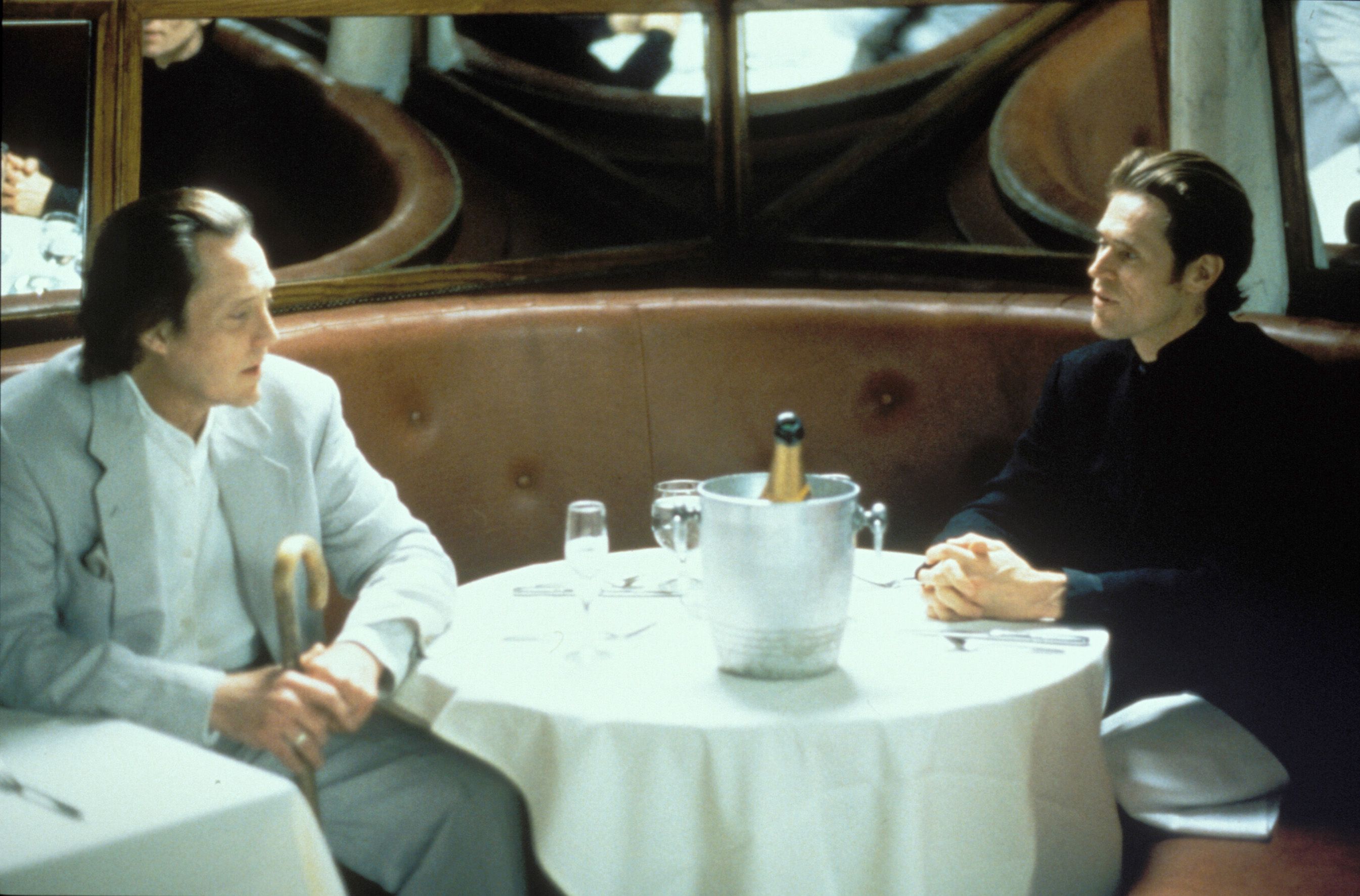
New Rose Hotel is kind of hazy in the best way. In a departure from his more distinctly NY films, this effort is disconcertingly anonymous in it’s various settings. X and Fox work in global terms. Hiroshi is in Japan. Their schemes involve layovers in Marrakesh, Barcelona, Vienna and Berlin, and the film is typified by transitory spaces – identikit, impersonal hotel rooms, restaurants and bars, minimalist meeting rooms. There’s little anchoring these characters, which only feeds further into the exoticism that X and Sandii derive from their domestic fantasies. It speaks to a wider, emerging worry around this time – the pre-millennial tension, if you will – that one could also see echoed in the works of other auteurs internationally. The degraded video streams of Hiroshi recall the cheap aesthetics of Japanese V-cinema; the arena in which Takashi Miike flourished. Ferrara is deliberately touching a scuzzy subset of tech-noirs, while also amorphously tapping into a collective paranoia exhibited by the likes of Cronenberg, Olivier Assayas and others.
The haziness extends to the film’s finality… or lack thereof. X’s dissolution into bittersweet memories feels like a dispersal of the character. We see him breaking down in front of us, emptying (both metaphorically and literally). Manifesting as a kind of deeply melancholic montage, the film undergoes a kind of dwindling fade-out quite unlike anything else I’ve seen, revealing new layers, new intricacies of X’s complicit direction to fall in love with Sandii. To embrace and believe the fantasy. X is alone now. Fox is dead. Sandii is gone. There’s a deep sense of abandonment at the end of the movie which may have contributed to it’s rather tepid reception when initially released. But it is just this mood that I find precious in the film – a kind of ending rarely attempted or achieved by others.
This elusive, elliptical quality is what makes New Rose Hotel so special. A top-tier Ferrara, even. But if this deference to a particular brand of melancholy isn’t to your liking there’s still the acting interplay to enjoy. For all it’s discreet technobabble and genre trappings, this is an actors’ piece above all else, and watching Argento, Dafoe and Walken bend and flex around one another in differing combinations is rewarding in and of itself. The father/son dynamic between X and Fox that bristles with the threat of disappointment. Fox’s tendency to objectify Sandii, diminishing her in their trifecta. And Sandii and X’s sexual chemistry, rendered bodily throughout the film as a kind of act of defiance against a world of coldly impersonal spaces. New Rose Hotel is as sexy as it is sad; a film worried about a future in which trust is eroded, where nowhere is home, where we’re compelled to keep refreshing our screens in hope of an answer. How hauntingly, horribly prescient.

