

Director: Jane Schoenbrun
Stars: Gillian Anderson, Amanda Fix, Hannah Einbinder
These things are all subjective, but how does one improve on a 10/10? I’m generally hesitant to give out top marks for fear of this very eventuality. Jane Schoenbrun’s I Saw the TV Glow was – and is – a 10 for me. A deeply personal work that aches and yearns and resonates like hell. I also get how and why it isn’t that for everybody. But damn it, that’s what it is for me. So while I’ve been excited for Teenage Sex and Death at Camp Miasma, that excitement has been tempered by a reticence that, honestly, what more can it do? How much more personal can it get?
Plenty, actually. If I Saw the TV Glow managed to successfully articulate the feeling I often share of alienation within my own body – of not belonging in here at all – then Camp Miasma taps acutely into difficulties I’ve also experienced feeling relaxed, safe and trusting with sexual intimacy. Once again I find myself writing about a Schoenbrun film from a perspective of naked, confessional bias, but they have a knack of expressing parts of myself that I can’t usually articulate. That’s what makes their films so special, so fast.
There’s been a progression of media through Schoenbrun’s films so far, from the exceedingly-online psychological games and videos of We’re All Going to the World’s Fair, to the TV-OD of her last. Camp Miasma makes the jump to the movies. Cinema. And, in another indelibly personal intersection, the squalid viscera of the ’80s summer camp slasher (a subgenre I’ve a long-standing affection for). Even the most cursory glance at the video nasty furor in the UK paints a broad-stroke picture of this problematic notch on cinema’s bedpost. Lascivious violence, recurrent transphobia and homophobia, widespread misogyny. Yet it’s also a microclimate that draws the outcasts toward it. Schoenbrun here explores it’s potentia as an allegory for sexual awakening, from phallic penetrating wounds to orgiastic gushes of blood that fill in for other bodily fluids (like all those nosebleeds in manga and anime…). It begins and ends in delicious overkill. But the middle is where the magic happens. The guts.
Kris (a wonderful Hannah Einbinder) is a young queer filmmaker hired by a big studio to resurrect ‘zombie IP’ Camp Miasma; a slasher franchise left to rot in a mire of flagging straight-to-video sequels decades ago. It’s original final girl, Billy Presley (Gillian Anderson), has become a Norma Desmond-esque recluse, holed-up at the Pacific Northwest location where the 1983 movie was shot. Kris has a few precious days booked in her company to soak up the atmosphere and mindset of the series and, she hopes, convince Billy to accept a walk-on part to give the studio’s reboot that ‘legacy’ credo.
Billy’s an eccentric, flamboyant entity gifted a delicious Dolly Parton drawl by Anderson, who would much rather get to know the person standing in front of her than intellectualise the movies that she thinks boil down to “flesh and fluids”. Kris fumbles at this, finding it difficult to drop her guard. When she does, her dissatisfaction with her present poly relationship and strained history with achieving orgasm cascade out of her. Anderson’s Billy becomes a heightened version of her Jean Millburn character from the Netflix show Sex Education, purring pearls of wisdom from a Cronenbergian headspace where sex and death coil around one another. It sometimes feels as though she’s readying to devour Kris. But, when the time comes, Billy shows her the utmost care and attention. Onscreen sex hasn’t been so imbued with love and tenderness this decade.
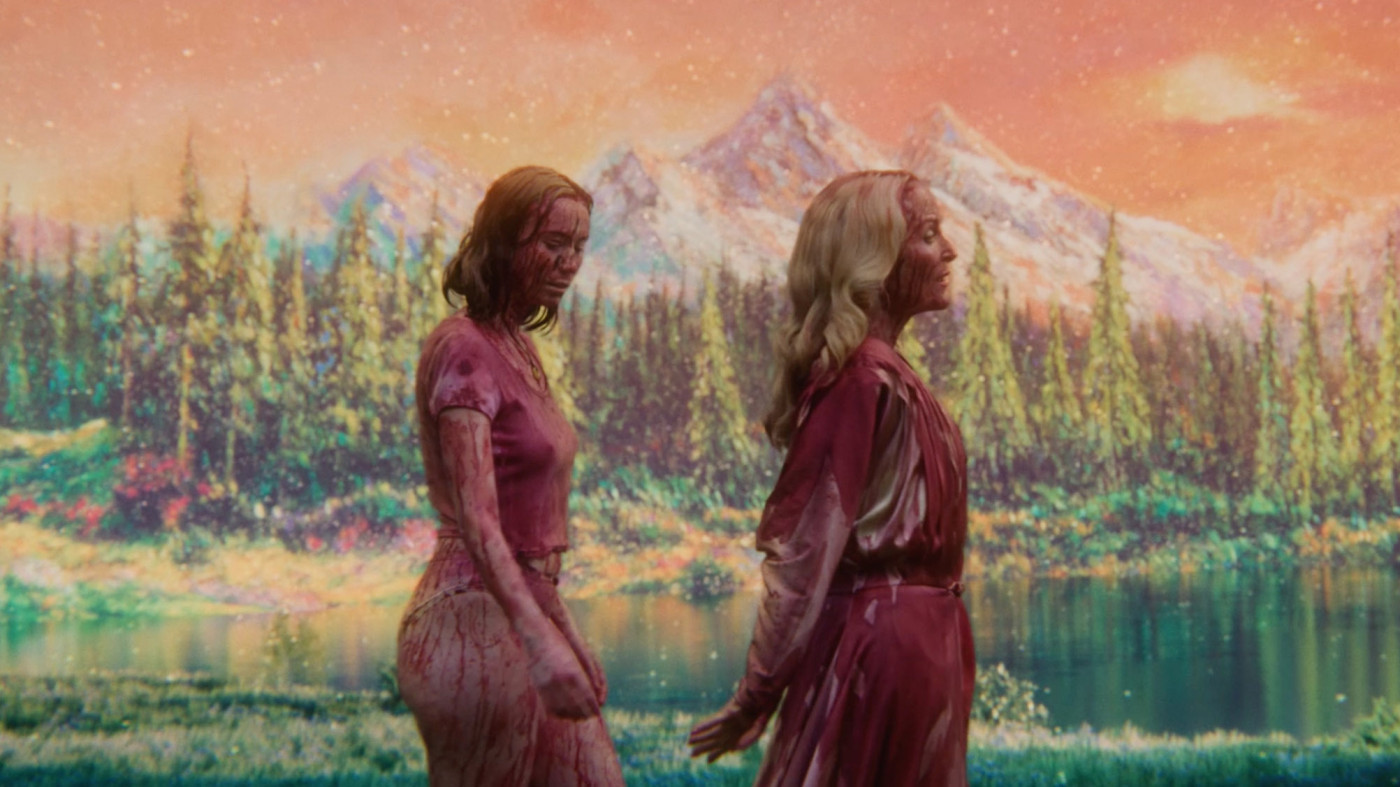
The gateway for this intimate sex therapy session is Billy’s print of the original Camp Miasma film. Through this Schoenbrun gets to play in two modes; the outer layer of discussion and healing, and the inner world of the film-within-a-film, which plays as a relatively ‘straight’ old school slasher, and feels remarkably authentic. It isn’t a comedy pastiche (though many will laugh), but a sincere ode to the art – and artistry – of those tawdry movies of old. And it’s clear Schoenbrun knows their stuff. Anyone who knows Felissa Rose and Pamela Springsteen’s genre contributions, or the storied origins of The Burning will be in seventh heaven.
Schoenbrun’s horror villain is Little Death, a trans victim of summer camp bullying played by I Saw the TV Glow standout Jack Haven. Reconfigured at the bottom of Tivoli (I love it?) Lake into a merciless killing machine with a ceiling vent for a helmet, Little Death brings a whole host of their own associations. Sleepaway Camp and Friday the 13th, of course, but the ceiling vent itself looks like a camera obscura or even, conceivably, a film camera or television set – all technologies through which we convey or project our desires.
The loss of virginity in slasher movies has become a cliché. Fuck in a horror film and you’re doomed to die. So, for the genre’s cadre of camp counselors, sex is a gateway to accepting mortality. A rites of passage and inevitability. But who’s to say one must lead intrinsically to the other, even if our best hopes are to reach orgasm? Le petite mort as the French so famously call it. The Little Death.
Schoenbrun isn’t too subtle with their metaphors. The Tivoli Lake ice cracks with each step on Kris’ journey to self-acceptance, each crack promising the release of Little Death. For viewers attuned to Schoenbrun’s taste for creativity, the journey is as rich and titillating as it’s final destination, be it relishing with Billy and Kris the twists and turns of the OG Camp Miasma or the comedic tailspin of Kris’ mortifying Zoom meeting with her mystified exec producers. And, as is becoming de rigeur, a phenomenally curated soundtrack cushioned by the original music of Alex G. Schoenbrun may have shifted up another gear in terms of ambition, but the handmade quality that is their developing aesthetic is increasingly lush. Camp Miasma can be dark and gloomy like an old school slasher… or it can be incredibly pink, puce, peach and soft, taking place in a matte-painted winter wonderland.
I could ramble a lot more (I haven’t even gotten to the Bound connection), but a final thought and successful connection to one of Schoenbrun’s clear spiritual forefathers. Kris’ (and by extension our) experience of the original Camp Miasma film keeps culminating in a revelatory sex scene for Billy’s young onscreen character (Amanda Fix). A moment of orgasm that we ultimately learn is tinged with something a lot darker. Camp Miasma pricks at the edges of the #MeToo movement and the looming shadow of Harvey Weinstein. But it also recalls and re-contextualises the ‘sex as trauma’ elements of David Lynch, particularly Mulholland Drive (Patrick Fischler is literally here). Diane Selwin’s scene of masturbatory misery is reflected here, but as a kind of exalted exorcism. It’s as though Schoenbrun has reached through the miasma of time and fantasy to heal the wounds of cinema history.
Just as with I Saw the TV Glow, their latest feels like an overture and act of generosity. A hand outstretched, beckoning to those who feel alone. If it gets too real you can always turn it off. But, really, why deny yourself the pleasure?


1 thought on “Review: Teenage Sex and Death at Camp Miasma”