
Director: David Robert Mitchell
Stars: Anne Hathaway, Ewan McGregor, Christian Convery
In spite of the repeated box office bonanza that keeps getting further sequels green lit, none of the directors tasked with following up Steven Spielberg’s Jurassic Park have ever really gotten close to fulfilling the mandate with any satisfaction. Not even, it has to be said, Steven Spielberg. The End of Oak Street has nothing to do with the Michael Crichton-created series, but it manages to do a better job of capturing some of that Amblin magic than any of the subsequent pretenders to the throne. And it does so with a frankly surprising – and perhaps polarising – streak of juvenile humour.
It’s only a week since we were ‘treated’ to our last middle-class American family reckoning with a suburban cataclysm but, mercifully, David Robert Mitchell’s long overdue return to our cinema screens vastly outstrips Louis Leterrier’s nincompoop effort. Working with J.J. Abrams (who has never met a story with an un-utilised volcano he didn’t like), Mitchell offers up a multiplex-ready summer movie that isn’t tied to some pre-existing IP, which is a small feat in itself. And while the Hollywood machine has subsumed some of the elements that made Mitchell’s independent efforts so distinctive, there are evident avenues of interest, kinks and foibles that manage to persist.
We’re in the fictional Detroit suburb of Flowervale circa 1982, and while community spirit is in full force, the Platt family is in crisis. Matriarch Denise (Anne Hathaway) channels her dreams of escape into a fledgling writing project, her dissatisfaction stemming solely, it seems, from her husband Greg’s (Ewan McGregor) downturn in fortunes and burgeoning alcoholism. Their kids Brian (Christian Convery) and Audrey (Maisy Stella) sense and react to the tension. They soon find themselves forced to regroup as a family unit when, inexplicably, the entire neighbourhood is sucked several million years back in time to the age of the dinosaurs.
These jurassic creatures – a particularly sneaky set of menaces – have character, imbued via some creative design choices that manage to make their presence feel distinctive compared to That Other Franchise. Mitchell’s dinosaurs, in-keeping with certain theories, are hairy. Feathery. Visually interesting mods on the bog-standard CG template pack. They sell themselves just fine. If anything, CG replacements for the family dog in action sequences are the more awkward digital elements.
With their arrival that aforementioned community spirit vanishes. One might well imagine a Joe Dante or Richard Donner joint from the film’s era crowbarring in an array of crackpot neighbours armed with spatulas and colanders. While a few who were established in the opening remain in the peripheries – and with a sole notable exception – Mitchell very much hunkers down with the Platts and draws a distinct, gendered line between pragmatism and idealism. The optimists and the pessimists. The boys are inclined to believe that a solution will simply present itself if they’re patient. The girls aren’t about to wait for a happy ending.
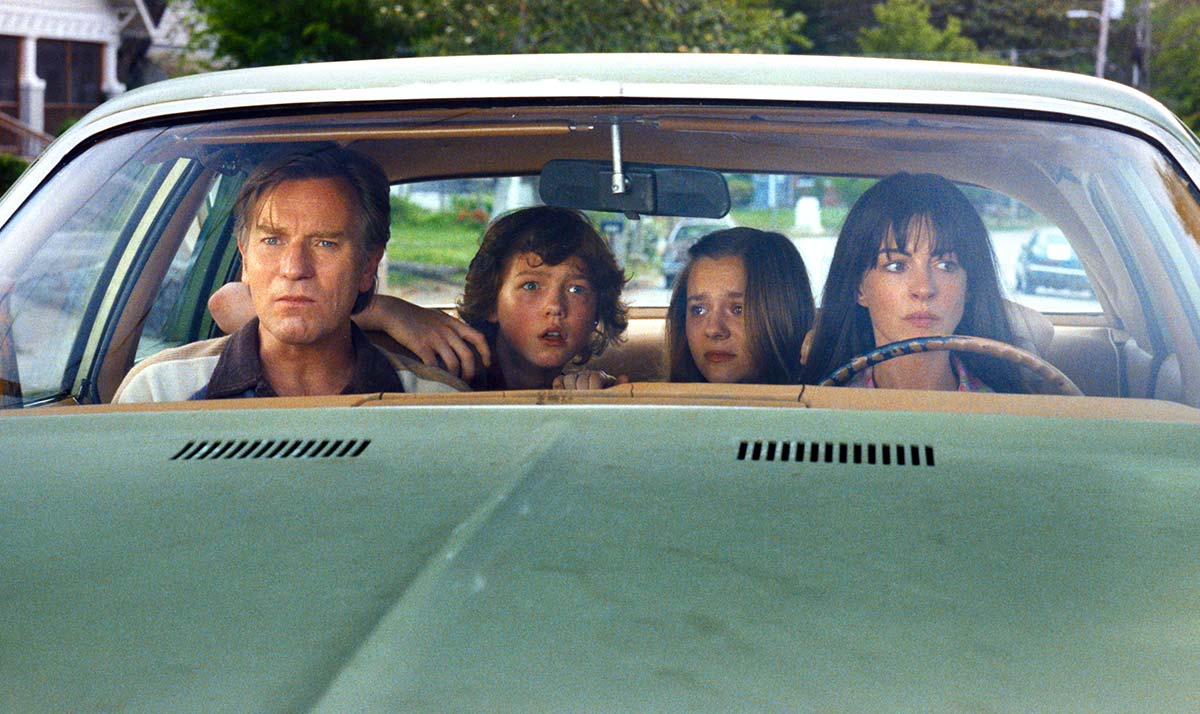
Once the chaotic threats of the outside world present themselves (and Mitchell is commendably, playfully coy about that to begin with) the kneejerk survival instinct is to retreat home, button up the windows and, metaphorically speaking, put one’s head in the sand. It may be the ’80s redirected to millennia ago, but The End of Oak Street resonates as an allegory for America’s traumatic present, in which wildly unpredictable horrors persist on everyday streets and the human brain’s overwhelmed inclination is to normalise the most insane shit imaginable. Our capacity to do this is comically underscored in a scene involving a Polaroid camera and something the Jurassic series would never commit to film.
Michael Giacchino’s music – while not intrusive or particularly memorable – takes a good crack at emulating the John Williams scores of old, but otherwise Oak Street isn’t as cloyingly desperate to be an Amblin joint as comparable and more desperate efforts. Working with a mass-audience mandate in mind, Mitchell’s It Follows-era MO, while diluted, still announces itself in details. His enjoyment of a slow push-in or methodical panning shot. Scenes of younger kids spying on older ones. Awkward, burgeoning sexuality, and the innocuous mazes of suburban lawns. He’s also evidently picked up (or merely found an excuse to play with) a penchant for split-diopter shots, which he uses particularly to visualise the fragmenting philosophies of the Platt family.
How you land on their divide may effect how you view the movie’s third act decisions, which rather squarely take a side in the argument. While the mechanics and origins of the phenomena that causes all this are kept out of conceptual reach of these characters, the astronomical variables involved feel self-evident. This lends the family’s ‘out’ a heavy ladling of contrivance and convenience. But if you’ve already gone with 20 foot dinosaurs lapping from backyard swimming pools, my best advice is to keep suspending that disbelief. Some may roll their eyes at a wish-fulfilling turns of events. Then Mitchell places a particular dedication card in the end credits and you realise that, yes, wish-fulfillment is exactly what’s intended.
This is a relatively tight 100-minute theme park ride, one that dares to collide disparate worlds and gleefully shake up the results. Mitchell feels, at best, like a child rampaging a set of dino figurines through a LEGO set never intended for such bedlam. All those early tensions are somewhat swiftly washed away when dwarfed by the fight or flight response and Oak Street ends with a slightly hammy ‘be thankful for what you’ve got’ sentiment, but the adventure is spritely, if distractingly preoccupied with gigantic piles of shit. Plus Anne Hathaway wields a shotgun so, really, what more do you want?


