
Director: Daniel Goldhaber
Stars: Dacre Montgomery, Barbie Ferreira, Josie Totah
“If it’s a remake, you can get away with anything…”
The original, controversial Faces of Death from 1978 (mis)presented itself as the ultimate mondo snuff compilation and whipped-up an international fururor that only fed into its much-desired reputation. Daniel Goldhaber smart 21st century reimagining quite aptly and accurately dubs it “the first viral video”. For decades only available on VHS and, even then, often times an under-the-counter exchange, it spawned numerous sequels and imitators despite being, frankly, insufferable to watch. When Goldhaber’s protagonist Margot (Barbie Ferrreria) watches it on fast-forward, she’s doing herself a favour.
In a creative move, the OG Faces of Death exists within the reality of Faces of Death circa 2026 and, decades later, is providing inspiration for a newly-birthed and terminally online serial killer, Arthur Spevak (Dacre Montogomery), whose ultimate goal is infamy and celebration in America’s ‘attention economy’. John Alan Schwartz’ original film, it argues, was well ahead of the curve, anticipating our present culture of reels, Tiktoks, clickbait and an obsession with ‘true crime’. We’ve all seen how the internet has proliferated an international addiction to instantaneous gratification, and this isn’t the first time that Goldhaber or his recurring collaborator Isa Mazzei have dissected its rising influence in our lives. Their first feature together Cam – based in part on Mazzei’s own superb memoir Camgirl – similarly excavated the intoxicating dopamine hits of receiving online attention.
Margot lives in New Orleans and works for Kino, a Tiktok-esque social platform that specialises in micro-length videos; a kind of forever doomscrolling intensification of what Faces of Death once represented. Her role is to filter out explicit or corrupting content – a kind of censor, if you will – which means subjecting herself to some of the most base material presented for consumption by the app’s amorphous users. Already Goldhaber’s take positions itself in kinship with Prano Bailey-Bond’s exemplary debut Censor from a few years ago not least because, like that film’s protagonist, Margot is also stuck trying to reconcile an overwhelming tragedy involving a lost sister.
While filtering through the daily cycle of flagged uploads, Margot pieces together a trend of execution mock-ups that she comes to believe aren’t immitations at all, but the real thing dressed up as pantomime. Of course, she’s absolutely right, but her soft-balling manager Josh (Jermaine Fowler) scoffs at her paranoia. Spurred on by self-belief and an evident pill-popping addiction to stimulants in an already over-stimulated environment, Margot risks her job and potential litigation to try and track down the culprit herself. Not just to identify him, but to personally ensure of his conviction. This further need for damning evidence not only vindicates the naysaying Margot has been subjected to by Josh and others, but feeds directly into the feedback loop of notoriety and approval that the film is keen to illuminate.
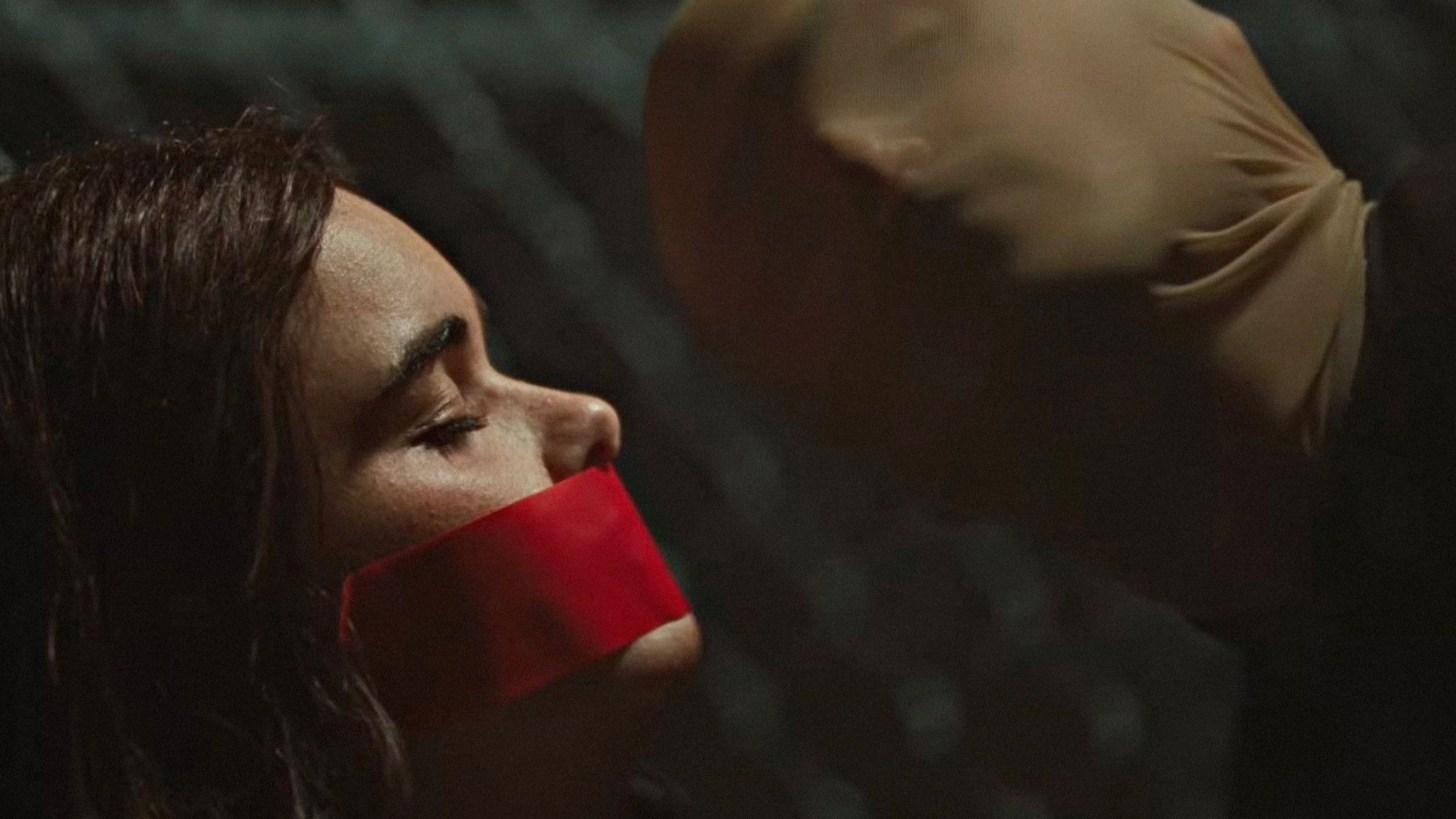
In the mid-section this edges close to becoming a bifurcated tech thriller, as both killer and hunter are computer savvy enough to track each other down. The internet becomes a multifaceted weapon wielded by both sides. Arthur’s selected victims are persons in the media landscape whom, one presumes, he has judged deserving of torture and murder for their complicity in society’s erosion. It’s a hypocritical condemnation, for it is exactly this rot that Arthur dreams of wallowing in. Having played such a mild, fearful and unassuming character recently for Gus Van Sant in Dead Man’s Wire it’s a kick to see Montgomery change tack so completely here, portraying Arthur as coldly, clinically psychopathic (he seems a lot like Jared Leto, actually). Ferreria, for her part, nails the rabbit-holing conspiracy-theorist vibe of Margot’s intensely obsessive spiral. She’s also deeply unprepared for the level of threat Arthur represents. The difference between horrors on-screen and in person frequently astound her.
Along the way, Faces of Death makes numerous observations about our changed and changing relationship to technology. Content creation is Work with a capital ‘W’. There’s a lack of nuance to Margot’s work for Kino, in which educational or otherwise positive uploads are still removed for their content irrespective of context. And, of course, a widespread desensitisation, expressed by the marijuana-fugged callousness of Margot’s co-worker Gabby (Charli xcx).
“Give the people what they want” becomes a recurring mantra here and, lo, Goldhaber joins the fray, dawdling somewhat in the first hour before upping the ante when necessary toward a ludicrously OTT blood-soaked finale. While a little too much of Faces of Death feels over-familiar, stitched together from so many other serial killer stories, the joie de vivre of the gallop to the finish line is quite irrepressible. Cam and the zeitgeist-grabbing How to Blow Up A Pipeline may be richer, more complete films by comparison, but if this is Goldhaber in a lower-stakes modus operandi, it still plays nimbly and summons enough wit and street smarts to warrant your (ever decreasing) attention. And it runs rings around the lowest-common-denominator carny barking of it’s notorious progenitor.