

Director: Chloé Zhao
Stars: Jessie Buckley, Paul Mescal, Joe Alwyn
Hamnet – I film I was fairly skeptical about before entering the theatre – made me think a lot about the magic of performance, and how some people genuinely can’t see the separation line between character and actor. The anecdotal tales of soap stars getting stalked by admirers who think they’re real-life doctors etc. In Chloé Zhao’s transformative adaptation of Maggie O’Farrell’s novel of the same name, Jessie Buckley plays Agnes, wooed life partner of hapless scholar William Shakespeare (Paul Mescal). Agnes is the subject of a lot of rumour and innuendo about town. That she’s a kind of witch for her holistic medicines, sensitivity to nature, and habit of offering up the odd prognostication. But by the end Zhao will have put forth a counter that William is a kind of witch, too. That, through his plays and the transfixing environment of his Globe Theatre, he does his own conjuring. Spells potent enough to bedazzle onlookers into believing an actor is a king, a troubadour, a ghost. That there are, in short, different kinds of magics, and that cinema is a kind, too.
This isn’t the only way in which Hamnet invites the viewer to consider something from another perspective. While attempting to court the strident and independently minded Agnes, William is challenged to tell a story and he choses the myth of Orpheus and Eurydice; a tale as universally known as Hamlet itself. In his telling, Orpheus’ decision to look over his shoulder and thus damn Eurydice back to the underworld is characterised – as it is often – as an act of weakness. By the end, however, Zhao will have countered that perhaps his turning was Eurydice’s act of will, reflected through Agnes’ seeming power over William. That the need to know and understand your other supersedes all other concerns.
We’ve seen Zhao in hazy tone poem mode, and in a less certain mainstream mode via her stint for the MCU. Hamnet looks to offer a third way, as the structure of O’Farrell’s story seems as though it might channel a more conventional narrative thrust. It does, but Zhao still manages to make the material thoroughly hers, largely through her ineffable ability to capture takes from her actors that look like off-the-cuff candid moments, suggestive of natural improvisation. Hamnet is full of such moments that sell the reality of those that inhabit it. That perform William’s magic, if you will. It’s an integral part of what keeps the film alive, and away from the trappings of glossy and/or stuffy prestige cinema strictures.
She has many aces in this regard. Cinematographer Łukasz Żal, while not above an elegantly constructed frame, is often in with the actors, evoking a kindred spontaneity. The energy from this feels removed from what is often expected from self-serious prestige work. In spite of the polish and elegance evident from the costume department on down etc, Zhao is eager to get her hands dirty (or, at the very least, give that appearance). The magic, again, is in the selling of it. Zhao convinces.
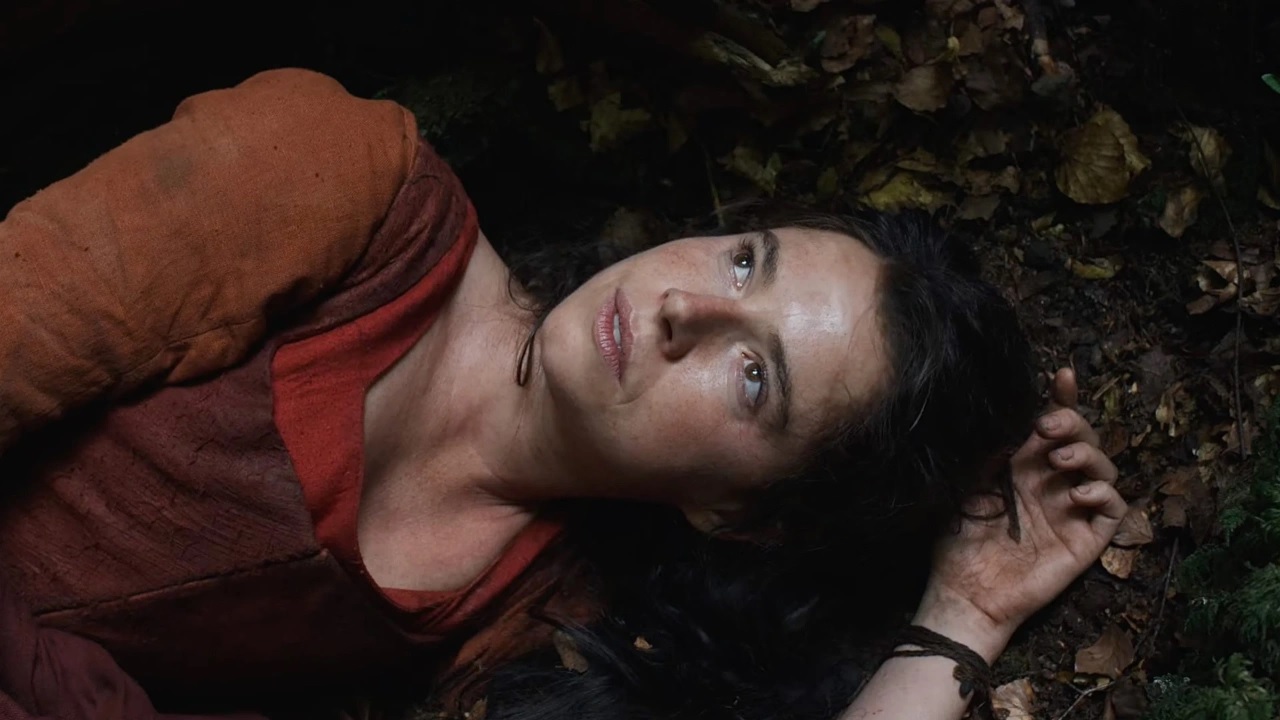
Hamnet hinges itself on a family tragedy that will put incredible strain on both Agnes and William, and open up a broader (and presently popular) enquiry into art-as-therapy. Haphazardly prophesised by Agnes, when disaster strikes their growing family, the film puts the audience through the wringer. The leads are every bit the powerhouse performers one would expect by now, but special mention must go to the very young players (Jacobi Jupe and Olivia Lynes) who navigate some emotionally mature material with disarming intensity. At it’s most feverish, this dark, dark mid-section of the film almost conjures the spirit of Robert Eggers’ The Witch. Returning, visually, to the thematic resonances of Orpheus’ underworld, Zhao pulls at loose threads of folk horror for all manner of underplayed insinuations. When William and Agnes’ young son Hamnet (Jupe) says he can see Death in the room… you believe him.
Zhao’s currently on board shepherding a reboot of Buffy the Vampire Slayer to our small screens (the wait is long) and, as unlikely a touchstone as it may seem, there’s a sinew of inspiration from that series’ landmark hour ‘The Body’ in Hamnet‘s mid-section. When you’re in it, it feels as though it teeters on a knife-edge. A deeply affecting presentation of the moment life changes forever. What started out as a benign, even gentle biopic-cum-romance takes a plunge toward the histrionic. Watching scene after scene of children in distress becomes particularly tough. The aftermath even more devastating. One grows concerned that Zhao’s approach has grown too heavy-handed.
But the third act bares out this winter of discontent. A mite gruelling it may be, but without it, the catharsis of Agnes’ visit to London and her experiences at the Globe Theatre would carry less weight. A rift in understanding between her and William is played out geographically. Grief is as bitter as adrenaline on the tongue, and it’s all too easily to spit it back out as blame and admonishment. William may be the tortured artist but the film is with Agnes, and her ultimate discovery of where he is through his art. Hamnet only really stumbles once, when we check in on William as he wrangles the classic “To be or not to be” speech from within himself. But put aside your fears that we’re about to be lead through a haphazard cacophony of East eggs as though this were some second-rate prequel to William’s masterpiece. Zhao regains her judiciousness.
I’m reminded of the wry punchline at the end of Brady Corbet and Mona Fastvold’s gargantuan The Brutalist; “No matter what the others try and sell you, it is the destination, not the journey“. Hamnet doesn’t take nearly so long to get to the crescendo, but when it does, the hushed reverence is a masterclass in another great magic trick; editing. Sustaining and building a level of special intimacy that conjures only the very best sensations of a live performance (and throwing in a career-best Noah Jupe), Hamnet manages to make us feel both the focused reconnection between Agnes and William and the buzz of an experience shared collectively by hundreds. Succeeding at such a vast dichotomy, Zhao brings the curtain down at just the right moment. No coda is necessary. All points are conveyed.
The play really is quite the thing.


1 thought on “Review: Hamnet”