

Director: Amanda Kramer
Stars: Juliette Lewis, Samantha Mathis, Mamoudou Athie
With her striking, triumphant psychosexual musical pastiche Please, Baby, Please Amanda Kramer announced herself as a preoccupied aestheticist, something which comes to the fore once again here in her stunning new curio By Design, a film made irresistible by it’s singular, one-line premise: “A woman swaps bodies with a chair, and everyone likes her better as a chair.” Wow.
Oozing a high-end eccentricity entwined with a materialistic fetishism that fondly recalls the likes of Peter Strickland or Kramer’s contemporary breakthrough visual artists Nadia Lee Cohen or Thomas Hardimann, By Design perhaps predictably skewers society’s engrained objectification of women. We’re introduced to Camille (Juliette Lewis) in the company of her friends Lisa (Samantha Mathis) and Irene (Robin Tunney) in an expensive furniture store where Camille first notices the beautiful chair that she will become so bewitched, betwixt and entwined with. The words used to describe the seat mirror typical compliments applied to women. Even before the inexplicable, magical MacGuffin of the film’s premise, Camille and the chair are linked by an implied shared femininity. And, thanks to these aforementioned words, a more troubling linked objectivity. Products of function, use, and quantifiable value.
Camille’s infatuation with the chair, her strong belief that it will change or centre her life, is relatable. We’ve all had these intense desires for things. When the style or design of an item – furniture, artwork or otherwise – feels so impeccably connected to us that we simply must have it. The lavish treats about which we might say, “Oh I really shouldn’t…” only to slowly justify. Maybe I’m simply an admitted materialist. But By Design both celebrates and interrogates these desires. When Camille is denied the chair, when it is bought by someone else after she hesitates and waits a day, we understand her sense of loss. But her connection is so unhealthily complete that she becomes the chair, and By Design starts exploring whole other realms of psychological intrigue.
Bought by a woman named Marta (Alisa Torres), ‘Camille’ finds herself in a chic living room, sensually unbound from her coverings by Marta’s now-ex Olivier (Mamoudou Athie) whose interactions with her – admiring her, sitting on her – are rendered explicitly sexual via the chair’s anthropomorphism. Olivier’s touches are gentle, venerated, and through them ‘Camille’ feels loved. Olivier feels a commensurate attachment. After all, he takes ‘Camille’ with him to sit on at a dinner party. Kramer reinforces our deeply rooted associations between objects and happiness. It’s a reflection of our addiction to consumerism, sure, but Kramer’s also tapping into feelings of belonging. Of needing to be thought of as owned by others. It’s a psychosexual enquiry. Not about BDSM ideas of dominance and subservience. But not not about that either. The way that the chair is bound for sale strongly calls to mind kinbaku.
Heartbreakingly, the now empty void of Camille’s body receives a number of visitors who don’t particularly register her conscious absence. They even manipulate her prone body, hug her, etc, and don’t seem bothered by her waking coma, presuming she’s either being sad or obstinate. Here By Design makes theatre of our paranoias that we’re not heard, understood or appreciated by other people. That we might as well not exist. That we contribute nothing. Camille is a prop of our own profound lack of self-worth. Or maybe I’m just revealing myself here.
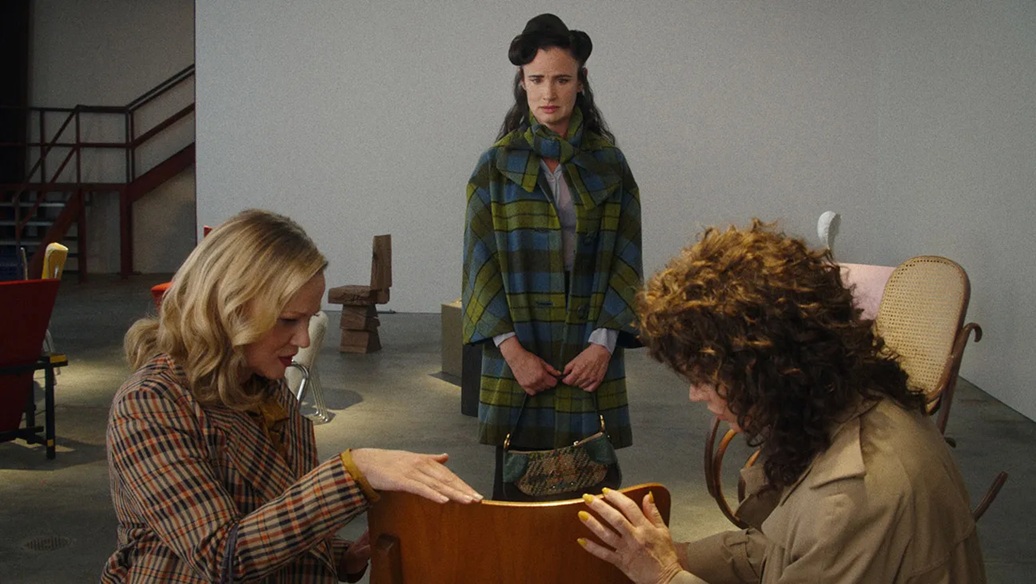
These interactions critique how women relate to one another, most often, but Kramer also drills into the disturbing depersonalisation of the male gaze, particularly when Camille’s prone body is bound and stolen by Jacob the Stalker (Clifton Collins, Jr.). By Design might lazily be called Lynchian, but Jacob’s jazzy tap-dancing is the closest to nailing the departed surrealist’s specific milieu. Jacob flutters around her on a fire escape, monologues about her, but is only overcome with remorse for his actions when he finally regards her. Until then she’s a fantasy filling a negative space. An abstract object of obsession.
Later on, hilariously, her body folded up in the bathtub, Camille’s silence is mined for artistic symbolism by her friend Irene. The scene is both good natured mockery of pretentious critics seeking deep meaning in the inscrutable (hi! hello!) and a further existential joke about our inability to simply be. Irene is rapt by the idea of sharing a silence with her friend as something symbolic and empowered… but she can’t exist in that moment. She’s a gabber.
Dialogue is typified by emphatic statements, presented within an airy, spacious edit and sound design that gives it the neurodivergent quality of the dopamine comedies of Adult Swim. Tim & Eric. The Eric Andre Show. Melanie Griffith’s narration is matter-of-fact. Combined with the precision of the production design – reflective of artfully minimalist showrooms or the oppressive emptiness of tasteful window displays – and By Design has an echoey, theatrical quality. Something we might intrude on by accident at a mysterious all-night club. A cool, woozy, abstract discovery. For this viewer, that’s high praise. Indulgence that is more delicious than pretentious. The belated arrival of the dear departed Udo Kier as the designer of the chair is the icing on the cake. Honestly, this feels like the movie The Substance so aggressively wanted to be. Kramer gets there with a louche exuberance. Hers is a wonderfully specific style; an aesthetic I could only dream of possessing.


