
Year: 2006
Director: Jafar Panahi
Stars: Sima Mobarak-Shahi, Mahnaz Zabihi, Shayesteh Irani
Yesterday, to my complete bemusement, the 2026 World Cup came to a close. This is not to overly besmirch the sport; I’ve just never managed to find a way into it, finding matches dull and aspects of the culture that surrounds it… questionable. Even with a national team in the mix, my response is simply ambivalence. I’ve grown to adulthood finding my escapism elsewhere. In movies. In music. In other sports. But I can wholly appreciate an overwhelming passion and devotion. Something that sweeps you up. Those emotions are universal.
In the UK, movies about football tend to fall into one of two categories; explorations/glorifications of the loathsome, terrifying culture of hooliganism that uses the sport as a kind of maypole to dance around, or the occasional hagiographic biopic of this or that underdog from the arcana of it’s various divisions. Only rarely do we achieve something more curious and approachable (Gurinder Chadha’s Bend It Like Beckham, for instance). But, for Iran’s premiere satirist Jafar Panahi, the sport itself proved key to this 2006 highlight from a career cluttered with them, an avenue through which he could explore and ridicule his country’s arcane and nonsensical gender inequality with the affable charm and lightness of touch he has so often demonstrated.
Attending stadium football matches is forbidden for women in Iran; patriarchal oppression masquerading as protection – to keep the so-called fairer sex from the roughness of men in the throes of their animalistic excitement. Panahi was inspired to make a film on the subject of just this inequality when his own daughter snuck into a match, defying the law. The opportunity proved irresistible when, in 2006, Iran found itself in the position to qualify for the World Cup, resting on a pivotal match against Bahrain. Ever resourceful and able to adapt to the real world in which he filmed, Panahi shot Offside around this event and even during the game itself at Azadi Stadium, flexing the course of his narrative in line with the outcome of the game.
Offside moves through a series of interlinked scenarios, changing hands nimbly for its respective sections that delight in mocking the system of oppression, mining it for contradictions and laughable pettiness through the eyes of a handful of young women attempting to sneak in to watch the game. The ‘First Girl’ (Sima Mobarak-Shahi) is attempting to break security for the first time. Through her we’re asked to empathise with the fearfulness of this illegal endeavour. The uncertainty, the amateurishness. And to understand the drive to take such a risk (though her real motivation isn’t revealed until much later on).
(Inevitably) caught, she is taken to a makeshift holding pen under guard by a handful of rueful soldiers who would much rather be watching the game themselves; their own responsibilities as monitors preventing them – one of the film’s first great ironies. Just off to the side of one of the main entrances to an upper terrace of the stadium, elements of the game are relayed to the girls by the excitable guards, raising the question of what constitutes ‘presence’ at the game, disrupting the authoritarian decree by blurring its lines. Effectively jailed along with their captors, the girls use the opportunity to question notions of gender in Iranian society. One of the girls – Nazanin Sdeiqzadeh’s ‘Young Girl’ – transpires to be a striker for the Iranian women’s team. If she can play for the country, why can’t she watch and support? Another – Mahnaz Zabihi’s ‘Soldier Girl’ – is so thoroughly convincing in her appropriated military outfit that she successfully fools her new captors on first approach.
Essentialism is wryly mocked throughout. The soldiers keep a countdown of their remaining days of manual service for their country, find women’s fervoured interest in attending the football baffling, but eschew responsibility at all times, deferring all decisions to their seldom-seen chief. When caught up in the excitement of the game, the men excitedly kiss one another. Later, on a transport bus with the girls to Vice Squad so that their wards can be detained, the culmination of the game leads one of the soldiers to tenderly rest his hand on his compatriot’s shoulder. The guard notices this but makes no effort to remove it. Assumptions about even these womens’ captors are upended.
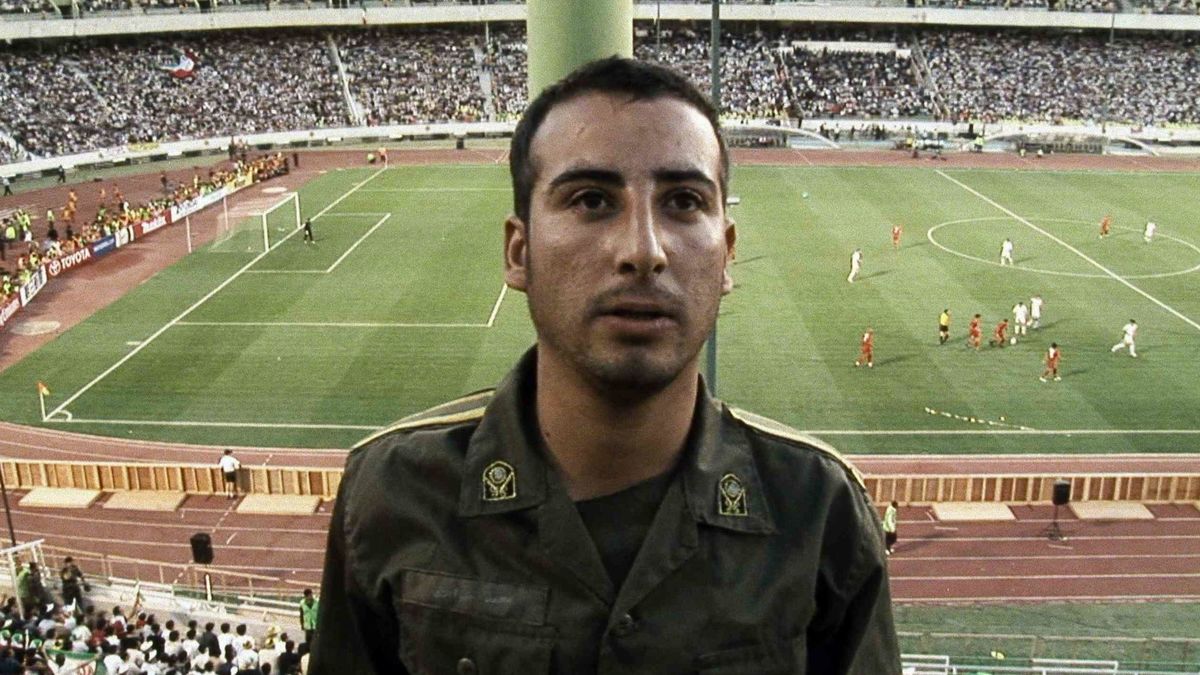
Panahi delights in farce. He has frequently used it as a weapon against his targets, in the process allowing his audiences to be greatly entertained as he goes for the takedown. Think of the ridiculous detours that occurred throughout his recent Palme d’Or winning success It Was Just An Accident. Offside is no different, and reaches a zenith of sorts when the ‘Young Girl’ requests permission to visit the bathroom. Of course, being a single sex stadium there is no women’s bathroom. Absurdly, the soldiers disguise her by tying a poster of one of the male players around her head, puncturing it with eyeholes that soon prove problematic. The walls of the bathrooms are daubed with graffiti, as dangerous to these women as the foul language on the terraces. The ‘Young Girl’ is made to promise she won’t read while the soldier struggles to stop men entering the restroom… or even clear out those already visiting.
Confined together with the game going on a few metres away, the girls inventively turn their pen into a makeshift football pitch in order to recreate an event detailed by one of their number who managed to sneak in during play. A central line is drawn dividing the pen into two halves, and even the guards are drawn into the threadbare reconstruction. The sequence has become startling in the interim as a prelude to one of Panahi’s most celebrated films. When, following the release of Offside, Panahi was placed under house arrest, he cannily defied the attempts to silence him by using the state’s restrictions as creative problems to solve. His 2011 feature This Is Not A Film made in collaboration with Mojtaba Mirtahmasb is a canny piece of autofiction in which Panahi plays out the moves of a work in progress within his own living room. Pacing about, placing markers on the floor, it is quite reminiscent of the motions made by the girls trapped in their holding pen.
At a remove of 20 years, I think it’s safe to say there’s no spoilers in the fact that Iran won against Bahrain 1-0. Offside closes as it began with an extended sequence aboard transport (not uncommon across Panahi’s body of work) as the girls are transferred for detainment. Aside from the classic physical comedy of a soldier struggling to maintain the radio signal so that they can all hear the final moments of the game, what truly lasts about this third act is the documented wave of celebrations seen both inside and outside of the transport vehicle. Panahi doesn’t have to ‘recreate’ the sense of citywide jubilation at the landmark win, he merely has the good fortune and nous to capture it. Much like the brief snatches of the game caught earlier on in the movie, Offspring is afforded limitless production value by Panahi’s wherewithal in using the present to make movie history.
In these most documentary-like moments, the communal positives of football shine through in celebratory form. It’s palpable. Our ‘First Girl’ from the start of the picture uses this moment to memorialise the 7 people who died at the preceding Iran-Japan match – feathering in some sobering politicised context – but that act only adds to the positive sense of a people broadly (if fleetingly) unified. Within that joy rank, hierarchies and gender are immaterial. It’s a halcyon, utopian moment of optimism in Panahi’s body of work. A wish for an Iran to come. It may not have materialised as of yet, but that hope and the urge to strive have powered Panahi through multiple adversities, and his work continues to inspire new generations that change is possible. Of course, the state’s efforts to ban the movie only made it more popular. And maybe one of the most widely seen of all of his films in Iran. Talk about an own goal.

