
Year: 1968
Director: Joseph W. Sarno
Stars: Maria Lease, Marianne Prevost, Peggy Steffans
Joseph W. Sarno is a name known exclusively by sicko cineastes who enjoy delving into the seamy underbelly of the medium’s salacious past. A peddler of sexploitation and porno films most prolific through the ’60s and ’70s, Sarno’s work exists a few feet further toward the deep end than contemporaries like Russ Meyer. It’s darker down there. Riskier. But while the quality is just as erratic, the discoveries can be worth the exploration if you have the constitution for it (or, let’s be real, you’re horny enough).
It’s hot right now in the UK. We’re entering the second of what promises to be a series of successive heatwaves as the summer unfurls. Houses are warm. Sleep is fitful. Fans are operating overtime. In this overtired, agitated state of being, I found myself returning to one of my favourite Sarno joints; Vibrations from 1968. It’s not a-typical of the work he was peddling around this time, but it is notable in several respects, and that made me wonder if I could possibly write something laudable about a style of cinema that is, for the most part, thought of as functional, transactional, mercenary and yes, exploitative.
Taking place on the same block as Manhattan’s Hotel Edison, the action is mainly confined to one cramped and noirishly filmed apartment block. Barbara (Maria Lease – none of the actors are credited) is a buttoned down writer and stenographer, dissatisfied with her lot in life. Her sister Julie (Marianne Prevost) pays her a visit. At night, Julie hears sounds through the mottled clay-looking wall; the sexual trysts of Barbara’s liberated and precocious sometime-neighbour Edna (Peggy Steffans) who writhes around beneath and atop one of her customers. Unable to sleep because of their lovemaking, Julie pushes the thin white sheet from her naked body and starts touching herself. In fact, she’s so aroused by the noise that she attempts to instigate something incenstuous with Barbara.
Sarno shoots what sounds like tawdry roughie material as though in competition with Jean-Luc Godard or Michelangelo Antonioni, drawing on the stark stylistic signatures of the contemporary European masters to apply something lofty to material often dismissed as belonging in the gutter. The crisp, rich, deep black and white photography is expertly toyed with for light and shadow. Sarno and his DP Steve Silverman evidence ambitions far beyond expectation. Gasp-worthy compositions or choreographed reveals. There’s a moment when Julie is so agitated in bed that she sits up and her eyes catch a slit of light no bigger than a letterbox. It’s remarkably well framed. Miles from the point-and-shoot mandates that often powered such films. Elsewhere, the blankness of walls is used to illicit a sense of internal emptiness or societal disconnect ala Antonioni, while Lease is frequently framed like Sarno’s answer to Anna Karina, her raven hair short and chic, her eyes wide and similarly expressive.
This being a sexploitation picture, bodies are a primary concern. The women are uncommonly beautiful, with large breasts and slim waists. Idealised figures who are frequently nude for the sake of the picture’s mandate. The world outside the apartment building appears mildly wintry. Julie crosses a rainwet street in a thick coat, returns home in the same garment. But the apartment building is more of a hothouse. A microclimate all of it’s own. But one that contains it’s own miniature biomes.
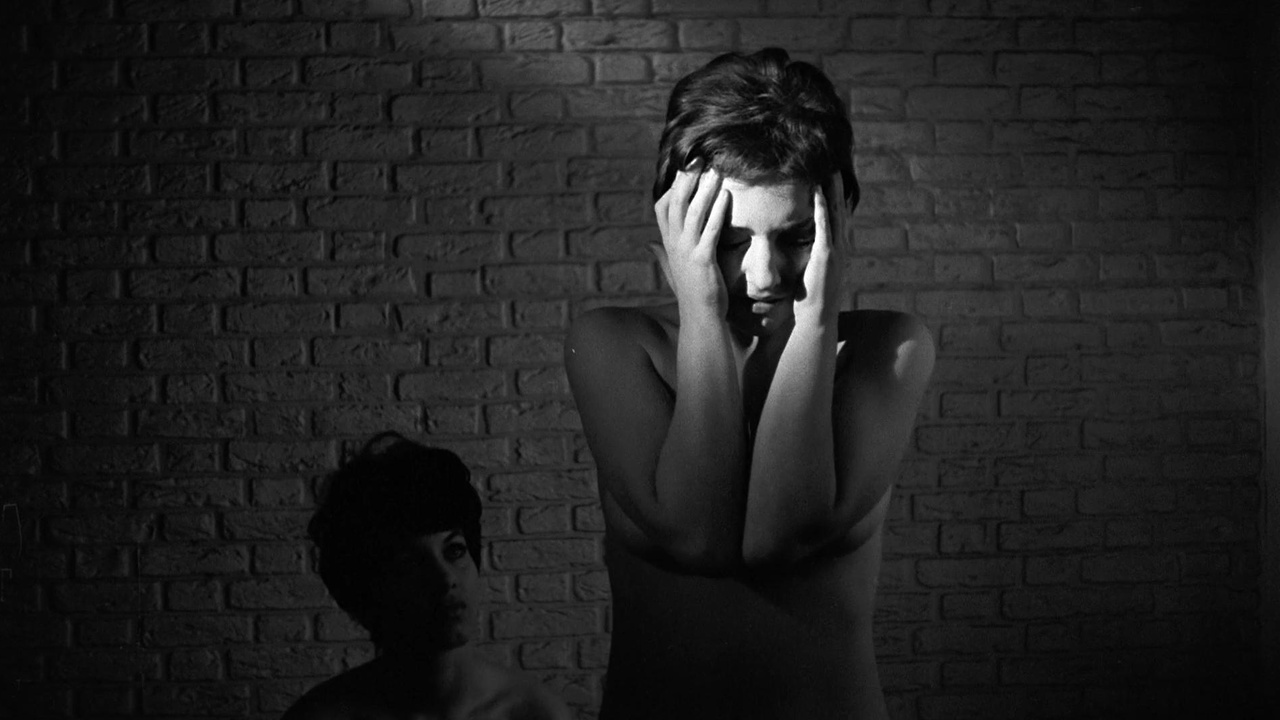
“You’re curious aren’t you, about me and this place?” Edna says when Julie rather boldly walks in on her, pleasuring herself with a handheld electronic device (which the film’s title naughtily eludes to). “This place” makes her apartment – a mere wall away from Barbara’s – feel like a world away. Somewhere that exists in an entirely different milieu, where there are a different set of social cues and priorities. Yet the eroginous heat radiates out from Edna’s core. It has effected Julie through the wall, and Julie is inspired to try it on with another of Barbara’s neighbours; a fellow writer who is easily persuaded. Edna’s presence is like the parasite from David Cronenberg’s Ballardian tower block sci-fi horror Shivers some years later, loosing uninhibited behaviours out into the world.
In a sense Vibrations is progressive for the times, acknowledging lesbian urges and fantasies, exploring them as valid and enjoyable feelings worth indulging. On the other it muddies these same waters with those incestuous overtones, equating queerness with more problematic lustful ‘deviations’. (Wisely) rejected by her sister, Julie goes off to engage in group sex with Edna and another couple. The man’s presence nominally sates a heteronormative status quo… but he is vastly outnumbered and we’re well aware of where her curiosities lie. Julie’s protestations later in the picture when there’s no man present don’t convince us or her new all-female sex partners. The pleasure’s too good.
Vibrations is in thrall of the female form, is as ensorceled by the breast as any Meyer picture. But also eyes, lips, hair, collar bones. Entire forms. Uses lighting to not just glamourise, but to celebrate. To worship. It’s sapphic and sexy in ways that a lot of similar films of the era simply aren’t. In it’s late stages – eager to up the ante – Julie is restrained and pleasured, Her abandon documented. Sarno’s effort reaches out with quivering, excited fingers for that often mocked halcyon place where sex films can be taken seriously as legitimate art. Where the interplay of bodies is legitimately beautiful. More remarkably – though undeniably in the eyes of the beholder – it achieves it. A modest but successful attempt to legitimise sexual abandon and desire and to find the feminine form in particular kind of miraculous.
The film’s rapant hedonism – which shocks, excites and frightens Barbara – is redolent of the times. Summer of ’67 was the so-called “summer of love” in which the hippie lifestyle exploded into mainstream consciousness, co-opted even by The Beatles. The prior decade’s suggestive repression had been eroded. New Hollywood lay ahead for cinema. It was time for the explicit. Sarno and his contemporaries took advantage of relaxed censorship, leading to waves of sexploitation films. Nudie cuties. Roughies. Softcore explorations of the worlds being hinted at by the media. A curtain falling down. Vibrations is – as far as this writer has seen anyway – one of the more vivid and needful examples of this wave of hungry cinema.
But it also has a melancholy to it. An edge of disquiet and worry (largely personified by Barbara and her sexual anxieties and repression). The hammond organ music is tremulous. Excited but nervy, as though anticipating the thrills promised behind Sarno’s closed doors and, like Barbara, slightly alarmed by them.
There are other Sarno movies I like as much and maybe more (Moonlighting Wives from 1966 deserves a full-on Mad Men-style TV serialisation). By the ’70s things get harsher. And there are absolute failures, too. But Vibrations seems clearly to sit comfortably among his most successfully realised projects. A movie for the dirty trench coat brigade that’s also artful, emotionally engaging, even (bi)curiously heartfelt.
Is anyone else hot?

