

Director: Sophy Romvari
Stars: Amy Zimmer, Edik Beddoes, Eylul Guven
Synesthesia at the movies is a powerful, all-too-rare occurrence; when a film evokes sense memories so acutely that you can smell scenes. Taste them. Sophy Romvari’s extraordinarily debut – one of the strongest debuts of recent times – repeatedly finds ways to conjure this uncanny experience, choosing potent shared memories and realising them with palpable success. Here, from the sound of a garden hose you can smell the metallic water. At the beach, you can feel the crush and depression of the shale, or the slimy sweet application of sunscreen to arms. As a desk fan slowly rotates you can feel the wafted hot breeze of an Indian summer. Blue Heron is a film of memories. The film’s father figure (Ádám Tompa) talks of a photograph as “time… going backwards”. Blue Heron is an arm outstretched making contact with the past.
Romvari’s film charts the difficulties encountered by a Hungarian family who have emigrated to the idyllic leafy coastlines of Vancouver Island, British Colombia. The three youngest children adapt to the move casually, preoccupied with play and discovery, but the eldest – late-teen Jeremy (Edik Beddoes) – has become belligerent, moody and increasingly prone to disobedient and antisocial behaviour. The mother (Iringó Réti) is noticeably stressed out by her son’s bad behaviour, her frustration only exacerbated by her husband’s relative passivity. Things come to ahead when Jeremy is brought home by the police for shoplifting and social services are brought into the conversation.
This all may sound like boilerplate kitchen sink drama, but it is rendered poetic and dreamy by the choices made by Romvari in collaboration with cinematographer Maya Bankovic, whose lens evokes the inquisitiveness of the children. There’s a creeping sense that Blue Heron is played through the eyes of the family’s young daughter, Sasha (Eylul Guven). The woozy sense of time period (chunky late ’90s PC monitors and camcorders) only adds to the nostalgic flavour of the film. This, combined with the fact of it being Romvari’s debut, furthers a notion that this may be a loosely autobiographical work, and that Sasha’s eyes are Romvari’s. This is all-but-confirmed with a surprise time jump around halfway through the picture that reframes the rest of it around guest star Amy Zimmer.
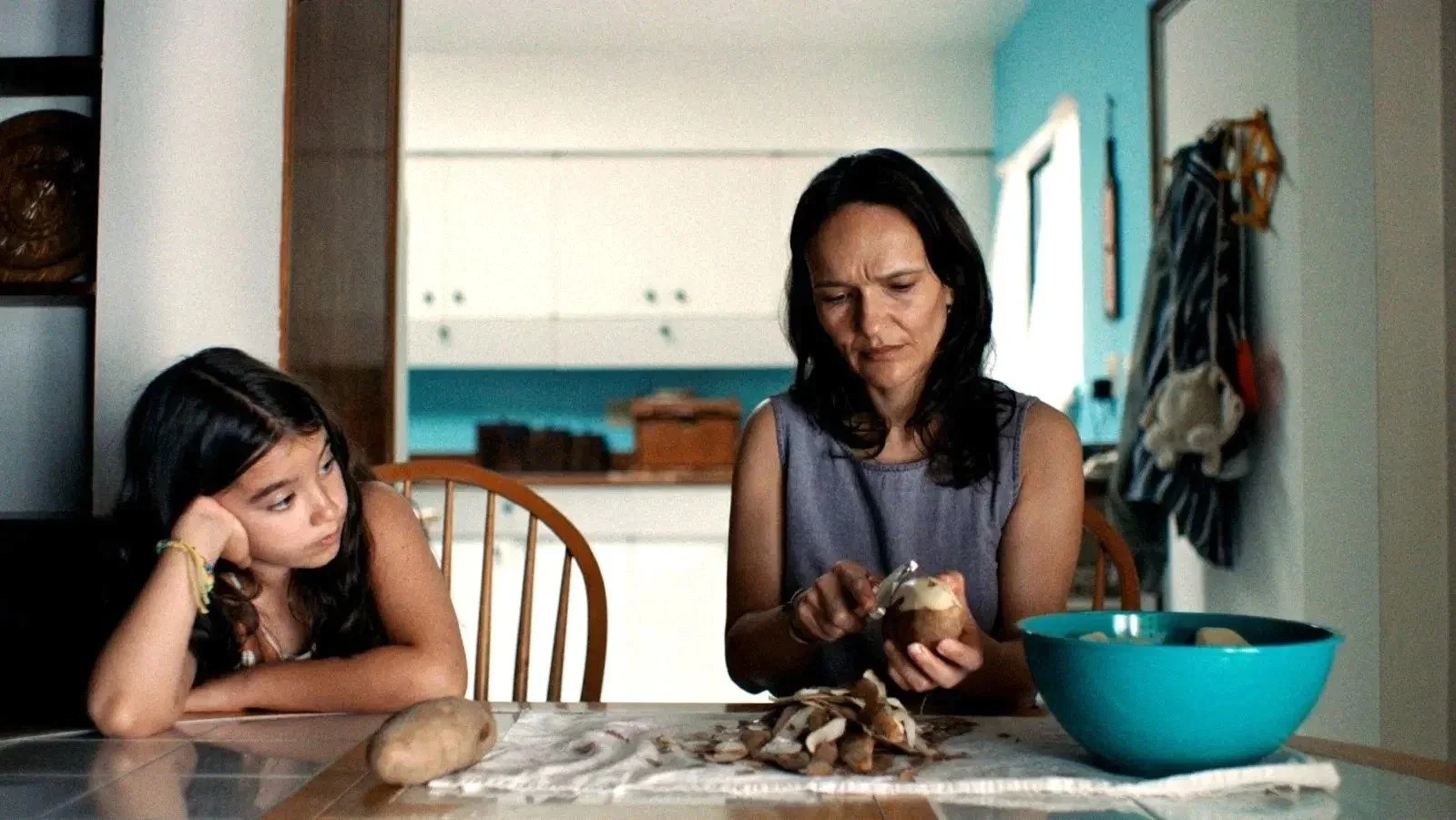
Blue Heron starts talking explicitly about the kinds of support available to families – then and now – with pangs of pessimism, surrounding the story with political commentary of the voids born of insufficient funding for rehabilitation and protection programs. But this isn’t used as an opportunity to soapbox, rather to place a human story within a wider context of struggle. So often the family seem isolated from the world around them; living within it but also aside from it. Neighbours prick at the edges of the story – raising concerns or providing playdates for the young children – but the family also feels, at times, like the only inhabitants of a verdant world with no-one to turn to. The experience, perhaps, of immigrants as outsiders in ‘friendly’ developed nations.
Clues as to the source of Jeremy’s malaise are offered but nothing as simplistic as a didactic solution. Was it his accent? His glasses? That he’s from a former relationship of his mother’s? The question “Why do you think he’s like this?” floors the parents; a question as simple as it’s answer is complex. It evokes the old allegory of three blind men discovering an elephant. The pieces are insufficient. The whole evades the quantifiable. In a beautiful visual simile for the difficulty, the camera disassociates from the question, floating away to consider objects to the side.
All of Blue Heron is communicated with a similar impeccable delicacy; a light, plaintive sentimentality that is evocative of the cinema of Sofia Coppola, Carla Simón and Charlotte Wells. Later, when the film refocuses it’s first half into a set of fallible memories being viewed through an academic lens, it feels adjacent to one of the year’s other clear highlights; Kleber Mendonça Filho’s The Secret Agent which similarly yearns to understand historic tragedies through the removes of time, autopsying the evidence. As in The Secret Agent – or Coppola’s take on The Virgin Suicides, or Carla Simón’s recent Romería – the success of such endeavours feels as fleeting as the memories themselves. A vast ocean as seen from the stern of a ferry, ceaselessly moving away from us.
And then… then Romvari does something a little maverick that I’m hesitant to spoil; an act of temporal magic that feels like beautiful, stirring wish fulfillment. Except that it’s not. There’s still no solution. No intervention that’s possible. It could have played as indulgent. Instead it feels emotionally generous. A different kind of fantasy cinema that hits harder because of how clearly it taps into our shared yearning to step into our own histories. Anyone with regrets will surely feel the seismic kick of this incredibly simple masterstroke.
Jeremy is seen making maps as a past time. These maps criss-cross live action footage in the opening of the film, relaying the credits. In the middle of one seen later is the word “FANTASY”, as though Jeremy is trying to create order out of his own chaos, aware of a kind of futility. When interviewed he is quoted as having said that one of his wishes would be “to travel through time”. With Blue Heron, Romvari has granted him – and all of us – this wish. A remarkable work.


