

Director: Kristoffer Borgli
Stars: Zendaya, Robert Pattinson, Mamoudou Athie
Kristoffer Borgli has a clear interest in how we value outside approval, evidenced by his recent films. The jovially repellent Sick of Myself skewered influencer culture by imagining a woman giving a skin infection deliberate longevity to sustain her position in the public eye, reflecting a particularly modern compulsion for external praise and validation. His A24 debut Dream Scenario presented a more fanciful notion of one man inadvertently invading a collective dream space, and the resulting sense of betrayal and infringement that he had seemingly no power to control.
For his latest, The Drama, Borgli proffers us a happily engaged couple mere days from their wedding whose bliss is shattered by a dark revelation from the bride-to-be’s past. Worry, shame and revulsion fester under the heat lamp of western wedding culture at a time when the pressure is on to be your absolute best, but what if you’re spiralling toward your worst?
The marketing for The Drama has done a fine job spicing up the reveal within the movie, making it hard to write about, as really the scene in question plays out around 20 minutes into the movie and obviously colours everything that follows it. I’ll try and cagily talk around it, but it’s a frustrating impingement when the admission in question is so fundamentally a piece of the movie’s (stilted) dialogue with the audience.
Suffice to say, however, that Borgli’s status as a European (Norwegian specifically) investigating American culture is of importance to remember. His chosen topic is both alien and grimly fascinating to him, as it is to many of us who live outside of the States. He’s able to embody this sense of morbid intrigue via Robert Pattinson’s Charlie, the hapless groom-to-be who hails from the UK. An Englishman in affluent Massachusetts who finds himself within touching distance of one of American’s most disturbing cultural phenomenas.
Charlie is soon to wed Emma (Zendaya), a bookstore clerk who is deaf in one ear, who spills her darkest secret while drunk and in the company of their married friends Mike (Mamoudou Athie) and Rachel (Alana Haim). Prone to neurotic fixation, Charlie can’t see passed Emma’s nakedly confessional story, and the group wrestle with accusatory language that bypasses empathy or understanding in the immediate aftermath. Like anyone stigmatised by a crisis of mental health – past or present – Emma is repeatedly obligated to explain herself, something she is inadequately prepared to do and which frequently ends with jags of vomiting.
There’s a blank universality to Emma, which may have been intentional from Borgli during the writing process, but in casting megastar Zendaya in the role, one senses a missed opportunity to tackle Emma’s now-Black womanhood come the production. Whether he ignores it or not, there’s a huge swathe of cultural circumstances hanging heavy in the air that complicate her backstory which The Drama decides not to engage with. It’s one of the movie’s biggest, most awkward blind spots.
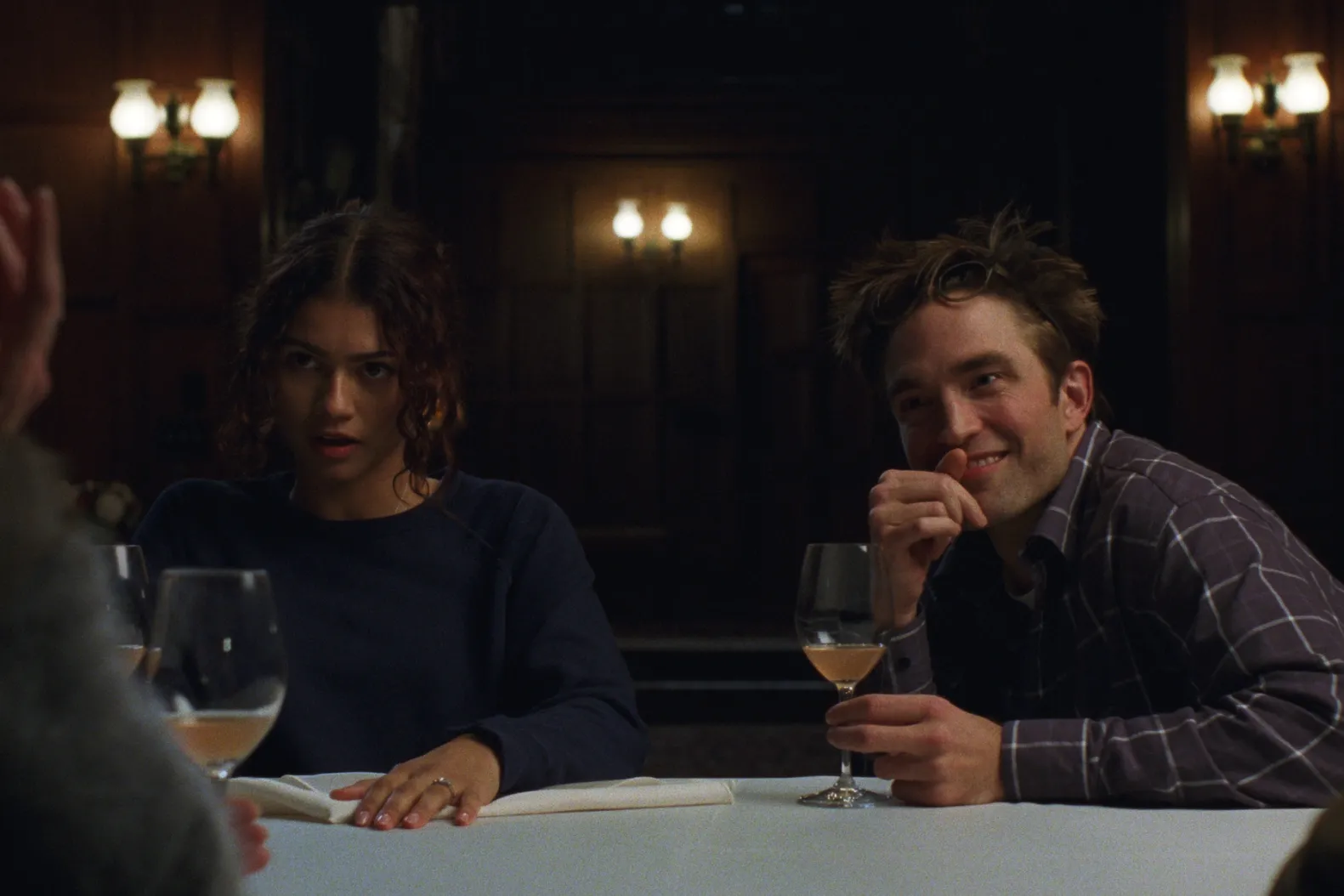
Zendaya seems successfully confounded, for her part, though she is relegated to varying degrees of hangdog frustration as Borgli focuses in on Charlie’s mental unspooling. Counterbalanced by the whimsical woodwinds of Daniel Pemberton’s almost flippant score, Borgli is clearly staying within the territory he feels most comfortable. Giving him his dues, he’s only getting better at his acute observations of human nature, here nailing particularly the ways in which we rehearse or imagine conversations, going down rabbit holes in our heads that spin us out of our regular moods and methodology. Pattinson – who has proven himself over and over – is at or near a career best here, free to express himself in his native accent and with a scruffy awkwardness with which he seems well accustomed. If Zendaya’s casting is problematic (through inaction after the fact), Pattinson’s is perfect, and he seems to have a sharp sense of Charlie’s underlying sleaziness. What comes to balance everything is the superb chemistry (in simpatico or otherwise) that these two display around one another.
With a precarious hot topic in front of him, Borgli hesitates on how to interrogate it. His usual instinct to treat the serious irreverently is displayed, teetering on the see-saw of good taste, but The Drama seems always concerned about the audience’s capacity to handle something provocative or edgelordish. As with his previous American picture Dream Scenario, one senses Borgli scaling back so as not to alienate anyone. Come the wedding day, the speeches become a fraught medium for individuals reeling with a secret to do battle with one another in a tense public arena. Borgli handles the situational comedy with expert aplomb, and The Drama is always naturally funny, even though it is visually boxed up in a relatively dour and muted colour palette. By this point he has backed away from the specifics of Emma’s confession almost totally and The Drama is reshaped – simply but effectively – into an engaging comedy of manners. Loosely adjacent to the rom-com, Borgli seeds the ending early and ultimately gives those of us yearning for a (kinda) feel-good finale exactly what we want.
If The Drama cowers at its own nasty topic of conversation, then, it works better as an observational piece cataloguing the ways we stumble when responding to shocks, while scurrying down well-traversed passages. How well can you really know another person? What are the bonds and boundaries of love and commitment? Aren’t we all compulsively self-destructive, and why is that? Charlie’s chaotic response to Emma bizarrely reminded me of David Cronenberg’s Dead Ringers, and the absurd impulse to level the playing field of a relationship through attaining balance. If Emma’s been appalling, does Charlie (unwittingly?) seek to find her again at the same level? Is that need for symbiosis the basis of a successful marriage? A sign of love? These notions are where The Drama thrives.
Borgli, like the rest of us, is feeling his way around the human condition. While it does feel as though the picture is a little too concerned with its self-image, that almost becomes a meta-textual point in conversation with Borgli’s previous pictures. Panic over how one might be received, something mirrored intensely in Emma’s wincing realisation that she’s shared more than she should have, and that acceptance is no prerequisite.