
Director: Maggie Gyllenhaal
Stars: Jessie Buckley, Christian Bale, Penélope Cruz
In the second season of David Simon and George Pelecanos’ sporadically great HBO series The Deuce, Maggie Gyllenhaal’s character Eileen ‘Candy Renee’ Merrell transforms from beleaguered streetwalking sex worker to pioneering hardcore filmmaker, bringing a feminist sensibility to the pornos being peddled for distribution among the sex shops of ’70s Manhattan. It’s one of the more empowered arcs of the series. Gyllenhaal’s own directorial career showed immense promise when she stepped behind the camera for 2021’s The Lost Daughter, suggestive of an artist with a similarly keen sensitivity for knotty feminine intrigue. Five years on, The Bride! certainly looked like a brash continuation of that spirit, teased as a re-imagining of James Whale’s Bride of Frankenstein with what appeared to be a sicko streak of Riot Grrl energy. It was only a much later trailer exhibited closer to the film’s release that suggested something altogether more confused. The picture that The Bride! unfortunately transpires to be.
You’ve got to hand it to Gyllenhaal, it takes some brass to open with the boast that what’s about to unfurl is better than Mary Shelley’s landmark novel (one of the most influential literary texts of the 19th – or any other – century), but she does. Speaking to us from some ill-defined afterlife, the spirit of Shelley (Jessie Buckley) saucily sells us a story unshackled from outside interference. Ironically, Gyllenhaal’s film reeks of already-hinted-at studio interference, from the shambolic state of the editing to the utter confusion of tone. But the problems feel as though they go back further than that. Part Bonnie & Clyde remake, part Joker and Harlequin cosplay, part reboot for the Universal Monsters cinematic universe, The Bride! comes across rather like one of Dr. Frankenstein’s creations. An amalgamation of parts that don’t fully add-up to a whole. Gyllenhaal the writer mixing plenty of inspirations but coming up short on that vital life spark.
It’s 1936 and Chicago. Before we can get any sense of who she is, Ida (also Buckley) causes a rumpus in front of sadistic mob boss Lupino* (Zlatko Burić) and meets a premature end in a dingy stairwell. Within this cacophonous opening we’re given to understand that Ida is possessed by the spirit of Shelley. Meanwhile, across town, Frankenstein’s monster (Christian Bale) comes cap-in-hand to mad scientist Dr. Cornelia Euphronious (Annette Bening), beseeching that she (re-)animate him a mate. A quick spot of grave-robbing later and Ida is electrified back into being, amnesiac, but still possessed by the spirit of Shelley, which manifests as spasms of Tourette’s from Countdown‘s Dictionary Corner. She trusts in ‘Frank”s assurances that they’re beloved and that her name is Penelope ‘Pretty Penny’ Rogers, and they scuttle off to paint the town red.
Ida/Penny’s backstory is kept from us for the sake of a late in the game laborious reveal by moping detective Jake Wiles (Peter Sarsgaard), but by denying us a worthwhile introduction to her, we’re as dislocated from knowing her as she is herself. Perhaps that’s Gyllenhaal’s play. An effort to submerge us in her sense of unknowing. But there’s no room for us to feel her plight and, as she seems unable to articulate her purpose going forward, we’re left mystified as to what she’s hoping to achieve. Billed so exaltingly has her story, we spend more time in the company of Frank, whose sadsack incel horniness we can at least chart. All we really get from Gyllenhaal’s Bride is frustrated disarray. That in itself is worthy of expression, but there’s too much competing for attention. The film’s pithy mantra – “I would rather not” – is a succinct, catchy rebuke to the patriarchy, but it feels as underdeveloped as everything else here.
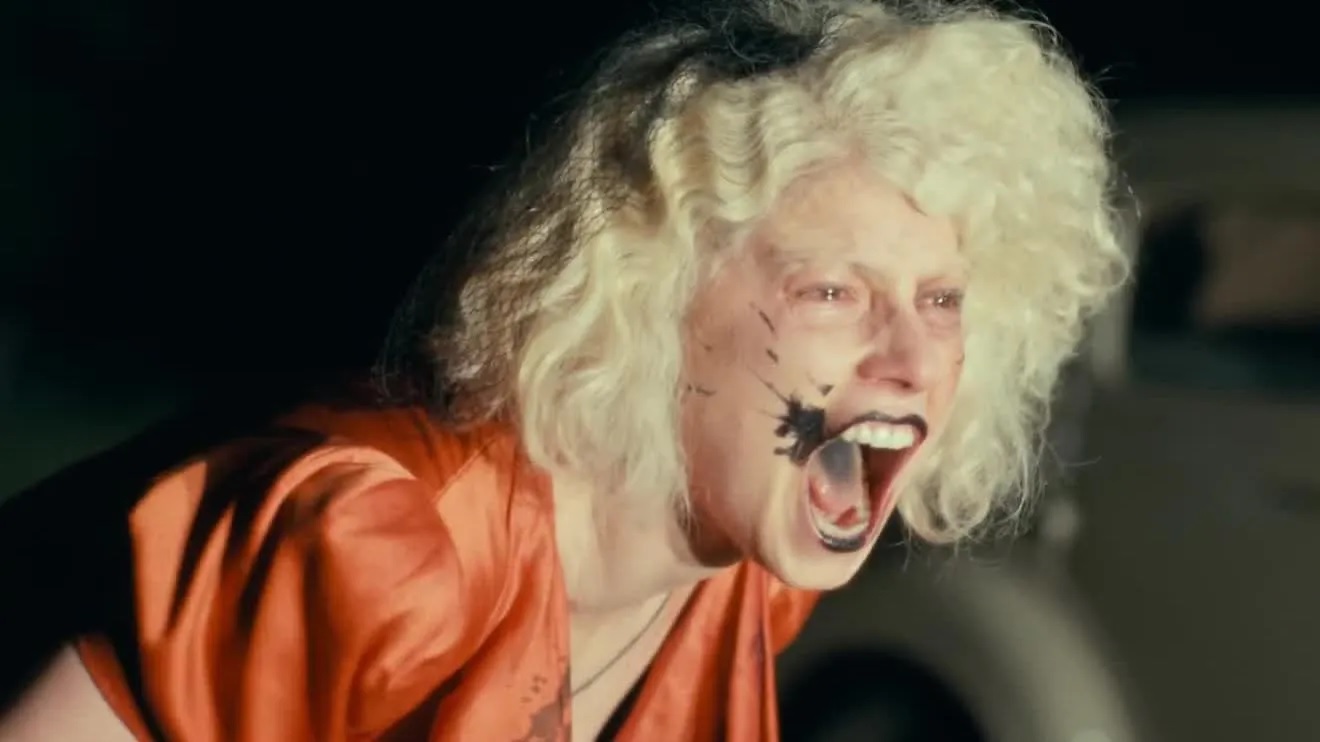
Gyllenhaal has a go at subverting gender stereotypes. As Wiles and his plucky secretary Myrna Molloy (Penélope Cruz) pursue Frank and The Bride from Chicago to New York and back up to Niagara Falls, it’s clear that the two pairs echo one another. Gyllenhaal has the men play the vulnerable emotions while their female companions drive the narrative forward with decision making. But The Bride’s decisions are always reactive and uncertain, in a large part because she’s been gaslit by her puzzle piece Romeo. It takes far too long for the other shoe to drop, and when it does it seems to make very little difference.
Everything involving our disembodied Mary Shelley onlooker is terrible. Everything. The Bride! would be an immediately stronger movie without it. Not only does it play lumpenly, not only is Buckley’s performance grating, but it creates a messy metatextual level within the film that it simply doesn’t have the space for. So Shelley’s novel exists within the timeline as a work of fiction but everyone’s just fine that Frankenstein’s monster (often irritatingly referred to as Frankenstein himself) is also real? It’s an accepted work of non-fiction then? These things need to be assumed. The Bride’s haphazard antics at a swanky New York ball whip-up a fun dance number that makes it seem as though these two have power over others like voodoo priests, but that isn’t exhibited elsewhere, so it’s just so that Gyllenhaal can have a dance number. Fine, but give us more! Sex and violence are interlinked (Louis Cancelmi needs to stop being typecast as abusive men in powerful roles), and Gyllenhaal has the nous to acknowledge that the dynamic has complexities when Frank himself is finally aroused by The Bride’s chaos. But it’s another through-line tilted at but not explored. Much like the supposed revolution inspired by her supposed fury.
Because Gyllenhaal has so many plates spinning, there’s rarely a dull moment. Something‘s always happening, and half the time whatever that is manages to be engaging in a quirky, volatile of simply baffling way. But there’s an overall dullness generated by the clouded sense of certainty behind the thing. Intentionally or not, the whole comes to feel like an expression of The Bride’s amnesiac mind; grasping for a single frame of reference to build itself around, but finding only the foggy echoes of old movies. Unfortunately, The Bride! lacks the all-out dynamism of so-called ‘big swing’ cinematic efforts, the likes of which have made themselves known of late via either their gambled-on successes (Yorgos Lanthimos’ Poor Things – a better version of this idea in every respect) or fascinating failures (Francis Ford Coppola’s Megalopolis). Ultimately, The Bride! slithers down the gap in between occupied by simple duds like Joker: Folie à Deux. And nobody wanted that fate for it.

*Ida… Lupino… gettit!?
 The Lost Highway Hotel