

Director: Kaouther Ben Hania
Stars: Saja Kilani, Amer Hlehel, Motaz Malhees
It’s 29th January 2024 and Hind Rajab Hamada is six years old. She is trapped in a car in northern Gaza with the corpses of six family members that she perceives as “sleeping” and the Israeli army are right outside. In theory, she is eight minutes from rescue. But the bureaucracy of achieving that rescue is a much lengthier affair. In the meantime she is intermittently kept on the phone by Red Crescent workers (the Palestinian equivalent of the Red Cross). It’s a real, documented story and filmmaker Kaouther Ben Hania uses the actual call recordings for this pressure cooker reconstruction.
Ben Hania is no stranger to blurring the lines between truth and dramatisation. Her exceptional 2023 documentary Four Daughters played cannily, even amusingly, with such boundaries. There’s no sense of amusement here, however, nor would it be fitting if there was, particularly. One might expect The Voice of Hind Rajab to feel transgressive or questionable for using these recordings, but sitting with the film it feels far from the kind of rote sensationalism that such decisions might suggest. From Predators to Hamnet there’s a lot of opinionated mileage right now surrounding the worth of emotional manipulation. In this case, I’d question how anyone could come away from this story unmoved irrespective of whether or not the source calls were authentic. Using them only underscores a warranted editorial anger. And Ben Hania goes to great pains to address subjects of perspective, discipline and distancing in the retelling of this story.
The action (for want of a better descriptor) is limited to within the Red Crescent call centre, where call-handler Omar (Motaz Malhees) initially receives the request to make contact with the car from a concerned overseas relative. Initially speaking to another family member, gunshots bring the communication to a darkly punctuated end. The next person Omar speaks to is Hind Rajab. Already cautioned that he may need counselling from the first call, Omar stays on as long as the situation lasts, as does Rana (Saja Kilani) (halfway out the door as the drama starts to unfold). Their attentions are torn between the girl on the phone and their mounting frustrations that middle manager Mahdi (Amer Hlehel) can’t get traction fast enough to green light their ambulance. “There’s no time,” pleads Hind Rajab.
It feels needless to say that this is a heartrending tale to be confronted with, and that the conflicts and frustrations stir up a lot of emotions. Ben Hania takes judicious opportunities to look for elegant frames, usually when allowing the film to breathe in it’s negative spaces. But mostly she defers to the intense (and intensely controlled) work of her actors. She allows for a couple of deliberate efforts at distancing, reminding us within the frame that we’re watching a reconstruction. Through a cellphone that records the dramatic events, we’re afforded a portal through realities. A vivid and inspired use of archival footage to frame our own watching as a third level of reality that is intrinsically connected to the world(s) on the screen.
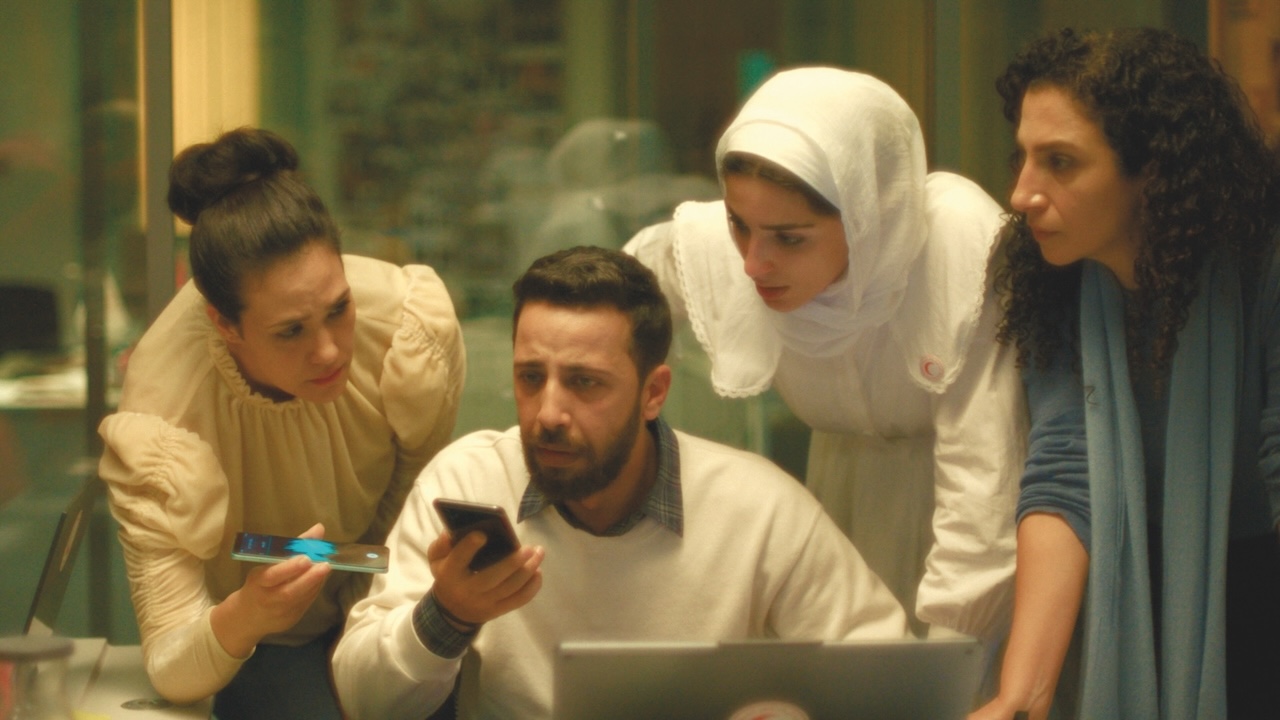
I said that perspective and distance were built into the tale itself. This occurs plainly in the emotional disparity between Omar and Mahdi. Omar, who is on the phone with Hind Rajab, is entirely inside the child’s crisis. Mahdi, who is removed – boxed into a glass office – deals more calmly and levelly with the situation due to this level of abstraction. Showing us this gulf, Ben Hania is in part accusing her audience of their further level of indifference. As minutes turn into hours and as the sun goes down, the group of people clinging to hope in this office multiplies, and efforts to circumnavigate procedure include publishing real-time updates about the crisis to social media. Facebook. Omar chides these efforts. What good is armchair empathy when what’s needed is an ambulance on site? It pricks at our relative comfort, be that in a cinema or at home, allowing ourselves the luxury of enduring this traumatic story from a crisis still ongoing. I came out of the film angry, frustrated, and guilty.
Repetition and inertia are weapons that Ben Hania uses to express these frustrations. Her film very deliberately takes the time to explain to the audience the necessary safety protocols that are in place that cause this achingly protracted amount of time to pass. That Red Crescent must co-ordinate with Red Cross who in turn will mediate the extraction with the Israeli M.O.D. before things move back down the chain again. A game of bureaucratic telephone. Reality can be so banally absurd.
Abstraction can also be therapeutic, however. Red Crescent have a system in place whereby anyone who deals with an anonymous fatality on a call receives a emoji-like sticker for their cubical to remember them by. These unknown dead are rendered literally faceless until efforts to identify them are successful, at which point photos are added to a remembrance mural. But even in the abstract the stickers (which might sound like a corny corporate band-aid, even a potentially tasteless one) serve a purpose and have meaning. Dealing with tragedies that are experienced in such a liminal manner, perhaps it is important to substantiate them, no matter how minor the gesture. Is Ben Hania’s film itself not another processing method? A collected record, now shared?
Early on in the film, Ben Hania creates a key visual simile. The voices on the phone calls are interpreted as sound waves. The kinds of readouts we’re all familiar with. Appearing along a dotted line to denote a base level, they can’t help but resemble the readouts on an EKG machine. They are the film’s literal heartbeat. When they stop, the film and it’s audience hold a breath in tandem. We’re unified.
Hope exists here. In lines like “There’s still some light left. We still have some time”. But one can’t help but come to the conclusion that it is pessimistically dwindling.

 The Lost Highway Hotel