
Director: James Cameron
Stars: Oona Chaplin, Zoe Saldaña, Jack Champion
The glib version of this review goes something like this; if Avatar was a remake of Fern Gully and The Way of Water was a remake of Free Willy, then Fire & Ash is – somehow – a remake of The Way of Water. Now, I don’t particularly hold any of those statements to be entirely accurate, but a flimsy case could be made. Our third visit to Pandora arrives comparatively quickly given the seismic gap between parts one and two, but the recency of the last instalment isn’t the only reason Fire & Ash winds up half-submerged in déjà vu. It’s a gargantuan, deeply frustrating watch, particularly because you can see the film it could’ve been at multiple opportunities, one with the exhilarating, transportive effects of James Cameron’s finest efforts. When it is that movie, it’s kind of wonderful, but it’s only that movie some of the time.
At its most interesting, Fire & Ash finds Cameron wrestling with his long and storied relationship with guns. To look at his action cinema of the ’80s and ’90s, Cameron seemed sponsored by the NRA. He brought the M41A Pulse Rifle and a cadre of marines to the xenomorph in Aliens, nullifying their threat through superior firepower. He had Arnie obliterate the ordinance of an entire police battalion with a minigun in T2. The fetishisation of such weapons has long been part of his aesthetic and identity. Fire & Ash continues his increasingly loud tirade against humanity as a species, a misanthropy that’s positively venomous, and finds Cameron partway trying to reconcile with his own obsession. You can sense his self-disgust, and the idea of this spilling out on screen at such colossal expense – a kind of $400 million exorcism – is quite arresting. But, like many ideas toyed with here, it never really amounts to anything for two reasons. One, Cameron is loath to remove any pieces from his increasingly cluttered board and, two, Fire & Ash is, ultimately, all about the fucking whales again.
We pick up not long after The Way of Water concluded. Narration duties have been passed to Jake Sully’s (Sam Worthington) surviving son Lo’Ak (Britain Dalton), a slightly incongruous move considering how little impact the character has throughout the course of the film. The Sullys are still living at the water’s edge on Koopa Troopa Beach from Mario Kart 64, and Quaritch (Stephen Lang) has regrouped back at RDA Headquarters under the watchful eye of Gen. Ardmore (Edie Falco). The focus turns to Spider (Jack Champion), the tiresome surfer-dude teenage human whose breathing masks worked fine all the way through The Way of Water, but which now seem to have succumbed to some kind of planned obsolescence the rate he’s going through them. Jake and Neytiri (Zoe Saldaña) agree that he needs to return to his own people, but their efforts to transport him put them within Quaritch’s firing lines, and give rise to a new enemy.
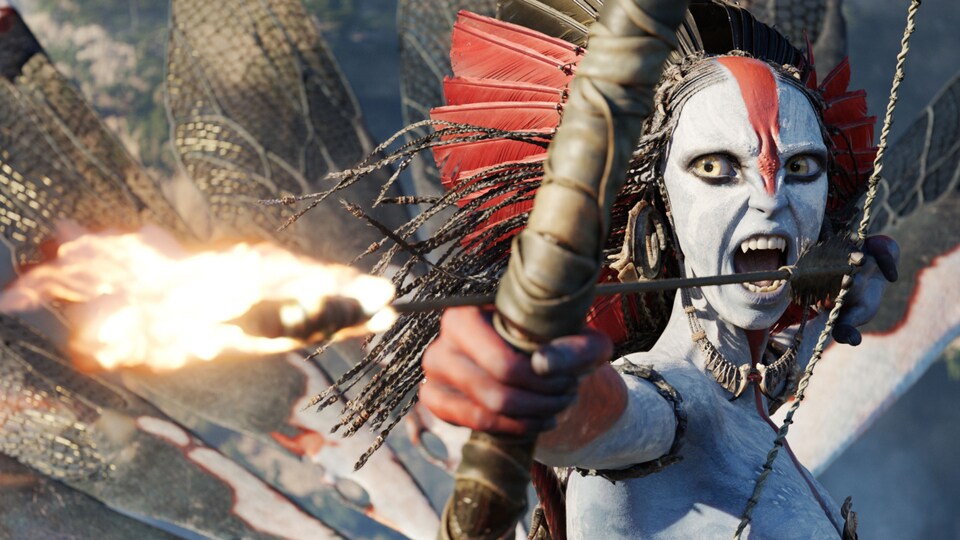
Fire & Ash is a comfortable improvement on The Way of Water simply for the smart decision to forefront Neytiri again after reducing her to a whimpering background character for the better part of the last three hours. Here she is calcified by her grief at having lost Neteyam (Jamie Flatters), committed anew to her hatred of the Sky People; a fire that brews tension with Jake. There’s fire also thanks to the other ace up Cameron’s sleeve. Oona Chaplin seethes seductively as warrior witch Varang; leader of a tribe of raiders who have cast aside the teachings of Eywa. One might even refer to her strident appearance from her pointedly vaginal tent as… cunty (hilariously, the interior looks like it’s been decorated by the Sawyer family from The Texas Chain Saw Massacre).
After a stuttering first hour, Fire & Ash is fiercest in the mid-section, which briefly ferries the action to the human home base on Pandora, realised as a kind of sprawling industrial mega-city, toxic and artificial. Here Cameron and his cadre of writers even manage to throw in some commentary on media bias and how war narratives are sculpted by institutions. Having never attempted a trilogy before, Cameron seems to have done his research, and even tilts toward some Return of the Jedi business between Jake and Quaritch (elsewhere there’s some Two Towers inspiration if you swap out talking trees for, yup, whales again). But – seemingly with further episodes always a nagging potentiality – the story is openly against making serious, corner-turning decisions. In the end, Jake and Quaritch remain trapped by Cameron in a holding pattern of capture and escape that plays out like a long and tiring flirtation.
Their increasingly homoerotic clashes remain a driving force, and you always want to know what Varang and Neytiri are up to, which makes the interminable whale stuff all the more exasperating, as this element once more swallows the picture. New themes, terrains and tensions give way to a do-over of the finale from The Way of Water, only this time extended to an all-out assault that makes up the entire last hour of the picture. By this point Cameron has so many plates spinning that efforts at tension are cut to ribbons by the need to keep switching parties. It is a deluge of overstimulation (I did not sleep well in the aftermath) but it’s also not that thrilling. Either through overfamiliarity or sheer overindulgence, Fire & Ash bludgeons the viewer with too much visual stimuli until it all feels rather meaningless. The strands become a snarl, and you’re left watching clean and resonant opportunities to wrap this up as they pass Cameron by.

For all the great bits – and there are great bits – there are as many frustrations. The significance of Sigourney Weaver’s miracle-child Kiri is tilted toward but again shied away from. An adolescent romance strand feels all kinds of forced and unpleasant, and similarly hasn’t the space to go anywhere (thankfully). And always, always there’s the bottom-of-the-barrel, garbage dialogue to navigate. The “bro”s, “cuz”s and “butthead”s that so grossly splattered the language of The Way of Water are in full-force once more, along with risible and regrettable new slurs like “pink ass” and “monkey boy”. It’s not unreasonable to say that Cameron’s bizarre affection for ’80s surfer-speak undoes the emotional integrity of a number of scenes here. A serious or affecting moment is always at risk of being undercut by an off-hand “that sucks”. Fire & Ash is the worst offender thus far.
And then there’s the ever-present and uncomfortable sense of racial tokenism and exotic tourism built into the series’ very brio, forever evidenced in the wishy-washy score that sounds like the background music piped into a hippie knickknack store. We talk of ‘vulgar auteurism’. Cameron’s well-intentioned crush on indigenous peoples often sees him slip into such a category. But that’s where Avatar lives. We’re three films deep into his vision. That stuff’s certainly not going to let-up now.
So it’s a spinning penny. On one side you have the rise of the series’ fierce women and Cameron taking an interesting look at himself, on the other you have those women’s stories being squandered (Varang’s potential particularly) for the safety net of an exhausting game of stalemate, one we’ve already watched. Too much of it unwisely lands on the shoulders of Jack Champion’s Spider, the most unlikeable element of the entire franchise. And while I’m as sympathetic to the plight of the whale as anyone, I was about ready to pick up a harpoon come the end of this. Should Avatar continue (and that seems box office contingent), I hope we never see those booming assholes again. You’ll be sick to death of them.
Later dude.

 The Lost Highway Hotel