

Director: Guillermo del Toro
Stars: Jacob Elordi, Oscar Isaac, David Bradley
That this has been Guillermo del Toro’s lifelong dream to bring to fruition makes complete sense. Hasn’t Mary Shelley’s Frankenstein been in the bones and the blood of his cinema all along? In the darkly gothic eroginous zones of Crimson Peak? In the icy tundra opening of Pacific Rim? The romantic interspecies fantastique of The Shape of Water? Directing films, supervising multiple departments, del Toro has been the head atop a patchwork body all of his career, steering some assemblage of disparate parts into staggering forward, hoping against hope that they find synchronicity. It’s not always worked smoothly. But here, perhaps when it counts for the filmmaker the most, he gives a creature genuine life and beauty.
Frankenstein’s monster as popularised by James Whale with his 1931 adaptation has become an icon of horror cinema, but does a disservice to the character created by Shelley in her seminal novel. Boris Karloff’s performance exists – with good reason – in the pantheon, as deserving of its place as Max Schreck embodying Count Orlok, but its ubiquity has obfuscated a broader understanding of The Creature. Perhaps more than anything del Toro seems eager to correct this. Unfurling opulently over 2 and a half hours, his vision is faithful to the book’s original structure, framing it – in typical 19th century style – as tale(s) told within a story.
We open in the wintry wilds of the North Atlantic with a ship trapped in the ice and a wounded man – Oscar Isaac’s dishevelled and diminished Victor Frankenstein – found as though left for dead in that wasteland. A hulking and horrific monster (Jacob Elordi) comes for him, but his visage is cannily hidden from our sights. The creature is kept at bay long enough for Victor to tell his story (the first half of the picture), but there’s another side to tell…
Karloff’s monster was kept effectively voiceless, groaning into the fog-laden night, but Shelley and del Toro’s Creature was and is strikingly eloquent (that is, after a fashion). Through his voice the storyteller is able to cast doubt over the true villain of the piece; to reflect damningly on man’s inhumanity and make the whole a grim reflection of our failing intentions when contrasted with innocence. But it’s a while before we get there.
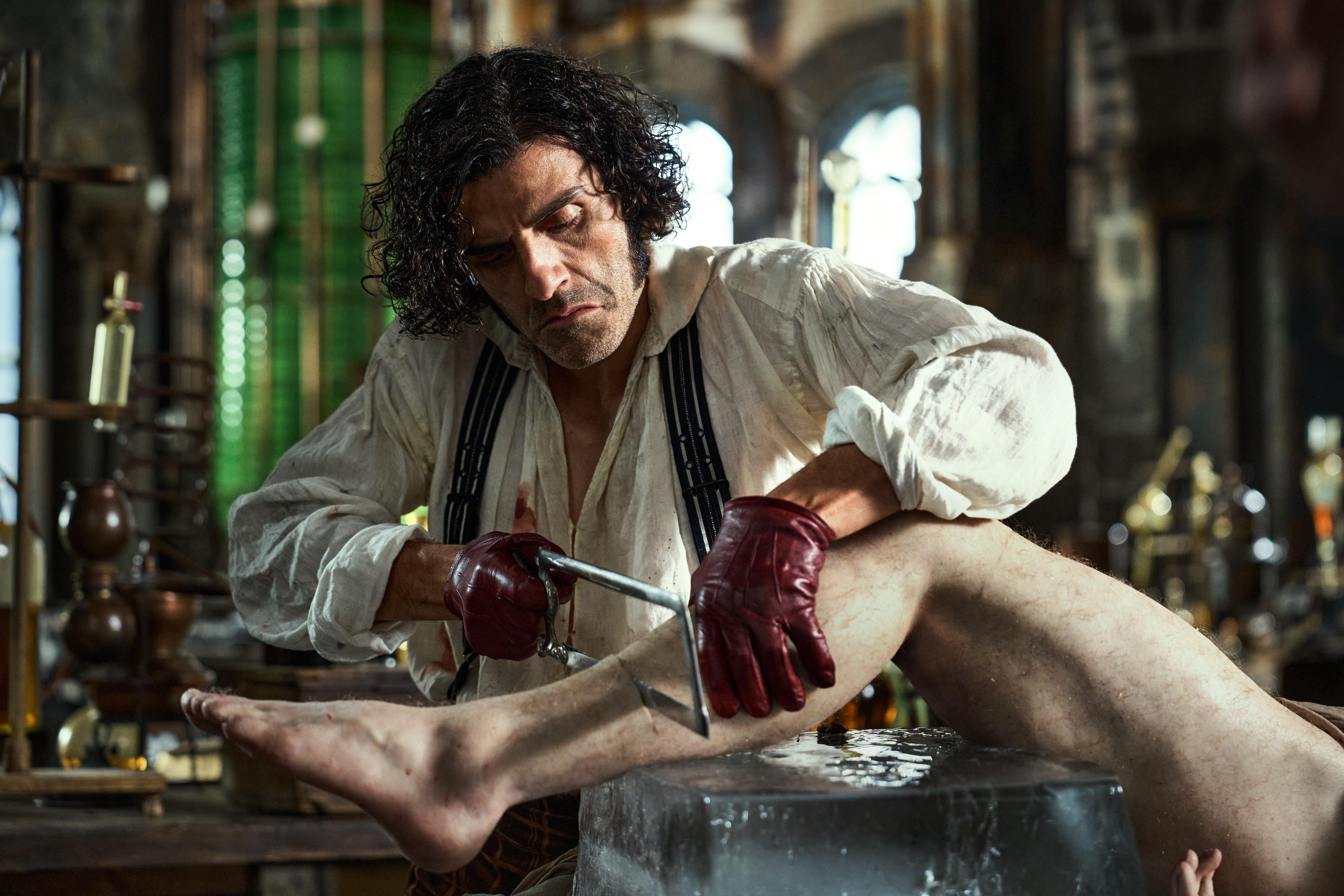
Isaac holds court for the first half of the picture, and his Victor Frankenstein is an adept and prideful showman (and, through that very performative ability, an untrustworthy narrator). His eloquence and arrogance before the learned men of medicine in London draws the patronage of the wealthy Heinrich Harlander (Christoph Waltz), who promises to bankroll Frankenstein’s circumspect experiments in reanimating flesh… so long as he honors an undisclosed favour when the time comes. Thus Victor – and by extension del Toro – constructs a grand gothic laboratory atop a stern and chilly crag, as ostentatious a piece of production design as any to have graced the Mexican filmmaker’s career to date.
Fittingly the craft throughout Frankenstein is immaculate. del Toro recently attended a screening of his film which ended in a rousing chant of “Fuck AI!” goaded on by the scholarly director himself. His film stands as a monument to the skills and collaborative craft of cinema as a medium, as tended by human hands (even through such modern methods as CG). Victor’s endeavours may make for a cautionary tale, but there’s as much admiration for the creator in del Toro as there is sympathy for his devil.
As enjoyable a rogue as Isaac can play, he is eclipsed by Elordi once the time comes. Through an exceptionally realised make-up design, the looming actor emotes with eyes and toned physicality that stands in stark contrast to the greats of old Hollywood; a tender reimagining closer to Shelley’s descriptions. Imagine an Engineer from Ridley Scott’s Prometheus blighted with the soul of a poet. Victor’s initial bewitchment with his creation gives way to learned patterns of behaviour from his own callous father (Charles Dance). Monsters begetting monsters. Indeed, the most self-effacing element of Victor’s tale is that he allows us to see, unvarnished(?), his acts of cruelty.
Frankenstein becomes something else once Elordi takes over, however, and del Toro takes us on the Creature’s journey out into the world to meet ‘civilisation’. Some of the most touching passages in Shelley’s book involve the detailing of his benevolent deeds in secret service of a family of lowly farmers, and it is to del Toro’s immense credit that he allows this chapter of the story to play out. David Bradley balances his villainous GoT work as Waldor Frey with something beautifully gentle here as the Blind Man who allows the Creature his humanity. It is in these passages that I came to feel what Frankenstein might mean to del Toro. As much as The Lord of the Rings may have meant to Peter Jackson. Vastly different texts, granted, but the commitment to both the messaging and the communication of those messages is evidenced in the tenderness of the craft.
![Frankenstein (2025) Film Review [Spoiler Free] | Borrowing Tape](https://borrowingtape.com/wp-content/uploads/2025/10/Frankenstein-2025-Film-Review-1.jpg)
This movie is resplendent with beautiful little visual ideas. To pluck one out of the many, the ways in which the Creature initially mirrors Victor as it awakens and starts to learn, implying the themes of dark reflection which are to emerge. As much as this is a mainstream work, its creator’s cineaste appreciations remain diverse and – in this instance – gooily grotesque. For all del Toro’s evident love of Golden Era cinema, he’s as delighted by the visceral body horrors of your Stuart Gordons or Brian Yuznas, and rarely passes up an opportunity to spill guts and viscera across the screen or show off grisly practical effects creations.
Nor the opportunity to lean into the gothic romanticism of the tale, either. From the erotically charged red silk sheets which Victor drapes himself in to the jagged shard of rock that becomes one character’s death bed, the indulgence is always, always appreciated. This is maximalist cinema and it’s a deeply frustrating crime that it is to be relegated to the anonymous small-scale boxiness of Netflix once this too-brief theatrical window has been completed. This is a rich, populist work which ought to have the opportunity to run and run at multiplexes and indies for weeks with the same scale roll out as, for instance, Robert Eggers’ Nosferatu last Christmas. Netflix’s disdain for the cinema hurts all the more when they shackle artistic triumphs such as this.
So run, run to your cinemas. Run while you still can. This is a master creation that ought to be given as long a life as its forlorn and long misunderstood antagonist, here given the beautiful opportunity to redress a century-long imbalance. The old adage is wrong: (Victor) Frankenstein is the monster! But a wretch as pitiable as any.

 The Lost Highway Hotel
1 thought on “Review: Frankenstein (2025)”