
Year: 1974
Director: Werner Herzog
Relatively early in the illustrious career of pioneering German filmmaker Werner Herzog comes this svelte 45 minute curio; a self-evidently biased profile film of renowned ski-flyer Walter Steiner. Herzog approaches the man with the unbridled respect and admiration of a fan, eschewing the kind of objectivity one might cite as beneficial for the prized objectivity of the documentary form. Yet this very affection is part of what makes this cinematic love letter so distinct, as enigmatic as its death-defying subject, and a key film in the development of a filmmaker fascinated by humankind’s reckless urge toward self-destruction.
Ski-flying is not to be confused with ski-jumping. The distances covered are far greater. The jumps constructed to grander specifications. As with anything that escalates in scale, the risks rise in proportion. Inclement conditions such as snow or wind can be the difference between victory and hospitalisation, or even death. Like any extreme sport it feels as though there’s an element of psychosis involved in the very act of participation. As much as Herzog is keen to lionise the achievements of his living hero, he is equally fascinated with that mindset.
From its very title, The Great Ecstasy acknowledges this element of Steiner’s psyche. Slow-motion footage of the ski-flyer launching from the end of a jump is couched in a lilting score by rock band Popul Vuh. The enhanced frame rate and musical blanket place Steiner in a euphoric heightened reality, suspended – no matter how fleetingly – in a transcendent space between mortal earth and the figurative and literal heavens. He is as foolhardy as Icarus.
While Steiner’s ‘regular’ job as a professional woodcarver gives the film its flamboyant title, Herzog includes only two scenes that display this aspect of his life (one of which sees the athlete modifying his own skis). In the main the documentary chronicles three days at Oberstdorf in the former Yugoslavia. Steiner repeatedly exceeds the distances anticipated by the venue’s organisers, landing – with grace or otherwise – beyond the extent of their measured boundaries, getting closer and closer to the lethal point after the slope has levelled. He is quite vocal that the authorities of the competition need to make adjustments to the length of the jump because the conditions are helping to create these exceeding circumstances. Gallingly, they not only disregard his outspoken criticisms, but act in opposition to them, lengthening the jump, encouraging ever-more-hazardous world records.
It goes some way to giving credence to Steiner’s concerns that the sport has become morbid viewing for voyeurs whom he compares to those who might slow down to get a better view of car crash victims. He is paranoid that many people are watching to see him fail, to see him injured. But he doesn’t venture anything to explain his own compulsion to put himself at risk. Even after a bad landing that results in broken ribs and concussion, Steiner returns the next day to the competition, performing several more jumps in spite of his own complaints, acting, it seems, to feed an addiction.
Steiner comes across as self-deprecating, cautious in spite of everything, even reasonable – in contrast to the evident madness of his chosen vocation. He’s a long way from comparable Herzog eccentrics whose past times led them into danger (like Timothy Treadwell of Grizzly Man for instance), but dicing with death connects a thread of Herzog protagonists. As recently as his 2022 Storyville contribution on volcanologists Katia and Maurice Krafft, Herzog’s obsession with those that blithely disregard their own safety has remained persistent (for what it’s worth his The Fire Within is the superior recent documentary on the Kraffts, besting the more sentimentally-minded Fire of Love thanks to Herzog’s inclination toward a more questioning line of enquiry).
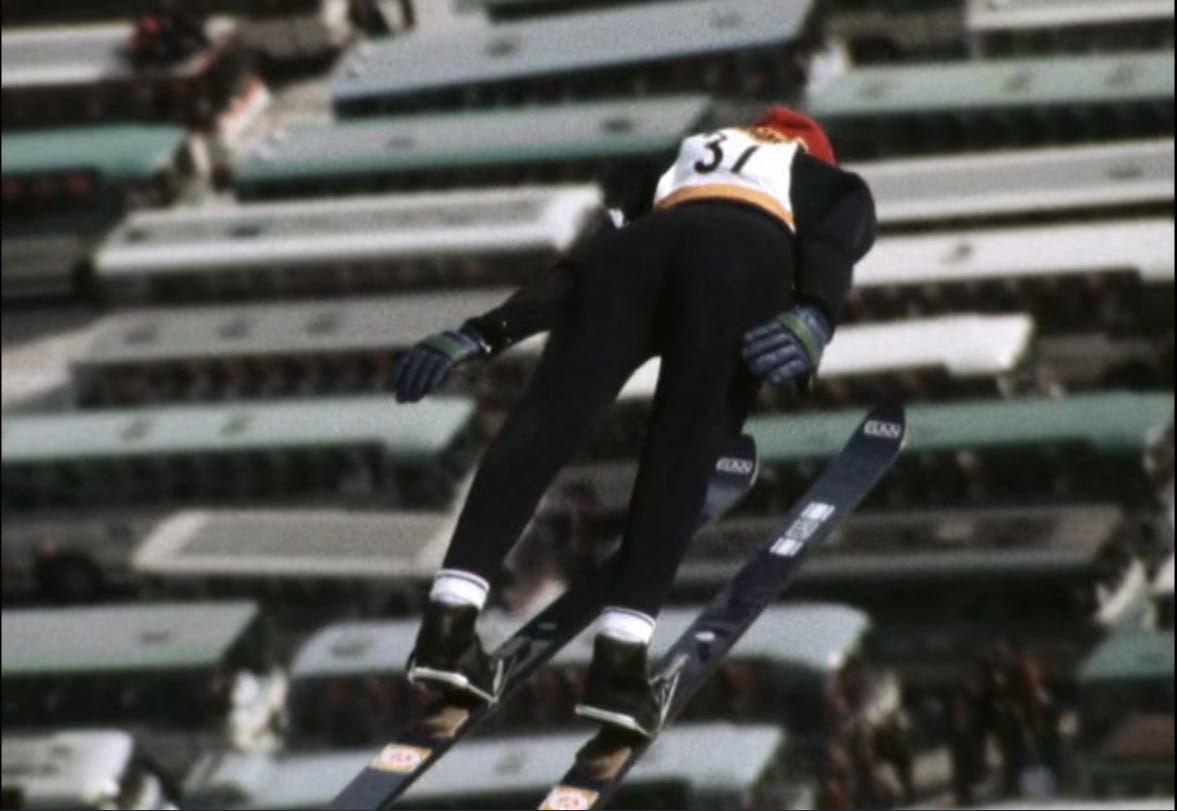
In recent years Herzog has become quasi-memeified for his decidedly quotable late-career documentaries. Encounters at the End of the World, for instance, contains multiple examples which float around social media platforms as viral titbits ready to amuse, particular his observations on fluffy penguins, fulcrums of an unsparing – and by extension incredibly humorous – nihilism. That version of Herzog had yet to fully reveal itself in the context of The Great Ecstasy. Here he is enthused and earnest, clearly in the thrall of a topic of some personal fascination.
This is communicated verbally throughout, but is better when cinematically conveyed via the aforementioned slow-mo shots of Steiner – and others – launching themselves toward the infinite. These sequences are magnificent in their beauty, taking flight like men in pursuit of some other kind of being, hurtling toward the sky as though they might transform – finally – into birds. As awe-inspiring are the shots that then track behind the skiers as they start to plummet; the buildings in deep background sailing into view giving scale to the descent, echoing the sense of entropy that seems to deeply concern Herzog. His replays of various spills and accidents come close to fashioning that lurid sense of voyeurism that Steiner himself is so troubled by. We’re invited to be those people, and its a little unsettling.
Though safety overhauls in the sport wouldn’t come into meaningful, revolutionary effect until the ’90s (following a run of back-to-back accidents), The Great Ecstasy must have contributed to an increasing awareness of the need for reform. The impact and influence of Herzog’s images have also carried well into the 21st century. In 2007, emerging noise band HEALTH directly cribbed images of Steiner in flight for the “HEAVEN” music video, essentially re-scoring the material in a re-edited fashion. Indeed, this was my introduction to the images. A long, occasionally lapsed search online ultimately led me to Herzog’s source film, whose limited length didn’t effect its overall impact. On reflection, the brevity of The Great Ecstasy is part of what makes it feel so fresh, singular and impactful even now. It could have been expanded into a longer feature, and these days most likely would have been, prying further into Steiner’s woodcarving and mindset away from the ski slope. But it wouldn’t feel as compact and punchy as the film Herzog ultimately delivers.
Herzog presents us an enclosed snapshot of a man flinging himself toward possible death in spite of his own seeming good sense not to. We’re left to muse on the psychology at work, the drives and impulses that compel Steiner toward destruction. The adrenaline is clearly in getting to that brink point, but there exists in Herzog’s presentation an undercurrent of worry. Worry that Steiner is emblematic of a darkness in all human nature, and that in him we can see the impulses that drive us, as a species, toward self-manifesting annihilation, freely skirting the fringes of insanity.
Breezy stuff for a 45 minute sports doc. but that’s our Werner.
 The Lost Highway Hotel