
Year: 1950
Director: Anthony Mann
Stars: James Stewart, Shelley Winters, Stephen McNally
Is it possible for a movie to be great because of a single scene? That sounds like a backhanded compliment right from the jump. There’s a lot to love about Anthony Mann’s Winchester ’73 (one of three westerns that bore his name in 1950 alone). A lot to admire in its craft, and in its atypical storytelling mode that even prefigures some arthouse classics (was Robert Bresson potentially influenced when envisioning Au Hasard Balthasar?!? L’Argent?!?). But there’s a scene in the midst of the journey that has lived in the memory of this writer as a stone-cold classic of the genre, enough to vault Winchester ’73 up from the good to the great. Enough to make reliving it a priority.
The first of eight collaborations Anthony Mann made with James Stewart (whose work from 1950 onwards would seek to dismantle the folksy charm of his earlier career highs) Winchester ’73 takes a sweeping look at the west circa 1876 – a decade after the end of American Civil War – by following one prized rifle’s chain of ownership, creating a patchwork of vignettes that can encompass many things.
Opening in Dodge City on the 4th of July, dusty blow-in Lin McAdam (Stewart) hands over his own iron to sheriff Wyatt Earp (Will Geer) with eyes on winning the titular rifle in a competitive shootout. Earp tells us the scarcity and value of the ‘one in a thousand’ prize; a limited edition issued by Winchester, acclaimed as perfect. What starts out as target practice turns into an exhibition match with the locals betting in a fervor. McAdam wins it, but the manner in which he does so is a pleasure of contrived showmanship. Sore loser Dutch Henry Brown (Stephen McNally) steals the rifle after surprising McAdam.
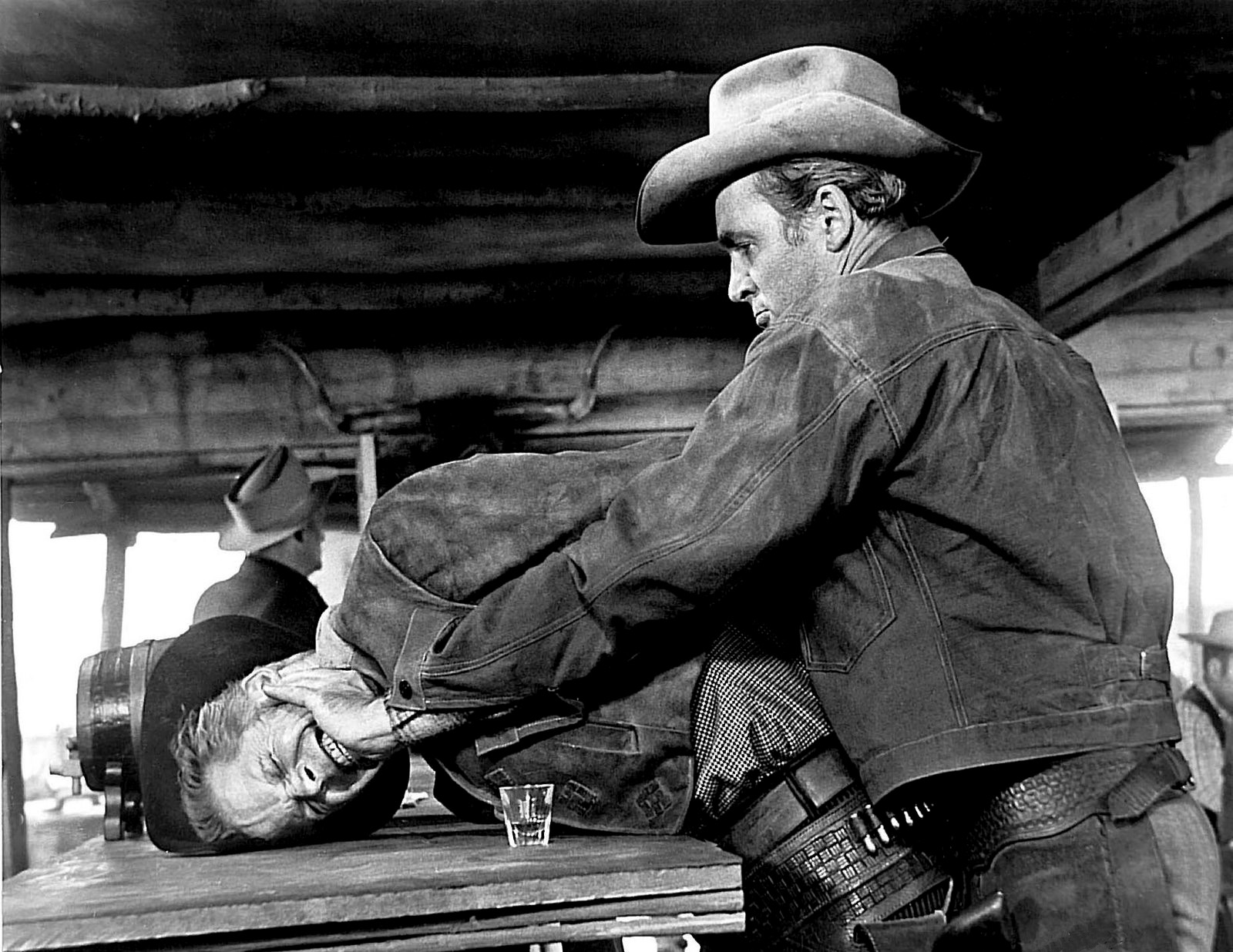
Dutch rides to the modest Riker’s bar in search of further munitions. Native American trader Joe Lamont (John McIntire) raises his prices in an effort to secure the rifle, but Dutch declines him, proposing a game of poker instead, but luck is against him. Indeed, luck doesn’t seem to follow the firearm. Lamont loses his life over the rifle in a slightly lamentable – but mercifully brief – encounter with some indigenous men shortly thereafter.
Saloon girl Lola (Shelley Winters, established briefly at the top of the picture) falls foul of the Native American Young Bull (Rock Hudson!) sporting the Winchester. So already we’ve had shootouts, poker and a pulse-pounding chase with indigenous peoples. Winchester ’73 is powering through the genre’s iconography, playing like a compilation of smashes in which each one’s a belter. If we’re continuing the metaphor, Winchester ’73 is nothing but pop hits. It’s instalments have no meat on them. They’re short, punchy, snappy and each one of them an earworm.
McAdam and his partner ‘High Spade’ Frankie Wilson (Millard Mitchell) – who never really disappeared from the narrative – re-enter it with a Native American posse at their own heels, pursued into a camp where they make Lola’s acquaintance once more. Here McAdam suggests a way to outfox the incoming raiding party (managing to play lip service to good ol’ Winchester and their fabulous ‘repeaters’ in the process, of course).
Perhaps the march of time and our distance now from Winchester ’73 has dampened how reproachful its product placement and endorsement is. Pull this shit in a modern picture and you’d be (rightly) roasted for selling out so brazenly. It helps that Winchester themselves went defunct in ’31, making this more of a nostalgia artefact. But Mann’s film places its thorny product – a weapon intended for mass murder – within a roiling context of romanticism, mythos and stark incoming revisionism. The gun is an unavoidable, nay intrinsic component of American heritage. For better and often worse. Winchester ’73 – for all its hagiography – is faithful to that. The importance of fine armaments, amid all that chaos, could be the difference between life and death. The excitement and adventure tied into that perilous situation is irresistible, certainly as presented here.
McAdam narrowly misses reunion with his ‘one in a thousand’, which instead passes to Lola’s chaperone Steve (Charles Drake). Steve, prone to flight and naivety, foolishly falls in with charismatic outlaw Waco Johnny Dean (Dan Duryea). Fleeing the law, Dean absconds with the rifle and Lola. The house is left in flames, continuing a pervasive sense that the rifle is in some way a cursed object, underscoring its inherent hellish intent.
Dean rides with Lola to a meet with Dutch, who recognises the weapon he once lost and takes possession of it once more as the two men’s gangs converge to stage a bank heist. At the film’s climax the heist plan is scuppered by a further run-in with McAdam, who reveals an all-consuming personal vendetta against Dutch. He chases Dutch out into the cactus-strewn Texan scrubland for the film’s action-packed climax, where McAdam is once more reunited with the Winchester ’73 he lost at the beginning of the picture. Lost, it is revealed, to his own brother. The vertiginous shoot-out that unfolds feels like some uncanny precursor to Mann and Stewart’s later match-up, the career-best (for both) The Naked Spur, which similarly makes use of the rocky west’s scalable geography.

So… with all this action and commotion, with all this passing of one gun from hand to hand, where is the fulcrum scene? The one that makes the movie. When I thought back on Winchester ’73 before re-watching it for this (the new Criterion 4K is gorgeous btw), the scene that stood out – and has stood in memory for all the years since I first saw it – was the poker scene between Dutch and Joe Lamont.
It’s funny how memory shapes and enlarges things. In my memory, this was the sequence that showed Mann’s prowess at suspense, his earlier days kicking out tough noir pictures self-evident. A weapon in his own arsenal. I remember the drama playing out with the kind of singular intensity and attention to minutiae that Quentin Tarantino would likely pour over and regurgitate.
That’s true of the scene. But, you know what? On re-watching Winchester ’73, on seeing it again, that scene didn’t pop out nearly as much as memory told me it did. In truth its emblematic of the whole movie. Tight, contained, riveting, driven by the desire and intent to provide maximum entertainment, to command all of our attention.
Can a movie be made by a single scene? Sure it can. But I no longer think it true of Winchester ’73. Here, every scene’s a firecracker. That poker scene bristles just as fiercely as any other. Screenwriters Borden Chase and Robert L. Richards ensure the journey is peppered with dialogue exchanges both clever and memorable, ensuring that every scene feels focused and meaningful, and that Winchester ’73 is anything but ambling or complacent. The telling is rich. It’s not a movie of one scene, but rather an immaculate machine rather like it’s titular weapon; each element exactly as pristine and useful as its neighbour. The whole becomes ‘one in a thousand’.
Its somewhat reeling to consider that Winchester ’73 – a 1950 movie – is now as far from us as it is from the time it depicts. An artefact from America’s recent history reflecting on its violent youth. It manages to make the States feel both old and incredibly young at the same time, careering through a charged adolescence that has the rest of the world gripped (often in terror). That it and the events it imagines are posts on a wire fence, stretching back into the past, and leading blindly ahead of us. Minor milestones in an enduring, violent tapestry.

