
Director: Drew Hancock
Stars: Sophie Thatcher, Jack Quaid, Lukas Gage
Last year, the horror comedy Abigail had it’s ‘surprise’ conceit bungled by an over-eager advertising campaign that went hard with the news that it was about – gasp! – a ballerina vampire, something that the film plays close-to-the-chest for it’s opening act. A similar thing has happened here with Drew Hancock’s handsome Companion. A wickedly constructed teaser did a great job of making us curious, but the one sheets for the film removed any doubt. Sophie Thatcher’s pretty Stepford Wives-looking Iris is a robot. And so we have an opening act, again, that plays coy with this detail for over 20 minutes, dropping hints like rocks until a big “aha!” reveal that’s been totally scooped.
Granted, it wasn’t a fatal blow to Abigail (which has other problems), and it isn’t a fatal blow to Companion. Maybe, in this instance, it’s to cushion disappointment. That teaser trailer did seem to promise something we hadn’t seen before. Hancock makes a stylish go of it, and many aspects of his sci-fi thriller play gangbusters with a willing audience, but there’s a hollow familiarity underneath it’s lacquered veneer, not to mention some nagging doubts about the messages it ultimately intends.
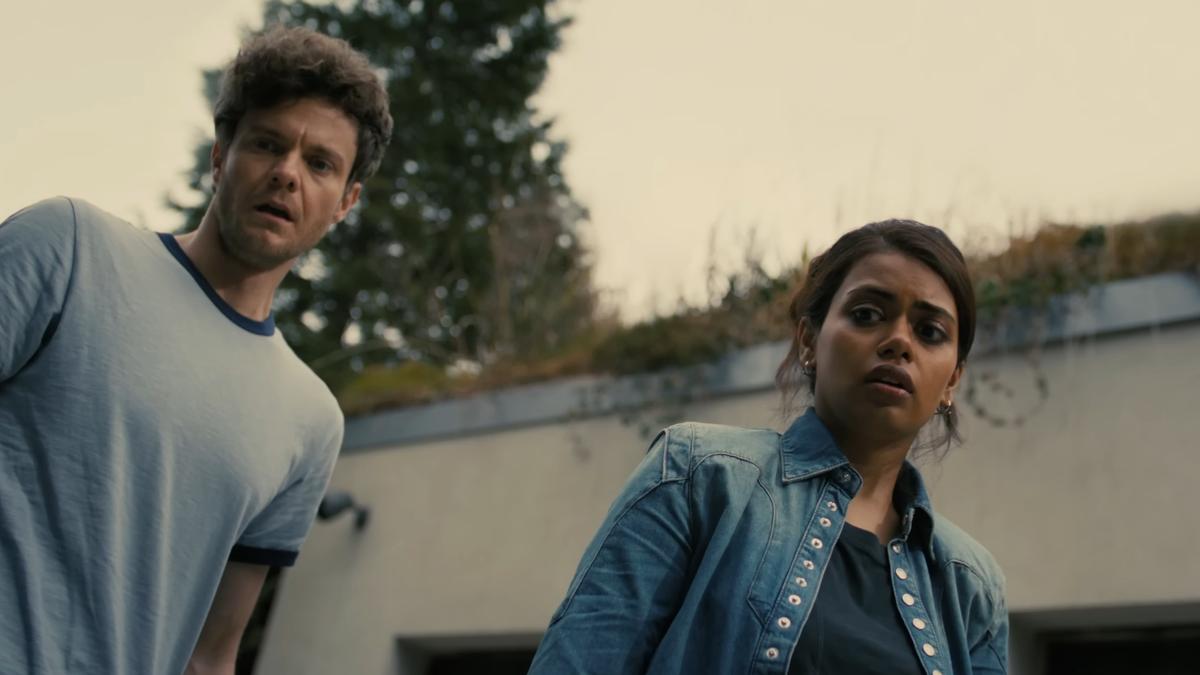
Josh (Jack Quaid) and his ‘girlfriend’ Iris (Thatcher) are off to an idyllic country spot in the woods for a gathering with friends. The lavish rural cabin – a palace – is owned by a suspicious and pervy Russian, Sergey (Rupert Friend). After a jovial first night of food, drinking and dancing, Sergey corners Iris by the shore of the lake. She returns to the group alone, covered in his blood. If one of her mandates is to Do No Harm to humans, something’s gone a bit awry. And – importantly – she doesn’t know what she is…
The character set are fun if broad and, as the narrative stretches out, it becomes clear that the humans in the group are more flawed than Iris ever could be. Josh’s pettiness and obvious misogyny really start to flourish once the cat’s out of the bag. Hancock’s script and a very-game Quaid lean into this, allowing us to enjoy every discomfort and failure that comes his way as a secret plan unravels. Iris’ opening monologue has already blown another seismic plot detail – Josh is going to die by the end. His protracted downfall makes for some decidedly pleasurable schadenfreude.
Thatcher, meanwhile, is a joy. The Yellowjackets breakout has had a decent little run of genre roles in the past two years, from PG horror The Boogeyman through to the widely acclaimed Heretic, where she was a little overshadowed by Hugh Grant. Companion could finally be her breakout. Having to mostly play deadpan, she makes good use of opportunities once Iris’ leash gets a little more slack in it, and Hancock’s script is never as witty as when Iris is allowed to flex the boundaries of her own limits.
This also leads it into some dangerous, possibly over-confident territory. One setting that Iris gets to access is her own intelligence (and it’s very telling of Josh that he has her set to 40%). Raising her own game out of a newly discovered sense of self also ups the stakes for Hancock. Iris and Companion needs, at this point, to get 60% smarter… watching the increasingly hurried and concertinaed third act, one doesn’t see the follow-through. Companion throws in a lot of compacted twists and turns for it’s characters, and some of these aren’t given room to breathe. Lukas Gage’s wonderful turn as beaming himbo Patrick goes through a series of evolutions, the last of which stretches credulity. Amping up at this point is the only direction available to Hancock, but the character feels like a casualty of this compulsion.
With such a gleefully misanthropic view of humanity, Companion also winds up putting its sympathies squarely with its robot characters. That might’ve worked fine in the past, but we’re quickly entering an era of marked AI scepticism, particularly in the arts. The mandate presented here suddenly feels a little counterintuitive to a pervasive mood in society that maybe, just maybe, imitation isn’t better than the real thing, landing Companion at-odds with the zeitgeist, as opposed to in communication with it.
Iris is supposed to be carried by a sense of feminist empowerment. That her awakening and subsequent fight back against her oppressors is a ‘Good for her’ moment. In the audience it’s easy to be right there with her, but her very nature as an automaton tempers the authenticity. The victories are less meaningful. Another sensitive issue here is the depiction of cruel domestic violence. Robot or not, Iris looks human, and so depictions of her mistreatment by an increasingly sadistic Josh register as what they look like. The harsh reality of these scenes has been quashed by the conceit that she’s a ‘fuckbot’ and not a person, but their violence retains a marked uncomfortable quality. So Companion has a habit of giving off mixed signals.
Analysing Companion ultimately hurts it. On the surface this is terrific fun, spritely in pace, humorous where it needs to be, and all presented with an encouraging confidence and aptitude from a first-time feature filmmaker and a talented cast. Lots to praise. There are also quite a few knowing winks to the Terminator films, showing that Hancock has an awareness of the oft-swam waters he is dipping in. It’s only when you start examining what’s under the surface, what’s on the inside, that things start feeling a little less than perfect. Derivative and less-than-timely it may be, Companion is a hoot. If only we could switch our brains off…

 The Lost Highway Hotel
2 thoughts on “Review: Companion”