
Year: 1995
Director: Rusty Cundieff
Stars: Clarence Williams III, Lamont Bentley, Anthony Griffith
Either by ignorance or simple forgetting, it seems partway assumed that Black horror only really came into being as recently as 2017 when Jordan Peele made the leap to directing with his zeitgeist-nabbing Get Out, and that the instances we’ve seen since have been as a direct result of Peele’s breakthrough. In the short term that’s true. I love Peele’s work and his influence has already been profound, but narrowing the view forgets a storied history of Black cinema that echoes back throughout the form.
Rusty Cundieff wasn’t the first African American to dabble in the genre either but, as Halloween draws near, his 1995 anthology Tales from the Hood is an apt example of fiery, funny and influential Black-directed work in the horror genre predating Peele, and further proof – if any were needed – that genre cinema is one of the most creative playgrounds for those looking to get political.
Los Angeles of the early-to-mid ’90s appeared a fraught place to be a Black American. The news, movies and docu-soap cop shows exported from the states depicted a class and race schism in the city typified by gang violence (Black voices were sharing these stories fiercely on our cinema screens, but it also seemed as though these lurid tales were the only ones getting the green light…). Rodney King’s police beating caught on camera in March 1991 was yet more searing film, igniting outrage, protest and unrest. And then there was a Black American icon, O.J. Simpson, televised in a bizarrely surreal low-speed pursuit by the LAPD after he refused to turn himself in on a murder charge in June of 1994.
These are but a handful of the scattered images and events congealing in the public consciousness around that time. An overstimulating conglomerate of agitating information that could feel like being bombarded. I think of David Bowie’s alien sat in front of a bank of televisions in The Man Who Fell to Earth, overcome by the chaos and the static. That’s how the mid-’90s felt. Rusty Cundieff’s Tales from the Hood – a riff on the horror anthology Tales from the Crypt – seems now like an effort to reckon with this flood of information. To process and repurpose it. And to do so wittily. To be entertaining while doing.
Already in that title there’s a wit and a tension. Equating a ‘hood’ with a ‘crypt’ grins ruefully at the reputation of LA’s impoverished, crime-ridden neighbourhoods. But that’s not all. Tales from the Crypt in its original incarnation was a prim and mannered – but still darkly funny – white British property. The act of rebranding here suggests the need to lift from or invert something extant in a colonialist’s repertoire. That Cundieff is staging some kind of (grave) robbery in the act of repurposing. The taking of space. The suggestion being that there’s a finite amount of it, and Black creatives need to aggress in order to hold court. The film’s titles tee this up beautifully, revealing a skeleton adorned with shades, a gold tooth and a large spliff brandishing a gun. This is a stick-up.
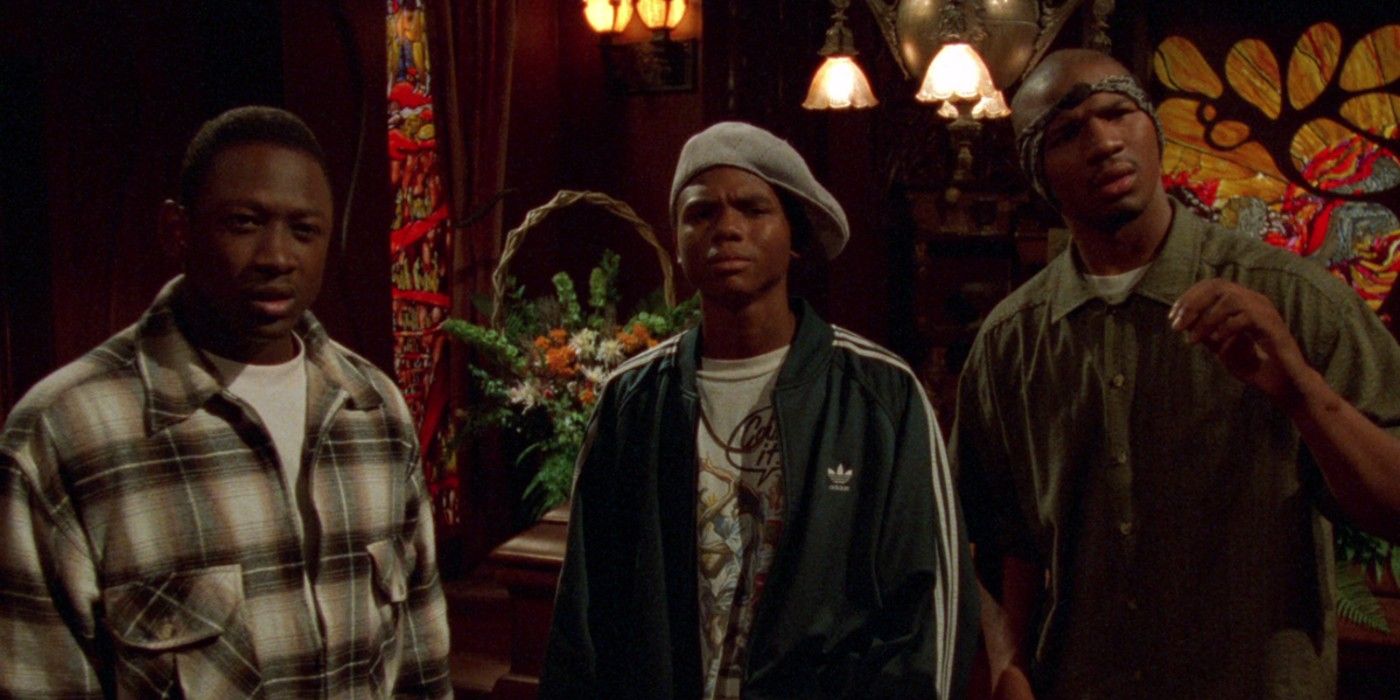
Like all fine horror anthologies, it presents its disparate stories and ideas via a wraparound framework. Stack (Joe Torry), Ball (De’Aundre Bonds) and Bulldog (Samuel Monroe, Jr.) are three stereotypical drug dealing hoodlums. Arriving at the Simms Funeral Home to procure some product, they encounter Mr. Simms (the great Clarence Williams, III), who will take on the persona of our eccentric ‘crypt keeper’ for the evening, telling the tales of the recently departed he has embalmed.
First up, Officer Clarence Smith (Anthony Griffith) of the LAPD who, in “Rogue Cop Revelation” suffers the tension of being a Black man within a racist institution. Partnered with bigoted Officer Newton Hauser (a dependably slimy Michael Massee), Clarence embodies the battling feelings of pride and shame that come from working a job – in a position of authority – stained by its vile reputation. The appearance of being a traitor, while also trying to hold up the values of an ideal long-since tarnished. Clarence is dismissed as a ‘rookie’ while his white colleagues beat and harass a middle-class Black politician (Tom Wright) pulled over without good reason. Cundieff ensures his intent is heard loud and clear, soundtracking the beating – hard to watch – with Billie Holiday’s rendition of ‘Strange Fruit’.
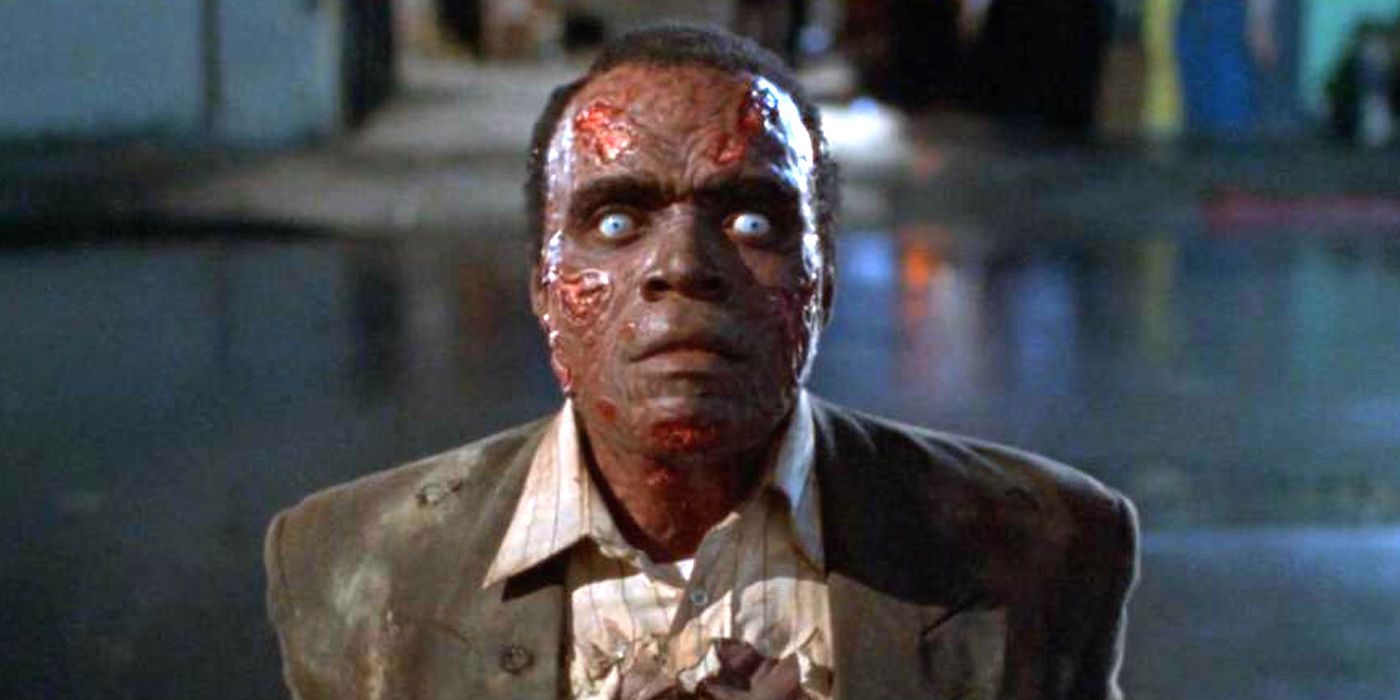
Wright’s politician Martin Ezeliel Moorehouse is murdered by the cops, staged as a drugged-out accident. Clarence is then swayed in his sleep to avenge Moorehouse by the man’s spirit, manifesting as a crucified figure (a delicious swipe at the warped idolatry of the American religious right). Drunk and traumatised, Clarence lures the officers out to the graveyard. With great economy Cundieff and co-writer/producer Darin Scott offer-up an understandable ‘Black Serpico‘ narrative with a supernatural twist. We understand the reference points, both from pop culture and the news. The spooky trappings are overrun by the abhorrent corruption and disrespect evidenced by the racist cops. Moorehouse’s zombified resurrection – which begins with him grabbing one of the policemen by the dick, neutering and emasculating him – is then explosive, righteous and inventive. An act of macabre wish-fulfilment for justice in an unjust world. Clarence’s own culpability – his year’s silence – proves ultimately unforgivable, too.
“Boys Do Get Bruised” turns attention to domestic violence, and the cultural depiction of Black fathers as either absent or abusive. Walter Johnson (Brandon Hammond) is a young and sensitive kid living in a middle-class home. Bullied at school and rescued by his teacher Mr Garvey (Cundieff himself), Walter’s home situation is discovered. Walter fears a ‘monster’ that tries to break into his bedroom at night. What’s more, Walter possesses – through his creative expressions; cartoon drawings – the ability to crumple those he caricatures.
Through this Cundieff and Scott proffer art as a method of literally dealing with our childhood traumas (albeit in a fantastical and violently supernatural manner), giving Walter the power to take hold of and crush those things that have tormented him. The segment is an encouragement to the young to weaponise creativity against the threats of the world. Tales from the Hood is a finished example of such ambition, and “Boys Do Get Bruised” is an invitation to the next generation to take up the gauntlet. It also ends with a wonderfully executed practical effects punch-line as Walter’s monster – his stepfather Carl (David Alan Grier) – is concertinaed before our eyes.
The third story is the voodoo inflected “KKK Comeuppance” which nods to another great anthology of the ’70s: Dan Curtis’ inventive Trilogy of Terror, and particularly it’s show-stopping final adventure in which Karen Black is assaulted by a savage living doll. Here we return to the theme of Black individuals working within inherently racist institutions, this time the political system. Rhodi Willis (Roger Gueneveur Smith) is a PR aid to racist Southern Senator Duke Metger (Corbin Bernsen), a former-KKK member who has set-up his campaign headquarters in a plantation house rife with urban folklore surrounding possessed dolls. In a canny act of role reversal, Willis acts as Metger as they prepare him for a television interview, putting words in his mouth and inhabiting the role of a hypocrite spinning his backstory. Willis dies in the effort.
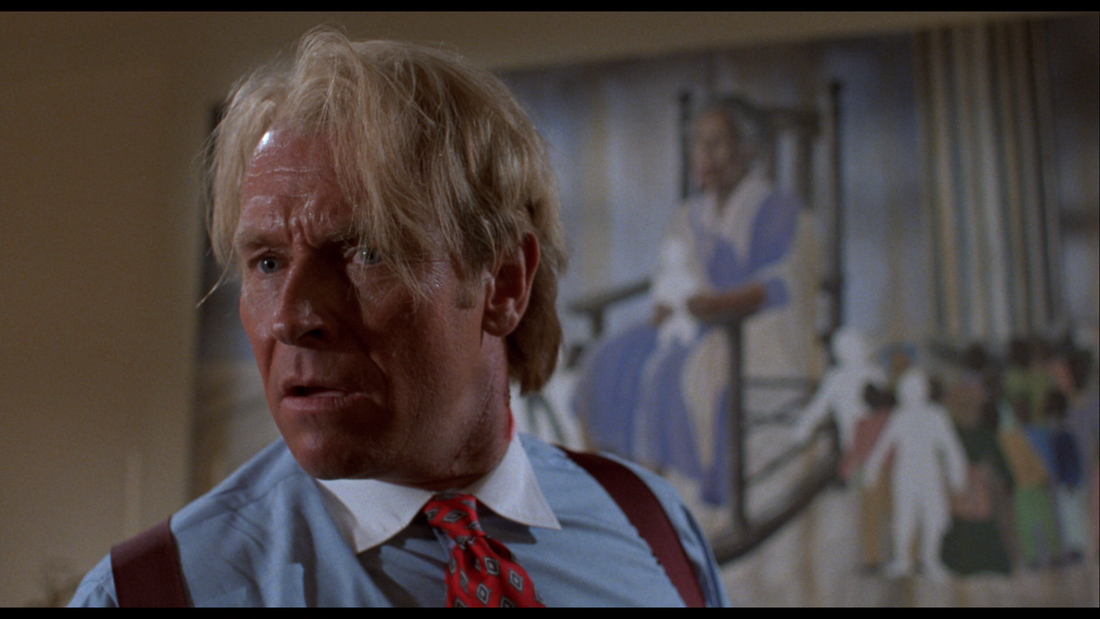
The story closes out with Metger beset by a relentless killer doll. The animation work – both the design and the stop-motion manifestation – is a hoot to behold, but in the current climate the segment resonates further because of Metger’s physical similarity to Donald Trump, and the wishy-washy soundbites he spouts about American values. The segment depicts a white politician stubbornly refusing to enter into a discussion surrounding reparations for slavery… and getting his ass handed to him for his blowhard cowardice.
Finally – and most potently – there is “Hard-Core Convert”. Here Lamont Bentley stars as a notorious gangbanging assassin Jerome ‘Crazy K’ Johns gunned down but not killed in a bloody shootout. Imprisoned, the unrepentant Johns is invited to take part in a conditioning program in order to secure early release.
While the segment’s action-orientated opening feels in conversation with the hoodsploitation pictures of the late ’80s/early ’90s, it quickly descends into Tales from the Hood‘s most intense and hellish depiction of the damned. The prison system hides an inhumane, Satanic underground of cruelty. In cavernous torture chambers, Johns is experimented on by Black doctors. Rosalind Cash is robotically callous as Dr. Cushing (a nod to Hammer’s elder statesman?) and the energy of the segment becomes mercilessly propulsive. An all-out attack. A Clockwork Orange-esque conditioning sequence is just like that feeling of being beset by violent imagery I mentioned earlier. A reflection of this sense of deluge. Gang violence and lynchings flood the screen. A barrage of pain and terror.
Cundieff refuses to let-up. Strapped to a chair that brings to mind capital punishment, Johns descends into a strobe-lit box in which his past demons interrogate him. Cundieff interrogates blame and responsibility for his country’s epidemic of Black-on-Black violence. It is a dark and uncomfortable pit – a literal pit – and a powerful evocation of the sense of desperation felt in the face of a seemingly overwhelming uphill climb. The movie’s wraparound reveals itself to be an extension of Johns’ story, and Cundieff even wryly apologises for going ‘too far’ in his anthology’s darkest segment. It’s a soft apology, though. Every frame and cut was intentional. His messages deliberately loud and articulate.
Tales from the Hood is one of those rare anthologies in which every segment is as strong as its neighbours. “Hard-Core Convert” is the piercing pinnacle of its barely-contained fury, but all episodes preceding it are stuffed with sharp visual ideas and savvy methods of communicating them. It’s an ideas factory, inspired by a prevalent culture of disparity and intolerance, one kicking these ideas back at the camera. If the final reveal is inevitable from the start, the journey to it is one of the ’90s most overstuffed feasts of determined social commentary. In a decade oft written-off for its genre efforts, Tales from the Hood is a vital, inspired and incendiary effort, too long overlooked.
If you’re impatient waiting for Peele’s next serve may I suggest looking to the past this Halloween to expand your frame of references. Cundieff’s anthology is just the beginning, but it’s also hard to beat.
 The Lost Highway Hotel
1 thought on “Why I Love… #175: Tales from the Hood”