

Director: Yorgos Lanthimos
Stars: Willem Dafoe, Emma Stone, Mark Ruffalo
The cinema of Yorgos Lanthimos – the best known filmmaker to emerge from the Greek Weird Wave – has its tics and foibles and its preoccupations. Dysfunctional family units are often front and centre, from the locked down strangeness of breakout cult title Dogtooth, through the Sophie’s Choice conundrums of The Killing of a Sacred Deer. Even weirdo fave The Lobster felt like an exorcism of conformist pressures in which the idea of family and togetherness had been obsessively warped out of all reason.
His latest – and largest – production is drawn from the novel of the same name by Alasdair Gray (via the pen of prior screenwriting collaborator Tony McNamara). Beginning in a fantastical reconfiguration of Victorian London, Poor Things takes the notion of found family literally, as Godwin Baxter (Willem Dafoe) – a talented, sentimental post-modern Prometheus – marvels over his latest creation; a re-animated corpse he names Bella (Emma Stone). Plucking ambitious would-be surgeon Max McCandles (Ramy Youssef) from his autopsy classes, Godwin sculpts both an apprentice and a prospective son-in-law. Max dutifully becomes ensorcelled by the curious, uncoordinated subject he has been employed to study. So do we.
(Literally) baby-brained, Bella has the propensity to embody the uncomfortable Hollywood trope Born Sexy Yesterday; a child-like yet fully developed female character who becomes the object of desire for the hero and – by extension – the (male) audience. An unchallenging and yielding foil for a traditional hero. Yet Poor Things thwarts the ideals of the trope through the irrepressible zeal for agency that it gifts Bella.
To begin with – imprisoned out of love and fear by ‘God’ – her world is monochrome. It is only when amorous cad Duncan Wedderburn (Mark Ruffalo) worms his way into the homestead – and Bella out of it – that Lanthimos flips the picture to living colour. A leap that openly recalls Dorothy’s discovery of Oz. She is a learning machine. A voracious AI, even. Or, as we’ll discover, more human than human…
Liberation – and colour – coincides with Bella’s enthusiastic discovery of her own sex. Poor Things is a ravishingly horny work. Kubrick has proven an influence for Lanthimos before, and the cool maestro’s adolescent verve for hanky-panky proves to be his greatest influence on this picture. Coupled with resplendent and elaborate costuming and vaguely steampunk production design, this frothing fantasy piece bests the giddiest, randiest dreams of Terry Gilliam or Tim Burton; two populists to whom it owes an evident debt.
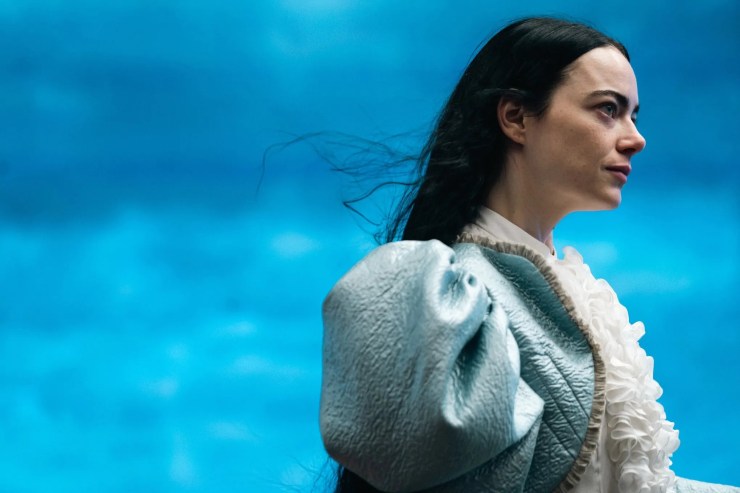
Absconding to Europe – with colour-coded chapters in Lisbon, Alexandria and Paris – Bella goes on an odyssey that connects itself intrinsically with her sexual agency. Through this journey we’re granted a mirthful riot of experience. Gorging herself on it, Bella grows into one of the most puckish, outspoken champions in modern cinema. It helps no end that her Don Juan is a ridiculous buffoon (further dismantling the aforementioned tropes); a role into which Ruffalo throws himself with incredibly pleasing gusto.
Lanthimos’ cinema has consistently positioned itself as sympathetic or understanding of the autistic spectrum, often generating worlds in which neurodivergence is the status quo. In Bella he has a literally rewired heroine, and through her gaze we are invited to perceive the world as ridiculous; tied in knots through custom and propriety; a hell of our own making. Yet it is important to remember that this is a fantasy re-imagining of the world and not a rigorous recreation, even when it comes to unpicking the thorny urge to politicise Bella herself.
Is the movie feminist? In a broad sense, yes, thanks to Bella’s dazzling commitment to thwarting efforts to control her. But her very nature means that she cannot be used as an avatar for all women. She is hyper-specific, and her origins and age constantly haunt our perception of her. How old is Bella? There’s a further deep dive to be made into notions of gender in the picture. Poor Things will strike a chord for many as an empowering trans metaphor.
It is at its best when it delights in thumbing its nose to conservative or constrictive modes of thought. Bella’s use of the English language is at first comically broken, creating amusing and inspired new idioms of speech as she tries to articulate her thoughts (“furious jumping” will stay with you a while). But there’s a measured and determined evolution that presents itself apace with her other thirsts. Thirsts for knowledge and understanding. If Godwin teaches her the sciences and Wedderburn carnality and hedonism, philosophy is her own personal journey. An encounter with wealthy nihilist Harry Astley (Jerrod Carmichael) aboard a cruise ship makes Bella aware – possibly for the first time – of the genuine horrors and cruelty of humanity, but she does not choose to adopt his worldview. Indeed, it puts a fire beneath her own idealism and indignance that the world could simply be left as-is. Improvement is her tireless quest.

In terms of presentation, Lanthimos and cinematographer Robbie Ryan continue a through line from The Favourite. The use of fish-eye lenses is prominent, though arguably more fitting here, complimenting Bella’s own intensified perception of the world. Yet they’re often used to take in tableaux of all players. Still, their intensity risks violating viewer immersion. One senses a little bit of ego in such efforts; Lanthimos imprinting visual identifiers on his work. The stamp of authorship. I didn’t mind them, personally, but it’s liable to be a point of contention for some. There are plenty of signifiers that run deeper than this, from the aforementioned dialogue style to the themes that resonate with Lanthimos’ prior works.
With its broad sex-comedy, filthy language and superior moments of slapstick comedy, Poor Things is played for populist appeal, even as it guides cautious viewers out of assumed or expected safety zones. This one feels exceedingly well measured in this way. Lanthimos and McNamara take us by the hand and lure us away from the staid, uptight norms of the cinema space, while keeping us sated with gorgeous flourishes and wall-to-wall eye candy. The movie is incredibly polished – maybe even to a fault – yet idiosyncratic enough to feel authored.
As has been noted repeatedly elsewhere (with good reason), Stone is excellent. A career-best bit of work that is notable for its whip-smart comic timing and controlled physicality. Curious to have yet another standout female lead performance this year that evokes the feel of a living doll. Poor Things – like Barbie – breaks out of the packaging, feels risky yet palatable enough for the mainstream, uses fantasy elements to talk to us about how women feel in the world. Creative and adult in its mixing of elements (that also brings to mind Leos Carax’s operatic Sparks collaboration Annette) Poor Things – like it’s protagonist – reminds us that there’s nothing wrong with dreaming a little bigger, or painting on an exceptionally large canvas. And that the cinema of the fantastique ought not be limited to the sanitised strictures of family friendly IPs.
Here, always, having the choice is the thing. An instant classic.
 The Lost Highway Hotel
3 thoughts on “Review: Poor Things”