

Director: Martin Scorsese
Stars: Lily Gladstone, Leonardo DiCaprio, Robert De Niro
Few filmmakers have proven themselves so preoccupied with America’s proclivity for evil, and fewer have managed a career as ostentatious as Martin Scorsese. Given his 50 year enquiry into how these dark desires manifest, it seems surprising that it has taken him this long to directly broach the subject of the indigenous genocide by whites. It seems now, in hindsight, such an inevitable place for him to end up. And, this late into his journey, the result is all the more impressive for its sinuous ability to shrug off simplistic pigeonholing. Killers of the Flower Moon isn’t a western. It’s almost a gangster picture but also it’s not quite that. It’s nearly a courtroom drama, except the vast scale of the piece outside of the bonds of law would make a mockery of such a moniker. Perhaps it is most keenly the dramatisation of tragedy. One epic tragedy that can be used as a lens to reflect on an entire genocide and the pathology behind it.
Ernest Buckhart (Leonardo DiCaprio) is a simple man returning from the Great War in need of guidance. Unfortunately, he chooses Oklahoma and Osage County, paying a visit to his rich uncle William ‘King’ Hale (Robert De Niro) amidst a vast oil boom that has made the reservation land uncommonly wealthy. Here the roles one is so used to seeing across America are reversed and it is the white man who is subservient. Ernest – wounded abroad and so unfit for heavy work – takes up a position as a taxi driver (what else), ferrying the rich Osage people about town. But not before his uncle – beloved in the community – insidiously infers a plan to siphon the local riches in their direction. “I do like that money, sir”, Ernest admits.
It’s up to you to decide whether there’s a genuine, guileless attraction in the ensuing meet-cute between Ernest and Mollie (Lily Gladstone), or whether the former is just following unkie’s orders. Still, regardless of the initial intent, Ernest and Mollie do romance, do fall in love, do marry and make a family. But, all the while, immediate family members of hers do keep dying. Some made to look like accidents, misadventure or succumbing to illness. Others are more sloppily dispatched thanks to the general incompetence of hick hires.
Regardless, the bodies – and the pain – pile up, while Ernest goes about his business as a middle man, steered by his uncle away from remorse or a sense of basic human empathy. In these ruthless passages Scorsese is afire with indignation for such men; illuminating an epidemic of sociopathy that seems to exist in white men who fundamentally cannot perceive other races as human. A staggering blindness that engenders atrocities.
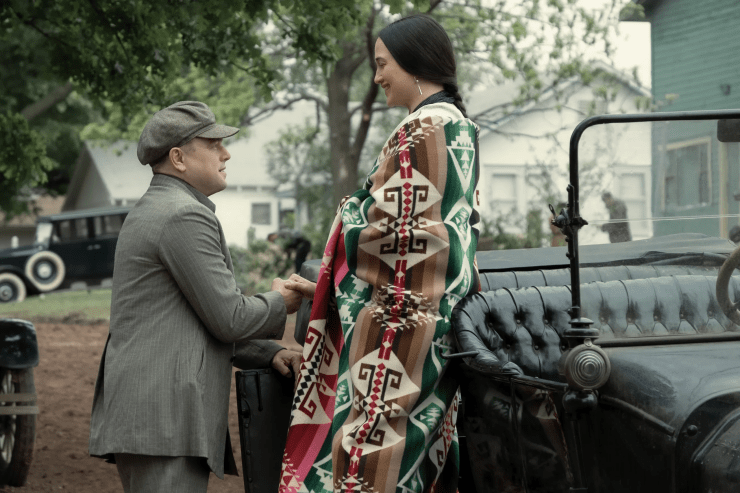
DiCaprio plays dumb evil awfully well, offering possibly his showiest – and best – performance since, hey, The Wolf of Wall Street. But where Jordan Belfort was all conniving charm, Ernest is devoid of any such magnetism or ingenuity. He is deliberately rendered as a borderline illiterate foot soldier. His eleventh hour change of heart as King’s plan narrows its sights to Mollie can’t be called a miraculous or even redemptive transformation into antihero. There’s too much red on the ledger and so much of it deplorable. As with The Irishman, this is Scorsese channelling evil with the mask slipped. The depiction and representation are both wholly uncompassionate. De Niro, meanwhile, is the institution. Waifish and cowardly, held together by greed and unblinking self-righteousness. As insidious are the countless other conspirators in municipal positions of influence who muddy the waters of what passes for truth in Osage.
Toward the end of the picture the two male leads share an overdue confrontation that Scorsese stages far from the more naturalistic settings that typify the majority of the movie. The inference is of them both in hell, King darkly prognosticating the indifference of society when evil reaches a particular scale. Ernest tries to leave him there but, ultimately, there’s no light left for him either.
Such a catalogue of white male travesties might prove too much were it not tempered by the multifaceted and typically restrained turn from the movie’s clear highlight; Lily Gladstone. Those of us who have been craving her coming out party since Kelly Reichardt’s sublime Certain Women will find a feast of heart-stopping humane moments offered here, all of them rendered at a lower register than her male counterparts. Her power is greater than any of them, evidenced by her ability to wield it with such economy. Gladstone allows Mollie to convey so much with a look or a glance or how she carries her shoulders. Such motions speak paragraphs. One of the biggest tragedies of Killers of the Flower Moon – beyond the murders themselves – is Mollie’s blindness to her husband’s transgressions. The extent of it another of the movie’s quiet conundrums.
If the film’s much-noted running time gives you trepidation or pause, leave such apprehensions at the door. With the aid of his loyal editing stalwart Thelma Schoonmaker, Scorsese propels this thing forward to the tempo of the itching, thrumming bassline on the soundtrack provided by Robbie Robertson. His score plays in the rhythms of the indigenous people, layering this with grassroots twangs of moonshine and prohibition-era country. At it’s boldest, the score and source music brings to mind the tremulous plucks of Ry Cooder’s music for Paris, Texas. It’s that good. A master at the top of his game, Scorsese corrals Flower Moon, makes the sprawl insignificant. It is almost impossible to look away for fear of missing anything.
How does one wrestle and wrangle such misdeeds to the ground and tie them off? If Scorsese and Eric Roth’s script doesn’t quite find an answer, Scorsese at least finds a maverick way of dispensing with the usual tired trope of on-screen text to deal with the inevitable narrative footnotes. His post-script is rendered as a breathless radio play, itself representative of how we feel the need to compartmentalise acts of horror with distracting and distancing theatrics. Casting himself in this presentation throws a shrewd amount of shade backward in the process. The flashiest mea culpa of his career.
 The Lost Highway Hotel
6 thoughts on “Review: Killers of the Flower Moon”