
By the late 1980s Hollywood’s doctrine on successes was set. Got a hit? Make more of it. Irrespective of whether a story warranted extending into a franchise, give the people what they want. More. Sometimes quite how to do this created more problems than it solved. Paul Verhoeven’s 1987 hit RoboCop was a case in point. The Dutch provocateur’s US debut fantastically skewered the nation’s dual appetites for materialism and destruction, while giving Verhoeven himself a heady Jesus allegory to play with. What now? What next? RoboCop 2, inevitably.
This isn’t some revisionist piece offering contrarian provocation that RoboCop 2 is some diamond in the rough. It isn’t. It pales in comparison to Verhoeven’s tight, driven satire. It’s narratively and thematically confused, tilting at windmills, keen to wantonly appeal to lowest common denominators, and not with the irony of Michael Miner and Edward Neumeier’s original screenplay. It even makes one of the main villains a pre-teen; a blatant ploy to snare a juvenile audience for whom acerbic reflections of Reaganomics were never going to be a primary draw. But stare into it’s gaping void of meaning and purpose and you’ll find a surprising metatextual struggle coded into it. RoboCop 2 isn’t about American gun violence, supressed individuality, fascist corporations or over-aggressive policing.
It’s about what a problem it is to have to make RoboCop 2 in the first place.
Peter Weller’s OCP cyborg RoboCop – formally Officer Alex Murphy – is still on the beat after the exploits of the first movie, patrolling the streets of Detroit with partner Officer Anne Lewis (Nancy Allen, along for the ride with nothing to do). But crime is up once again, thanks to the proliferation of a new designer drug called Nuke, designed by user and pusher Cain (Tom Noonan). In the opening act, the film suggests it’ll continue a line of enquiry opened up in its predecessor regarding RoboCop’s humanity (or lack thereof), as he stalks Murphy’s former wife Ellen (Angie Bolling). This humanistic angle is unceremoniously dropped, however, in favour of the ambitious corporate maneuvers of Dr. Juliette Faxx (Belinda Bauer), a psychologist trying to strong-arm her way into the favours of OCP CEO ‘The Old Man’ (Dan O’Herlihy) by launching her own lumpen and problematic ‘RoboCop 2’ program.
But getting RoboCop 2 to work is a persistent stumbling block. Putting a well-adjusted, moral brain into the cyborg system leads only to violent trauma and suicide. It’s a machine that kills itself. It isn’t supposed to be. Faxx theorises that she therefore needs a psychotic brain to steer the machine. In the second half of the picture Cain ultimately provides the most desirable specimen, but the bastardised hybrid that results from these experiments comes to bluntly represent all the problems inherent in a sequel around the year of our lord 1990. It has to be bigger. It has to be louder. More violent and unruly. Less predictable. It has to be virtually unstoppable. But it’s also janky, prone to being dumber, uglier, more difficult to control or contend with. Running amuck when it’s launched to a dismally small audience inside a stadium (a glum prognostication of diminishing box office?), RoboCop 2 becomes the main problem of RoboCop 2, one that can only be solved via a forced lobotomy – something viewers might feel as though they’ve also suffered by the time they’re through watching.
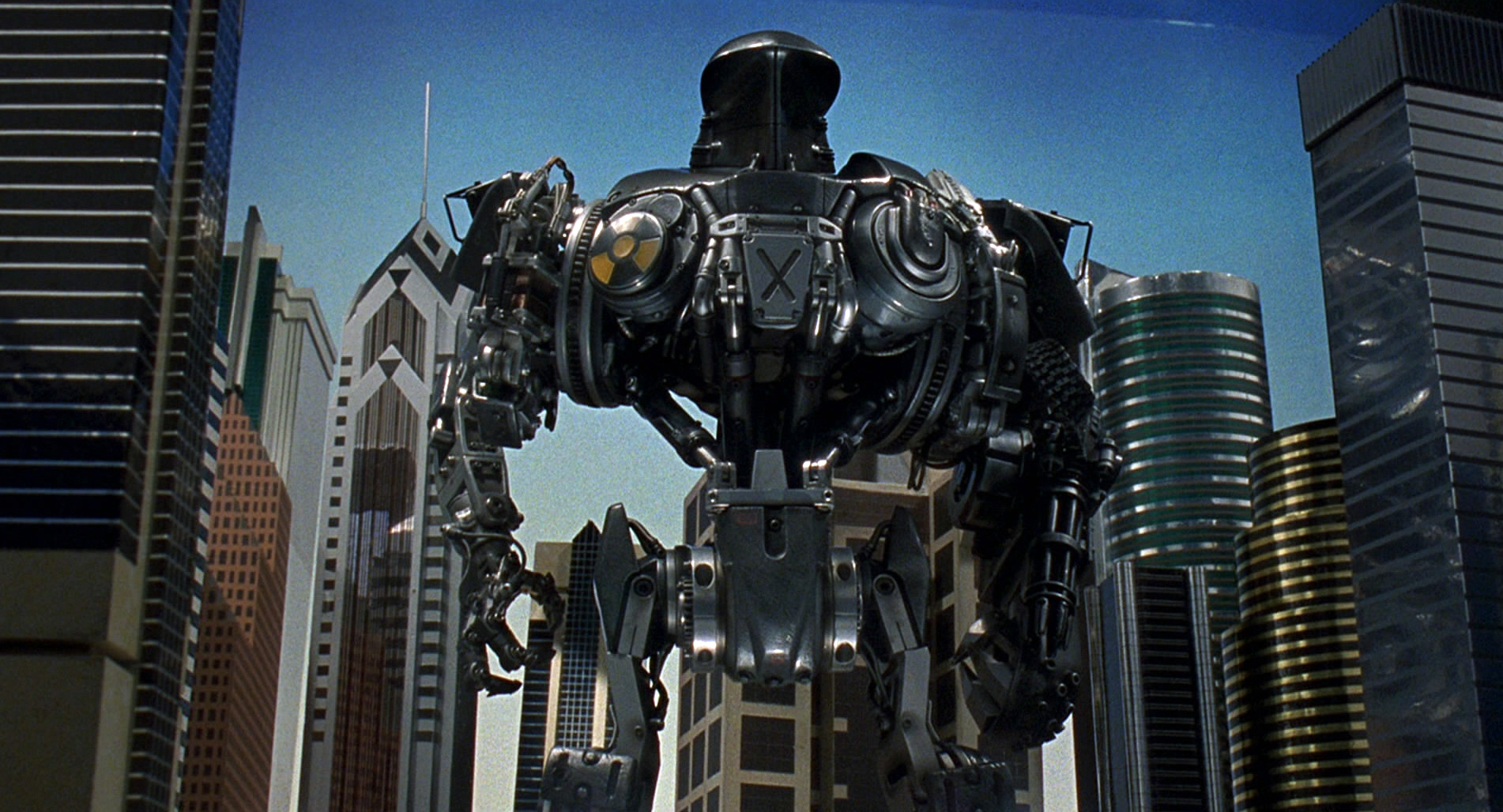
RoboCop 2 looks unpleasant. It has no face. Even Murphy has a face, which we’re invited to gawp at through various means in the movie’s opening chapters, but which is removed from view from the second act on, as Irvin Kershner’s workmanlike sequel begins its process of rapid depersonalisation. Instead RoboCop 2 has a monitor on which a deeply crude polygon face can appear (at great length), but this isn’t the same thing; it’s a half-hearted projection that serves very little use in the overriding function of the killbot. Like ED-209 before it, this machine doesn’t exist to court human interaction, only to quell us into submission. It’s limbs are weapons. Distilled, brutalist function. It’s a vehicle for investment, coldly representative of the shrewd shill that is an obligatory franchise extension. A corporation’s next step in perpetuating itself.
It also can’t match the original. RoboCop and RoboCop 2 battle it out from the basement of a skyscraper to the roof and back down again before an ungodly raucous shootout continues into the streets. Even after Lewis ineffectually rams RoboCop 2 into a wall with a tank it won’t back down but, ultimately, it is defeated by the OG. Now, this was always the inevitable outcome in such a broadly comic movie (comic in the literal sense), but there’s a defeatist feeling here, from the writing by Frank Miller (yes, that Frank Miller) and Walon Green to the direction from Kershner that suggests RoboCop 2’s loss is a self-fulfilling prophecy. Regardless of the need for Weller’s Murphy to come out on top as the film’s lumbering, emotionless hero, RoboCop 2 and RoboCop 2 were set up to fail. Both of them are the cost of doing business in corporate America. The quality of the output is immaterial so long as the shareholders are placated at the end (something The Old Man is keen to do by throwing Faxx to the wolves).
So I’m moved to ponder is RoboCop 2 secretly smarter than it lets on? Does it present a parody of a sequel only to culminate in a brash treaty on why such endeavours are so often doomed to failure? So much of the general messiness about the movie suggests that this is wishful thinking. But maybe it’s very good at playing dumb? Regardless of whether it is intentional or not, the overwhelming metatextual crisis that comes to the fore in the film’s third act becomes its only saving grace. Having worn through a lot of goodwill with some poorly played comedic beats, inferior retreads of past glories and the flat-out refusal of anything approaching character development, the film’s eleventh hour self-awareness feels uncanny. As though it finally saw it’s own ungainly reflection and became frozen in abject contemplation.
RoboCop 2 knows that it is trash, and seems to howl painfully about it, those early suicidal iterations ultimately feeling most representative of the movie as a whole. A monster that didn’t need to be.
 The Lost Highway Hotel