

Director: Mascha Schilinski
Stars: Lena Urzendowsky, Hanna Heckt, Laeni Geiseler
We try to fix the past in place. To contain and define it with dates and records. But like a river, time flows. It’s never the same river. In Mascha Schilinski’s ambitious sophomore feature we come to know four generations of women living in the same rural farm property close to the Intra-German border; east and west separated by, yes, a river. These tales of women are presented a-chronologically, mixed into one another making a mockery of the linear. In two of these stories photos depict women in the act of movement, blurred so as to look like phantoms. Much as the worlds they live in try, these women can’t be contained, and Sound of Falling deals with the myriad murky depths that come from attempts to do just that. These are tales of lost innocence, of depression and death wishes.
In the 1910s, seven-year-old Alma (Hanna Heckt) is confronted with death on All Souls’ Day, before her parents deliberately cause her older brother Fritz (Filip Schnack) to lose a leg in a ‘work accident’ in the family barn (so as to avoid drafting into the army, one assumes). By the 1940s, Fritz’s care has fallen to teenage sisters Erika (Lea Drinda) and Irm. Erika identifies keenly with her ward, tying her own leg up to mimic his condition. Schilinski evidences her burgeoning sexuality via a fascination with the sweat slipping into his navel.
In the 1980s, a middle-aged Irm (Claudia Seisler-Bading) continues to live and work the farm with her husband Albat (Andrea Anke) and their precocious teenage daughter Angelika (Lena Urzendowsky), who longs for escape to the nearby towns and their modern discos – anything to get away from the incestuous advances of her uncle Uwe (Konstantin Lindhorst) and cousin Rainer (Florian Geißelmann). Finally, a new family takes on the property in the 2020s. Oldest daughter Lenka (Laeni Geiseler) navigates her first infatuation with her new friend Kaya (Ninel Skrzypczyk), while Lenka’s younger sister Nelly (Zoë Baier) flirts with some galling suicidal tendencies for one so young.
It’s a great deal to contend with, and through beguiling imagery, a discerning approach to pacing and an artful edit, Mascha Schilinski allows these stories to braid hypnotically. So much so that her film’s 148 minutes positively blur by. The tales are peppered here and there with narration, scant nuggets that provide the only semblance of exposition and usually find the minds of these characters waxing poetically. They’re aware of us, watching, and voyeurism and the catching of voyeurs weaves into the tales of how all of these girls are perceived (often by men). As if to further incriminate us sitting in the dark, Schilinski has them break the fourth wall on multiple occasions, fixing us a glare so we might admonish ourselves, despite the fact we’re invited.
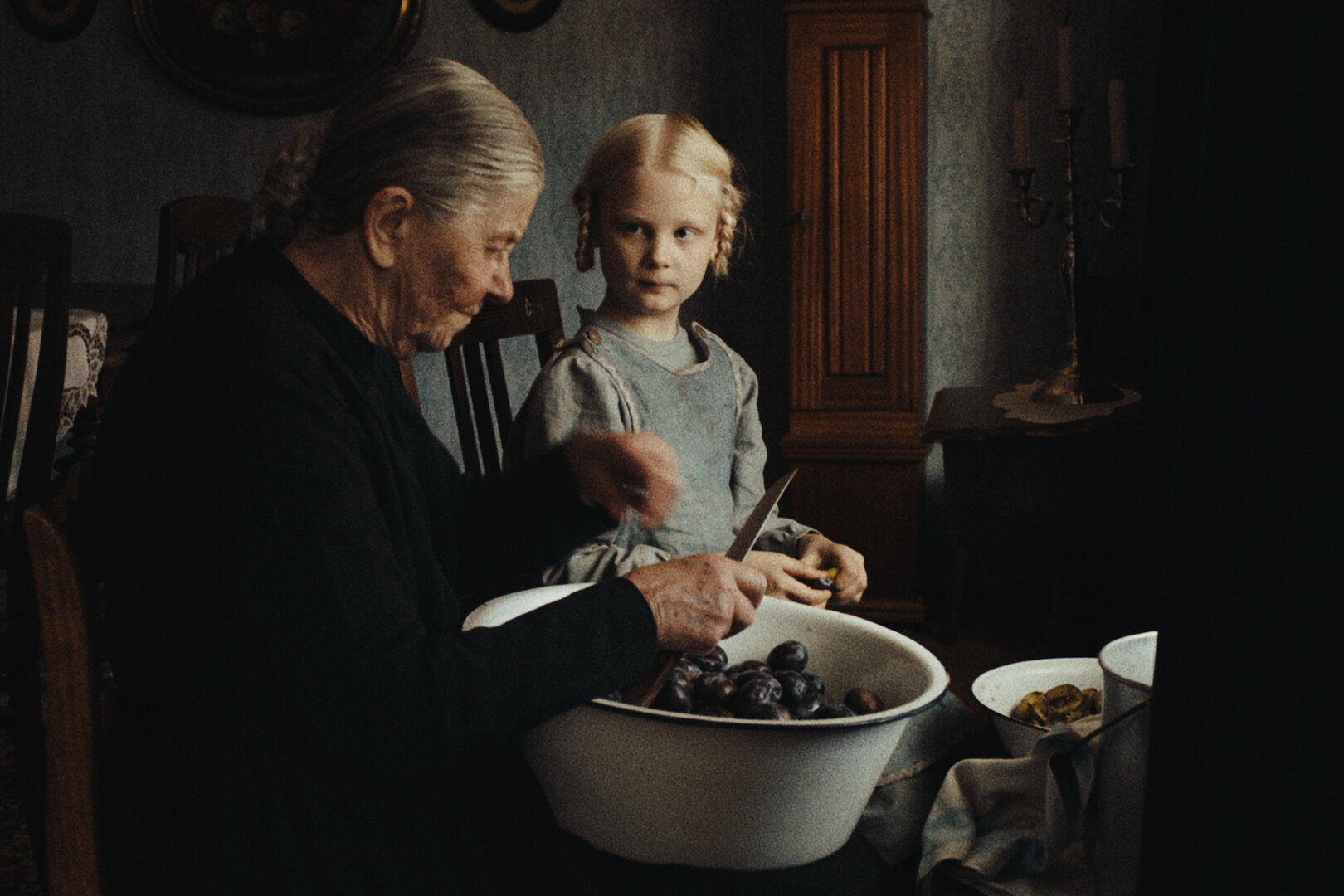
Cinematographer Fabian Gamper is the ace up Schilinski’s sleeve, and his work here lifts Sound of Falling into the stratosphere. We roam dark corridors with natural light sources. At other times, out in nature, the camera has the stalking soft focus quality of a home movie or even a snuff film (I’d assume!). It can feel as though we’re in the POV of a ghost. Such is the haunting, liminal nature of a movie that dares to present us miracles. Pranks are a frequent past time for children across time periods, but Schilinski has her own in-camera marvels. A late scene in which a woman is swept up into the air by strong winds touches the kind of supernatural grace achieved by Malick or Tarkovsky. Sound of Falling feels capable of touching the skies.
This sense of the spectral persists. Each tale seems to exist along a gossamer membrane between life and death, the moment and memory. “Funny how something can hurt that’s no longer there” muses Alma in disembodied voiceover, regarding Fritz and the pain of his phantom limb, but she could just as well be making a universal observation about trauma and recollection. The ghosts we accumulate. Another such paean to a past you cannot hold onto goes “Too bad you never know when you’re at your happiest”. We have no idea from where these four girls are sharing their memories. Sound of Falling sometimes feels like the net result of a seance we’ve walked in on.
Each story seems to rest on the acceptability of a woman’s curiosity. Looking, peeping, prying often results in trouble, or the discovery of something that snatches away at innocence. There are recurrent death fantasies that play out across narratives, from Nelly imaging letting herself drown in the river to Angelika laying down in the path of a voracious combine harvester. A moment of almost-horror that outdoes anything in Scott Derrickson’s Sinister. For another side character death is a protest. An act of terminal rebellion and rejection of subjugation.
Often we’re whisked from one time period to another via the impeccably judged sound design, which whooshes us across decades with, perhaps, that titular rushing noise. Elsewhere it is used to zero in on the focused attention of whichever protagonist we’re with, sometimes even pre-empting a shift or a change, suggestive of intuition. All of this coalesces into a choral cry from Germany’s forgotten or marginalised women. Instead of feeling impenetrable with it’s interior codes, Sound of Falling is inviting. When the girls lock eyes with us, it could be accusatory, or it could be a plea for our intervention. We’re encouraged to make connections and, chiefly, to find our empathy. While austere and sometimes a little testing, it has the feel of a major work.

 The Lost Highway Hotel