

Director: Mona Fastvold
Stars: Amanda Seyfried, Thomasin McKenzie, Lewis Pullman
If the recent output of the fruitful Brady Corbet/Mona Fastvold partnership has been driven by anything, it’s the idea that migration to the United States is as keenly driven by a refugee’s crisis of displacement as it is any fancier notion of changing or overcoming the land, and that those who dare are – as often as not – ill-treated on their arrival. That the USA particularly promises freedoms, riches, all sorts of possibilities, but that there’s something darker inherent in those that have found themselves restlessly settled there already. Greed. Fear. And an intolerance for new interlopers.
This was bitingly true in The Brutalist, and it surfaces again here in The Testament of Ann Lee or The Woman Clothed By The Sun with the Moon Under Her Feet, Fastvold’s improbable biopic of the pioneering Mancunian ‘Shaker’ of the film’s name. Improbable not just for the forthright determination of a woman of her times forging a splinter religion on outspoken convictions, but in the decision from Fastvold and Corbet to tell her story in the form of a quasi-musical.
Born the second of eight children in Manchester in 1736, Ann Lee (Amanda Seyfried) grew up with a close relationship to God, but by her 22nd year found herself window-shopping among the Christian denominations for something that matched her vivid sense of spirituality. She finds it at the Wardley Society; a branching of the Quaker movement who express their closeness to the divine through something approaching Primal Scream Therapy. It’s a physically enrapt form of prayer, brought to bear for the screen in scenes of mesmeric, undulating choreography. Prone to divine visions herself, Ann dares to become vocal about her prognostications at a time when women weren’t commonly allowed to speak on religious matters. Corralling her own followers – nicknamed Shakers because of their convulsive, ecstatic movements – Ann earns the moniker ‘Mother’, as well as the consternation of patriarchal England. The decision to take her burgeoning flock to the Americas is timely. Did they jump, or were they pushed?
Still, the first act of the film (“The First Song Is Of A Girl”) charts 16 years in England before Ann’s Shakers are displaced. A tumultuous run of tragic pregnancies from her taciturn husband Abraham (Christopher Abbot) instills in Ann a steadfast correlation between pain and sexuality. In vivid montage we race through these pregnancies as though they were a choreography of their own. Sex. Birth. Breastfeeding. Death. Moves in a dance of despair. It’s no wonder, then, that Ann comes to see celibacy as the cornerstone of a devout life and eschews further amorous contact from her disgruntled husband.
Like a deeply improbable reimagining of Nicolas Winding Refn’s Valhalla Rising, the second act (“The Second Is Of A Woman: A Hop, Skip & A Jump Across The Atlantic”) depicts exactly that; a storied crossing as we journey from Britain to the New World. Ann is joined by her closest allies, including brother Will (Lewis Pullman) and doting converts Mary (Thomas McKenzie, who also narrates – quite heavyhandedly), John Hocknell (David Cale) and others. Despite initial protestations from crew and passengers alike, Ann and company make the deck of the Mariah (a condemned vessel) their stage.
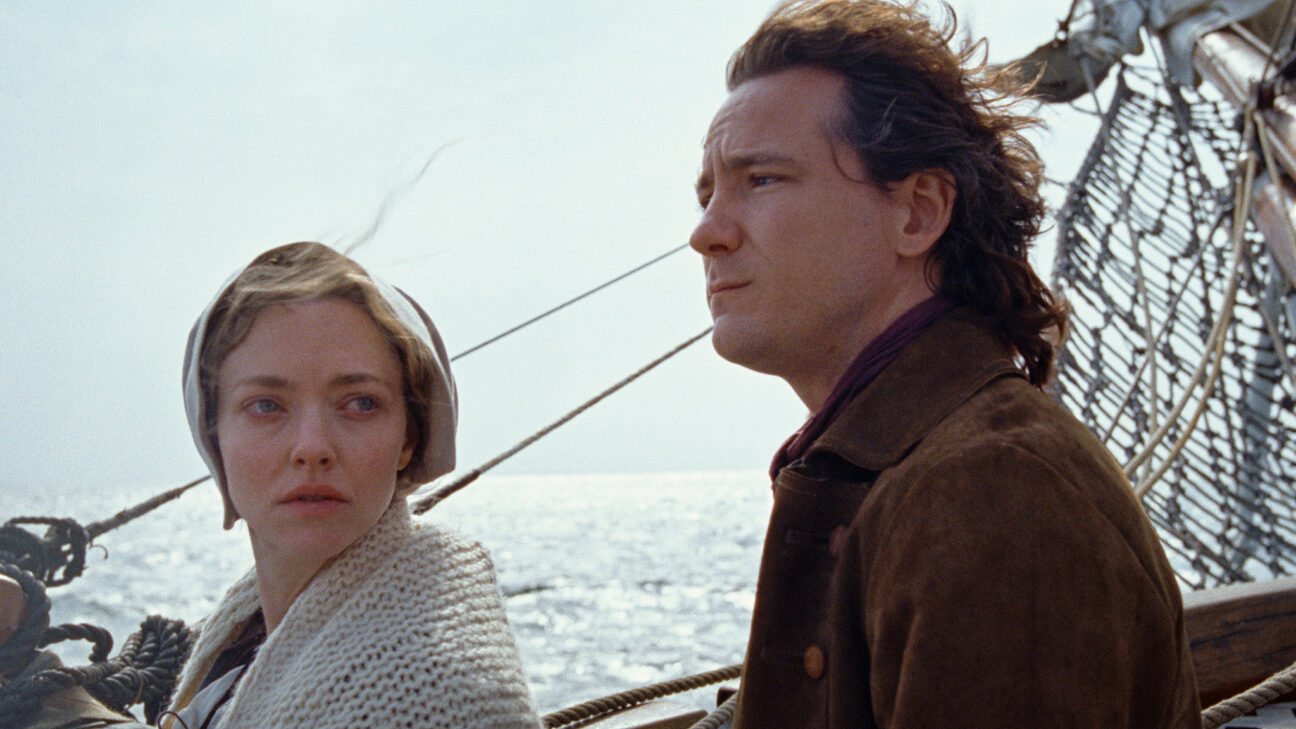
While filled with musicality and singing, it’s worth noting that the Shakers’ spectacular and rhythmic acts of worship are closer to chants or mantras than songs. Fastvold rather wryly observes a contradictory notion. That, for all their piousness and Ann’s puritanical vows of chastity, their divinity is breathy, thrusting, orgiastic, often predicated on Seyfried’s intensely lusty gaze (not a criticism!). That, perhaps, human nature finds a way after all. Daniel Blumberg’s music and Celia Rowlson-Hall’s choreography combine in a manner designed to get us all hyperventilating. We’re kept at bay by Fastvold who – with the aid of cinematographer William Rexer – keeps her film steady, even slightly detached. We’re never quite as invested as Ann or her evangelicals, which can create a disconnect. A sense that we’re missing some key piece or ingredient.
Just when complacency feels like it might be settling in, absurdism reignites the narrative via Hocknell and his madly wandering finger (you’ll see). Now questing for A Place To Call Their Own (ultimately Niskayuna, NY), Blumberg throws in some incongruous but wholly ecstatic electric guitars. Fleetingly, The Testament of Ann Lee flirts with the idea of Luhrmann-esque maximalism. One wonders if Fastvold and Corbet are amused by the notion of a Broadway spin-off. It’s not wholly unthinkable, but the narrative tumble ahead may need some embellishing if it’s to meet the criteria of a bombastic stage show. There’s fire and wailing, but not at all of a kind one would categorise as celebratory.
Seyfried makes for a wonderful lead here. There are shades of Lillian Gish in The Night of the Hunter tending her flock with pearls of matriarchal wisdom, but Ann is also a little dazzled, prone to utopian optimism that runs her into danger. There’s tragedy in this refusal of reality, but also a kind of liberated escapism that I can’t help but feel a little jealous of. In spite of the overbearing amount of narration, neither Ann nor Mary feel like true anchors for us. Connecting and investing are tall orders.
Still there’s plenty to admire, not least a codification of old ways and craftsmanship to rival Robert Eggers’. Fastvold notices how other things travel with religion. Practical knowledge, skills, commerce. Building blocks of western civilisation. Are these part and parcel of a broader sickness, the one that seems to have infected America? There’s enough of an inference if you’re looking for it. Rexer’s cinematography, too, is replete with small wonders. Dark interior tableaux from natural light sources corral like Renaissance paintings. And Ann’s readings of divinity feature some sparkling notions of the transness of God. Later, confusion over her own gender factors into her potential diagnosis as a witch. The past seems to keep haunting the present.
The Testament of Ann Lee may gain ardent devotees, but it does not seek to convert. At numerous times (one might argue throughout) the religious exaltation and fervant belief depicted is framed tantamount to madness. What might easily at one time have been diagnoses as hysteria (Ann even spends a key period hospitalised/incarcerated for her convictions). But just as insane are the brutal, intolerant outcries against Ann and the Shakers, scenes which feel undeniably contemporary (ICE). In Fastvold and Corbet’s vision, madness is an inherent – nay ubiquitous – human trait. It can manifest as dance just as easily as it can manifest in violence. Here, we’re all incurables, with only God to save us.

 The Lost Highway Hotel