

Director: Kleber Mendonça Filho
Stars: Wagner Moura, Tânia Maria, Laura Lufési
This review was supposed to land in a timely manner approximately three weeks ago ahead of The Secret Agent‘s wide UK release but an embarrassing thing happened; I fell asleep for more than half of the movie’s luxuriously sprawling 161 minute running time. Even a cursory glance above and readers will note that I’ve stamped this Oscar contender with a Seal of Approval, so this should not be taken as a measure of the film’s quality, more a conspiracy of fatigue, a comfy recliner and a warmer-than-usual screening room for a matinee. I was a goner not long out of the gate. It wasn’t even the movie I intended to see today. I went to see EPiC: Elvis Presley in Concert, but when technical difficulties blew that opportunity, I suddenly had a window, a comfortable level of alertness and the opportunity to fill in the blanks.
Maybe it was all fated to work out this way. The intervening weeks have seen MUBI fortuitously present a number of Kleber Mendonça Filho’s earlier works that help place his latest into greater personal context, not least his recent 2023 love letter to the cinema itself, Pictures of Ghosts, which chronicles the cultural footprint of the cinemaplex in his hometown of Recife, where many of his films including The Secret Agent are set. Indeed, cinema plays a crucial part in this story; an almost platonic ideal of a cool political thriller. Or, in this case, a warm one, thanks to the honeyed cinematography and lush production design. The movie looks like heaven, even if it deals with far less idyllic conflicts from Brazil’s recent past.
It’s 1977 and Armando (Wagner Moura) has been forced to abscond from his life in Pernambuco following death threats from corrupt industrialist Henrique Ghirotti (Luciano Chirolli). He has a new name, Marcelo, and is offered safe haven at a kind of ad-hoc witness protection apartment complex overseen by the irrepressibly jovial Dona Sebastiana (Tânia Maria). There’s even a job arranged for him at the nearby Institute of Identification (one of the film’s abundant wry ironies). His son Fernando (Enzo Nunes) is close at hand under the custodianship of his father-in-law, Alexandre (Carlos Francisco) – owner of the aforementioned cinema where Hollywood hits Jaws, The Omen and a then-current King Kong remake are packing in ravenous cinemagoers night after night. But Ghirotti has a pair of hitmen (Roney Villela, Gabriel Leone) on Armando’s tail for a cool 60,000 cruzeiro reals. Since the Federal Police have banned him from travel under this real name, Armando feels the pressure of the four day wait to get his new forged documents.
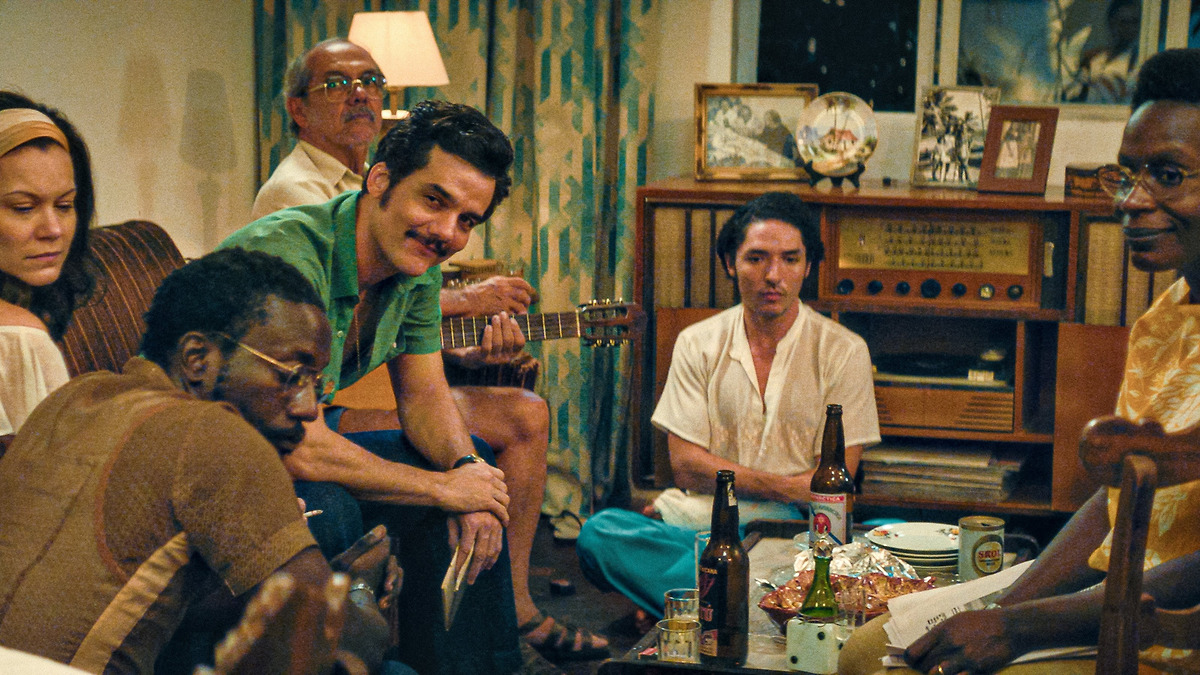
All of this unfolds piecemeal, with context feathered in casually. In as relaxed a manner as Moura’s affable and charismatic performance. Mendonça Filho wants us to feel the vibes of late ’70s Recife before flooding us with exposition, so it is a patient, detailed and exacting watch, but all the more rewarding for it. There are a lot of long films jostling for space at the moment, and these extended running times can feel daunting, withering even. And while the leisurely opening act can feel frustratingly cagey about specifics, in the grander scheme of things it comes to feel as though not a moment has been wasted. The Secret Agent has plenty of wonderful, eminently playful asides (particularly a Sam Raimi-esque detour into the mythos of a severed leg), but it also concertinas into a driving thriller come the final act, set sensationally to the street rhythms of Banda de Pifaros de Caruaru’s “A Briga Do Cachorro Com a Onça” (add it to your playlists, now). When violence ultimately spills out, it is with the lean efficiency of the Coen Brothers circa No Country for Old Men. And in Kaiony Venâncio’s weaselly-looking subcontractor Vilmar, Mendonça Filho gifts us a scruffy hired goon for the ages.
Before all this, however, there is the humanistic drama of what life must be like for someone driven unfairly out of their everyday to live underground. The emotional toll of it, which one can find heavy in Moura’s expressive eyes, even when masked by a smile. The word ‘refugee’ comes up in a couple of different contexts for those staying under Dona Sebastiana’s supervision, but the etymology of refugee is ‘refuge’, and The Secret Agent is at its warmest when it recognises that salvation and resistance thrives in community. Armando’s predicament is quixotically mirrored in the abode’s feline guest; a cat with two faces called Liza and Elis. The cat also feels like a symbol of pluralism, a concept lost on Ghirotti, who stands in for all manner of corporate and political corruptions plaguing Brazil in this period.
Though it feels now as though I’m working backwards through the film, these ideas of corruption and violence waiting in plain sight are set-up with great economy in the film’s subtly oppressive prologue. Here, Armando stops off on his drive to Recife for gas, only to be confronted with a headshot body lying in the gas station forecourt covered with a sheet of cardboard. The attendant advises it has been there for over a week. Highway police officers then search and question Armando when they happen to drive by. This is all before any context has been given to us, but with next to nothing Mendonça Filho is able to manifest palpable Leone-esque tension. An omen for the slow-escalating pressure cooker to come. An evident cineaste himself, one feels as though Mendonça Filho would have no qualms about being contextualised through comparison. He uses the movies as cultural reference points to position his story (even the sweaty chief of police looks as though he’s taken tailoring inspiration from the mayor in Jaws). Charting The Secret Agent‘s successes the same way feels particularly apt.
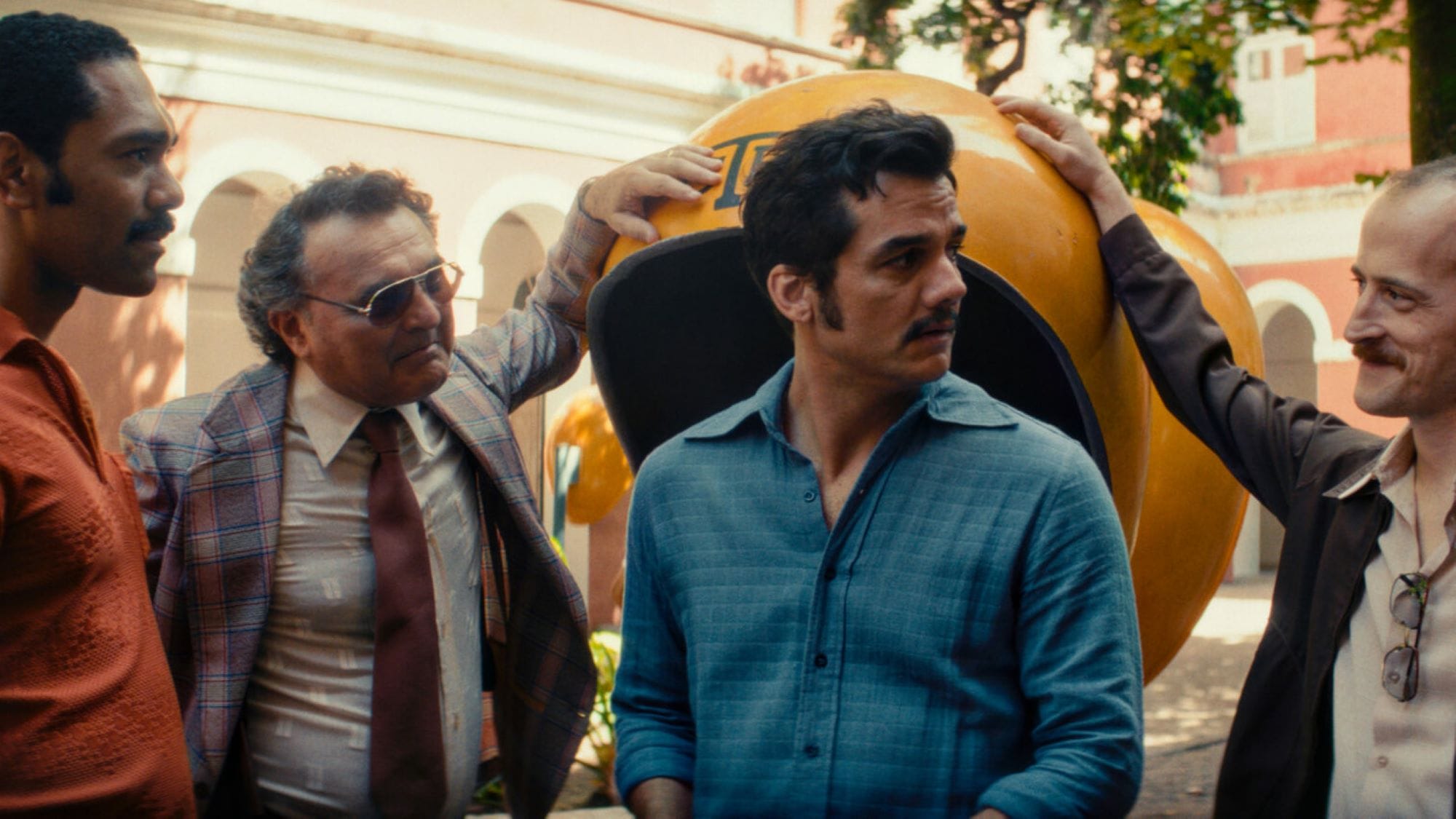
And this is bravura filmmaking in every respect. Juggling a vast wealth of characters – a great many more than itemised above, and all superbly cast (there are so many good faces here) – while keeping Armando’s patient longing as an emotional centre, Mendonça Filho manages to draw a network as rich and complex as any you’d find in a complete season of The Wire. Genre mainstays are all pleasingly present, from the paranoia of wiretaps to suspenseful foot chases through bustling thoroughfares.
Mendonça Filho shows a fealty for the tangible. Taking advantage of his new position at the Institute of Identification, Armando searches for evidence of the mother he never knew, stating, “My mother died and I’d like to have a document of her”. We memorialise through the tactile. There is something so substantive about the substantive. The Secret Agent has an important additional layer. It takes a while to materialise, but we come to discover this is all framed from a present day vantage, as plucky uni student Flavia (Laura Lufési) goes down a rabbit hole of archival material to unearth Armando’s story and, ultimately, pass it on to the person who might need it most. The film’s coda reaches right back into the sentiments of Pictures of Ghosts, mourning the disappearance of culturally rich spaces like the cinema. But there’s something truly fitting in a cinema being reconstituted as a(nother) place of healing.

 The Lost Highway Hotel