
Director: Sam Raimi
Stars: Rachel McAdams, Dylan O’Brien, Edyll Ismail
While his ’00s Spider-Man films are beloved by many and movies like Oz The Great and Powerful and Doctor Strange in the Multiverse of Madness… certainly exist, it’s not particularly felt like we’ve had the Sam Raimi of old around much of late. And I imagine a portion of his audience have boxed-up their hopes by this point and stashed them in the basement with their Necronomicons. But there’s life in the old rogue yet. At 66 years young (no age at all, really), his welcome return to the wilds of populist horror comes with a little bit of worry that he might’ve lost his touch (c’mon, Drag Me to Hell was so-so, at best)… but Send Help mostly finds the feted filmmaker in remarkably rude health.
Working from a script by Damian Shannon and Mark Swift (whose prior credits include the dubious Baywatch reboot and the gloriously tacky Friday the 13th one), Raimi takes aim at the boys’ club of corporate America, unpacking the machismo facades or predatory playboys, and humanising (to a degree) even the most detestable of boardroom monsters. In this case that would be Bradley Preston (Dylan O’Brien), a broad caricature of loathsome traits who has just inherited a profitable strategic solutions company. His ascent cuts down the hopes of beleaguered accountant Linda Liddle (Rachel McAdams), promised a promotion by Brad’s recently deceased father, and here rendered as a mousy misfit through bad eating habits, a pet bird, and the slightly bizarre addition of a wart on McAdams’ cheek.
Linda isn’t Brad’s idea of a ‘people person’ and he has every intention of burying her at the company. However, when the two of them are the lone survivors of a terrible plane crash on the way to Japan, Brad is left prone and injured after they’re washed ashore on a deserted island. Fortunately(?) for Brad, Linda is a budding survivalist who has long dreamed of a side hustle on reality television. Their dire situation gives Linda a new lease of life, one in which she has the upper hand; a fantasy that anyone who’s had a jerk for a boss can appreciate. But Linda might be a little too invested in perpetuating this happenstance role-reversal.
The early stages of Send Help lay the dichotomy between these central figures on awfully thick, and the film plays solely as a comedy for it’s entire opening act. Only Raimi’s reputation and the movie’s marketing would have you think anything different. It’s really not until Linda skewers a boar on her first hunting endeavour that Raimi takes the top off the bottle and the ketchup starts to pour. Raimi’s boar is more cartoonish than the one presented recently in another woman vs beast tussle-up, but his explosions of blood are ecstatic. A gushing rebirth for a set of instincts contained for too long.
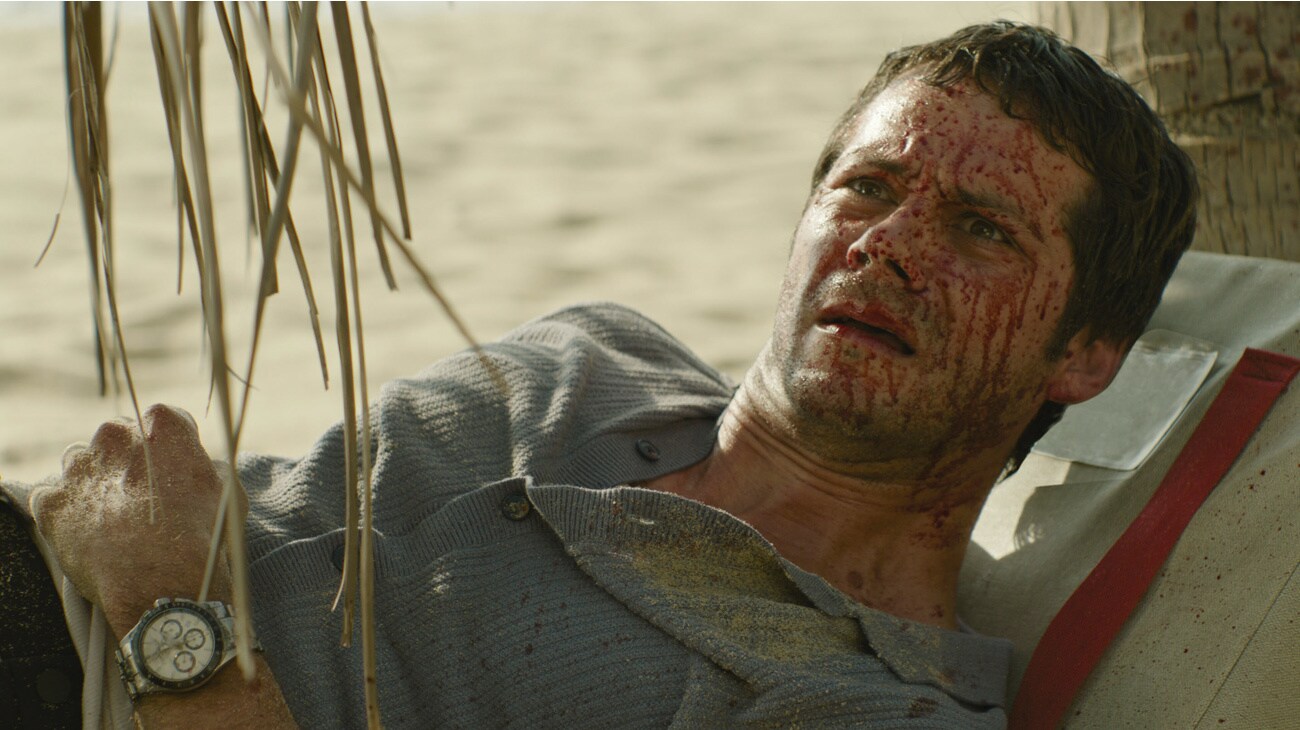
From here on everything’s fair game. Linda quite quickly comes to seem unstable in a manner mildly reminiscent of Kathy Bates in Misery – replete with a prone patient to lavish her attentions on – but McAdams engages her keen comedic sensibilities to steer the character down other avenues. O’Brien, for his part, surprises also, locating a game and goofy register that genuinely does cast him, in some lights, as an heir to Bruce Campbell. Raimi asks us to bask in the glee of Brad’s misfortunes, but we’re as wary of Linda, whose own rebirth as the Martha Stewart of LOST is made thornier by both the secrets she keeps and the ones she lets slip.
As Send Help progresses it flirts dangerously with greater substance and psychological insight. One particular turn of events presents Linda with the threat of a challenger to her newfound status, and there’s a (too brief) line of enquiry into female territoriality. What that means, how that manifests, and what motivates it. A complex mesh of propositions that Linda herself might not know how to unpick. It’s a little bit of a letdown when this angle abruptly ends in the movie’s clear nadir; a stumbling throwback to deadites that’s launched at the audience like so much chum.
But there’s a great deal to enjoy elsewhere. Raimi happily goes for the gross-out during a sequence of nauseous resuscitation, following it up quickly with a scene which threatens to take Brad’s emasculation to a quite literal conclusion. Indeed the rigors of his blowhard masculinity are forever called into question, and it’s surely a deliberate gag that – when these two finally do come to blows – the ensuing scrap is all biting and hair-pulling.
Linda’s malaise with the world she’s been tossed out of is rooted in a deeply pessimistic view of the modern workplace for women. It feels as though she really is better off on the island, embracing her adept mother nature/Gia/earth-goddess side. When she shouts, “There’s nothing for us back there!” at Brad in their inevitable showdown, that comes from a place of honesty for her. It makes the film’s final moments more complicated. Is this a happy ending, or is the movie a mite too cynical for that?
The central turns, a script that always has it’s eye on what’s most entertaining, and Raimi’s irrepressible eye for the madcap all ensure that this is a riotously enjoyable break from reality. Sure, the CG’s a bit syrupy and some of the dialogue feels conspicuously aimed at those not paying attention (“She didn’t leave me any water!”), but for the most part this delivers both the laughs and the body punishment of the Raimi of old. A sick and silly island getaway that might also have you reassessing the office politics.

 The Lost Highway Hotel