

Director: Kristen Stewart
Stars: Imogen Poots, Thora Birch, Michael Epp
The art of seeing through someone else’s eyes is the core of auteur theory. That one person can direct (literally) a singular vision of their own, hewn through the collaborative craft of hundreds. Kristen Stewart has been a part of that process for others for well over two decades now, playing her parts as an actor. Now she takes her first turn as director, and we as audience members get to see how she sees. Her eye.
There’s a further layer and complexity to this invitation as Stewart has chosen to adapt the memoir of another for her jump into feature filmmaking. Lidia Yuknavitch is an American author and teacher based out of Oregon, whose troubled and tempestuous upbringing formed the fulcrum of her writing, and which is brought to the screen by Stewart in a brash, wantonly ‘alternative’ flood of sounds and images. To be reductive, imagine Fiona Apple making a Terrence Malick picture and you’re already part-way there. Kim Gordon’s in the cast and that totally makes sense. Honestly, I was half expecting Chloë Sevigny to turn up at any moment. That’s how dyed-in-the-wool indie Stewart’s intentions are.
While the titular chronology is sometimes scattershot, there is a mostly linear flow to the movie, subdivided as it is into five chapters. Beginning with ‘1. Holding Breath’, we gain a picture of Lidia as a young woman, played by Imogen Poots. School-age, Lidia is a wannabe professional swimmer. But despite displaying a natural aptitude, she doesn’t garner enough merit to warrant a full scholarship, something her abusive father Mike (Michael Epp) wields over her with overt, blunt-force malice. Stewart’s depiction of this blowhard oppressor seems to tilt crudely toward caricatures of patriotic conservatism. It’s only later in the film that we’ll come to understand what a true monster he really was, and that Stewart’s quick, broad sketching of character is part of a methodology.
The Chronology of Water opens with stuttering cuts, setting out it’s stall early on. It’s all harsh, juddering tempos; raspy acapella and Mica Levi-like itches on the soundtrack; hyperactive, deliberately distracting pops in the sound mix. With so much ground to cover, the movie has the lurching sensibility of someone burning through a flick-book, missing out whole sections so that the action shunts forward abruptly. It can feel like watching an eight-hour miniseries that’s been fiercely – even callously – edited down to two hours.
But give it time and Stewart’s method grows quite impressive. By drawing us tremendously unsubtle stereotypes, Stewart shows how these can be utilised to shortcut her audience to the most direct and primal understanding of any given situation or scenario. This allows her the ability to power through a life story. It means some things get short shrift. Addiction and overdose happen to Lidia in the space of the same minute, it seems. Her BDSM affair with Kim Gordon’s college professor, meanwhile, feels like an impromptu deleted scene from Lars Von Trier’s Nymphomaniac. Not everything gels seamlessly. But still, overall, we’re parcelled a lot of information with confident economy. The Chronology of Water often feels like a precocious, bratty, irritating film… but a good one.
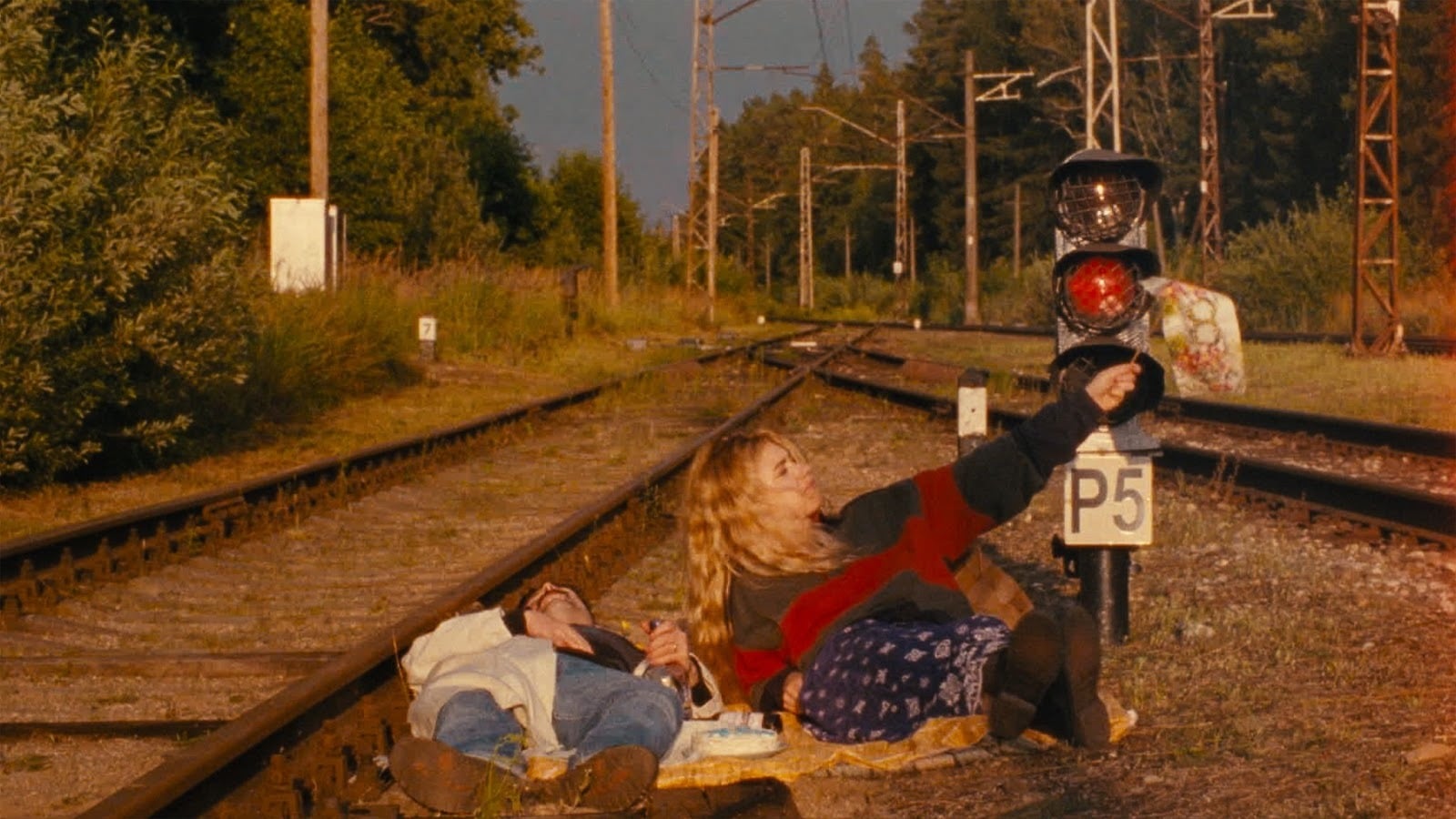
Because, as in Yuknavitch’s writing, there’s great emotional intelligence here. Intelligence enough to appreciate the contradictory responses in human nature. That you can laugh while spreading the ashes of a stillborn child and it’s still cathartic. That Lidia’s series of doomed, malfunctioning relationships with men amount to a litany of anti-fathers, from Earl Cave’s folkish nice boy Philip, Jim Belushi as burned-out author Ken Kesey, and on to Tom Sturridge’s alcoholic performance artist Devin. Stewart’s artfully collaged 16mm movie might be the platonic ideal of every angsty indie girl’s coming-of-age tale. This has the potential to be an entire generation’s The Virgin Suicides. Considering the career Sofia Coppola has had since, hopefully it’s also Kristen Stewart’s Virgin Suicides.
Chapter III, ‘The Wet’ feels the closest to Stewart herself, but perhaps that’s because she made her own queerness coquettishly public (“so gay, dude!”). This passage of the film charts Lidia’s college-age sexual experimentation with girlfriends, and the palette of the movie noticeably warms. We’re presented a droning montage of cavernous discoveries. An erotic, impressionistic high. What Lidia refers to elsewhere in voiceover as “that pink muscle”. At other times sex is cut-up. With men it’s often presented disassociatively. But alone or with women these episodes are indeed wet and lingering, bending that title to new meanings.
Slowly but surely, wisdom is accumulated. Through Poots’ performance we come to understand that Lidia is asking herself serious questions. Does she need painful relationships to inspire her art, or does she just think she does? Poots has spiralled into Lidia. It’s an egoless turn, a mirror to that given fearlessly by Jennifer Lawrence in Lynne Ramsay’s Die My Love – a similarly sensorial and freewheeling unravelling of womanhood. Aside from some scant childhood flashbacks, Lidia doesn’t age throughout the movie. Even as the decades flash by, Poots looks the same. We’re moved to ask, is this how Lidia felt? Frozen by her father’s abuse? In some respects always just a girl?
Thanks to the credibility afforded Stewart throughout her career (and particularly post-Twilight), this is an unusually uncompromised debut. It’s a privileged position, for sure, but she’s made the most of it. Her tendencies can run to the try-hard but, when compared to the apathy and low-stakes presented by other actors-turned-directors lately (hi ScarJo), we should be thankful for such an effortful, hungry approach. Attacking the material, she attacks the audience. A slightly overlong but thrilling shock to the system.

 The Lost Highway Hotel
1 thought on “Review: The Chronology of Water”