
Year: 1993
Director: Brian Yuzna
Stars: Melinda Clarke, J. Trevor Edmond, Basil Wallace
If there’s an unsung hero of the direct-to-video horror sequel in the early 1990s, it might be Brian Yuzna. While 1990’s Bride of Re-Animator admittedly struggled to add anything revelatory to the Stuart Gordon cult favourite, the same year’s Silent Night, Deadly Night 4: Initiation is something of a diamond in the rough; an oddity that dares take the yuletide slasher series in a wildly different direction. That curio deserves a write-up of its own some day. But for now we’ll take some time to appreciate Yuzna’s third jobbing sequel (and best film of all). Return of the Living Dead III is almost a companion piece of SN, DN 4 in the sense that it takes an established entity with a niche but loyal fanbase and dares to present them something new.
Dan O’Bannon’s The Return of the Living Dead set an enjoyably goofball tone that Ken Wiederhorn was keen to perpetuate in his 1988 sequel, which is another underappreciated act of IP extension in itself, one that even corralled a number of the first movie’s stars to return. For Return of the Living Dead III, however, Yuzna was keen to change tack somewhat. And while the resulting picture wears it’s B-movie trappings as a badge of honour – a trait shared by both forbearers – it’s a movie that comes as you like a sneak attack. You’d be forgiven for expecting another example of the plentiful trash being peddled around this time (particularly with the likes of Troma cluttering the rental shelves). It’s effects-heavy, a bit goofy, conspicuously cheap (Yuzna’s a fearlessly unpretentious filmmaker). An earnest bit of schlock. But the further you get through it, the more cutting it becomes. Pun grimly intended.
Making frankly miraculous use of a handful of limited sets, Yuzna presents a covert military project determined to bio-engineer super soldiers from the undead who had been re-animated over the course of the last two movies. But this takes second fiddle to the romanticised teenage rebellion of the film’s two stars, Curt (J. Trevor Edmund) and Julie (Melinda Clarke, credited as Mindy Clarke), who sneak onto the base using a key-card belonging to Curt’s father, Col. John Reynolds (Kent McCord). There they witness the defrosting of one such zombie (the rake-thin Clarence Epperson in a particularly striking make-up and costuming combo from Chris Nelson). Col. Reynolds aims to fuse the re-animated undead to state-of-the-art exoskeletons, creating the most advanced standing army on the planet. But his would-be grunts initially prove difficult to control.
When Julie is involved in an horrific motorcycle accident, the experiments at the base give a desperate Curt recourse to sneak back in, in the hopes of bringing his beloved back to life. Curt and Julie’s relationship has already been presented as deeply rooted in sensuality (both Edmond and Clarke give intense performances throughout), and even before her accident Julie is fixated on extremes of sensation. Indeed, her preoccupation even interrupts their love-making. Once re-animated by Curt, Julie is distressed at her newfound numbness, and quickly turns to self-harm as a method of feeling again.
Julie and Curt are already framed as star-crossed lovers rooted in rebellion. Col. Reynolds’ imminent transfer means that Curt is told they’re to move away, something he outright refuses to his father’s face. Their fateful motorcycle crash is in part caused by the couple’s distracted elation at their combined bucking of authority in the direct aftermath. Undead Julie’s cutting initially seems as though Return of the Living Dead III is trying to be performatively edgy. A misguided depiction of punk (she initially pricks her hands with a skull pin plucked from her own leather jacket).
But the longer the film runs, the more considered it becomes, and Julie’s self-harm seems deeply rooted in an understanding of the psychology of a cutter, as she attempts to control an overwhelming and spiralling situation; her own mortality. Confronted with the degradation of her humanity and the evils of the world – and her own capacity for the same – she even attempts suicide, jumping from a bridge. In this context the cutting for stimulation becomes inherently more complex. It’s an incredibly insightful turn from John Penney’s screenplay. Living Dead III, like Marina de Van’s staggering In My Skin, sees the fundamental flower of feeling in excavating a new wound.
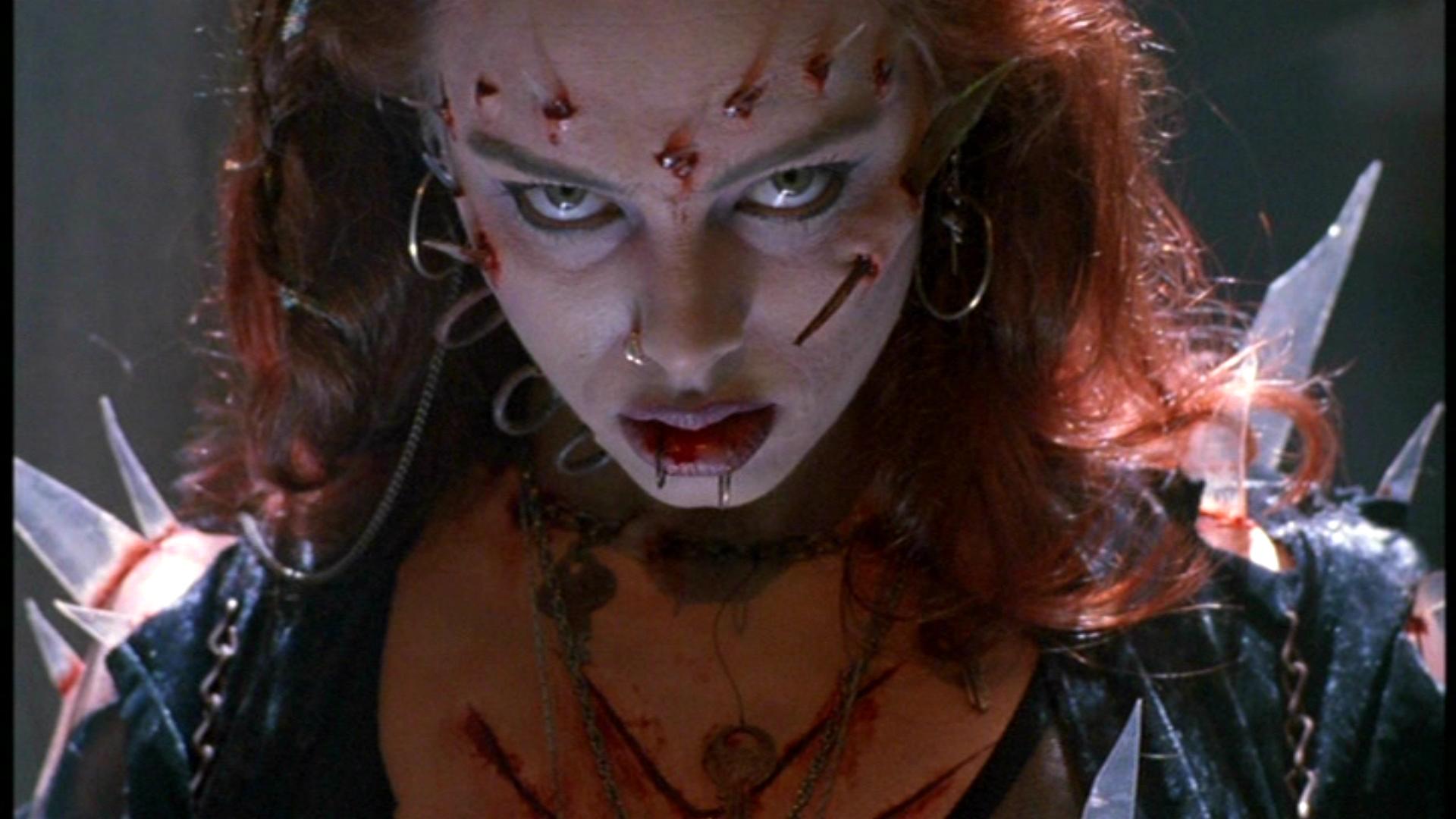
Like de Van’s film, Living Dead III understands human nature and the need to escalate any burgeoning fetish or psychopathology. For Julie, cutting helps her stave off her increasing imposter syndrome, death and oblivion itself, as well as her hunger for human flesh. In her words “the pain makes the hunger go away”, supplicating her more violent urges. Coquettishly, one might even discern a biblical reading, as this miraculously resurrected innocent configures her own stigmata through extreme and sexualised body modification (a playful thought but not one I’m altogether inclined to pursue).
As the inevitable crushes in on her, Julie’s rule of thumb is simple: the harder, the better. There are many acts of desperation in the film, but this is also a very personal act of control. By the end of her transformation, Julie has become a heavy-metal hybrid of flesh and glass, pocked with shards like spikes, mirroring the film’s other late-coming and more politicised revelation.
The film’s final 15 minutes are among the darkest in ’90s horror cinema, rivalled only by the final story of Rusty Cundieff’s staggering anthology Tales from the Hood. Allow me to catch you up. During their eventful time on the run, after Julia jumps from the bridge, she and Curt befriend a homeless fellow known as Riverman (Basil Wallace). Many of the additions to Julie’s increasingly stylised appearance come from Riverman’s scavenges. He is ultimately bitten and infected by Julia in the film’s late passages (her failing humanity is rendered as deeply tragic). The military aspect of the storyline reasserts itself, and Yuzna goes all-out on his orgy of disturbing body horror effects (realised by an incredible special make-up effects team).
Riverman’s fate is horrific in the true sense of the word; his humanity stripped away not just through infection, but by the bastardisation of his body by Col. Reynolds’ cadre of scientists. We’re ‘treated’ to a dark funhouse exhibition of grotesquely tortured test subjects, reduced to the dehumanised status of numbered specimen. Fused with an exoskeleton (created by Tim Ralston), we see Riverman having his head drilled into by Sarah Douglas’ unfeeling Lt. Col. Sinclair; an apparatus that comes with a headpiece incredibly reminiscent of the type affixed to a death row inmate sitting in an electric chair.
That Riverman is a Black man adds all kinds of pointed political significance to the sequence, which feels bitingly representative of America’s addiction to incarcerating African American males – the modern continuation of the principles of slavery. Living Dead 3 makes painful horror out of Riverman’s continual mistreatment. The military angle also invites connotations of Vietnam, and the perception that African American men were drafted en masse to fight for a country that wouldn’t recognise them otherwise. The end sequence becomes a potent melting pot of racial exploitations throughout American history, here projected into the potentiality of it’s sci-fi future. It is grimly, grimly pessimistic, and unreserved in its statements. Barry Goldberg’s music as the credits play out only emphasise this via a relentless and propulsive dirge of cold-hearted synths.
There’s a tragic love story at the centre of Living Dead 3 redolent of Romeo & Juliet (no really), tangled up in a chaotic thrashing of special effects grue and hard genre excesses, but it is these embedded insights into both the deeply personal, psychological and political that make it all seem razor sharp in retrospect. It is, to this viewer, grossly overlooked, likely down to it’s lowly status as a direct-to-video third entry in a dwindling series. It ought to be thought of as a pillar of ’90s horror, up there with the likes of Candyman, Audition or Cundieff’s aforementioned Tales of the Hood as a must-see entry from a surprisingly diverse chapter in the genre’s storied history.
 The Lost Highway Hotel