

Director: Julia Ducournau
Stars: Golshifteh Frahani, Tahar Rahim, Mélissa Boros
Julia Ducournau’s third feature eschews much of the visceral intensity that made her prior features Raw and Titane such immediate cult favourites, but there’s still plenty of body horror to be found in this soulful rumination on the eternality of death which sits hunched in the wind-blasted shadows of both the AIDS crisis and, more recently, the COVID-19 pandemic.
A non-specific time and place. A new virus which causes people to turn to stone is causing panic in the populous, spiking fear and segregation across generations. Little is known about the infection, though it is presumed to be passed on through the blood. As Alpha unfolds it comes to feel as though persecution might be just as viable a method of transmission.
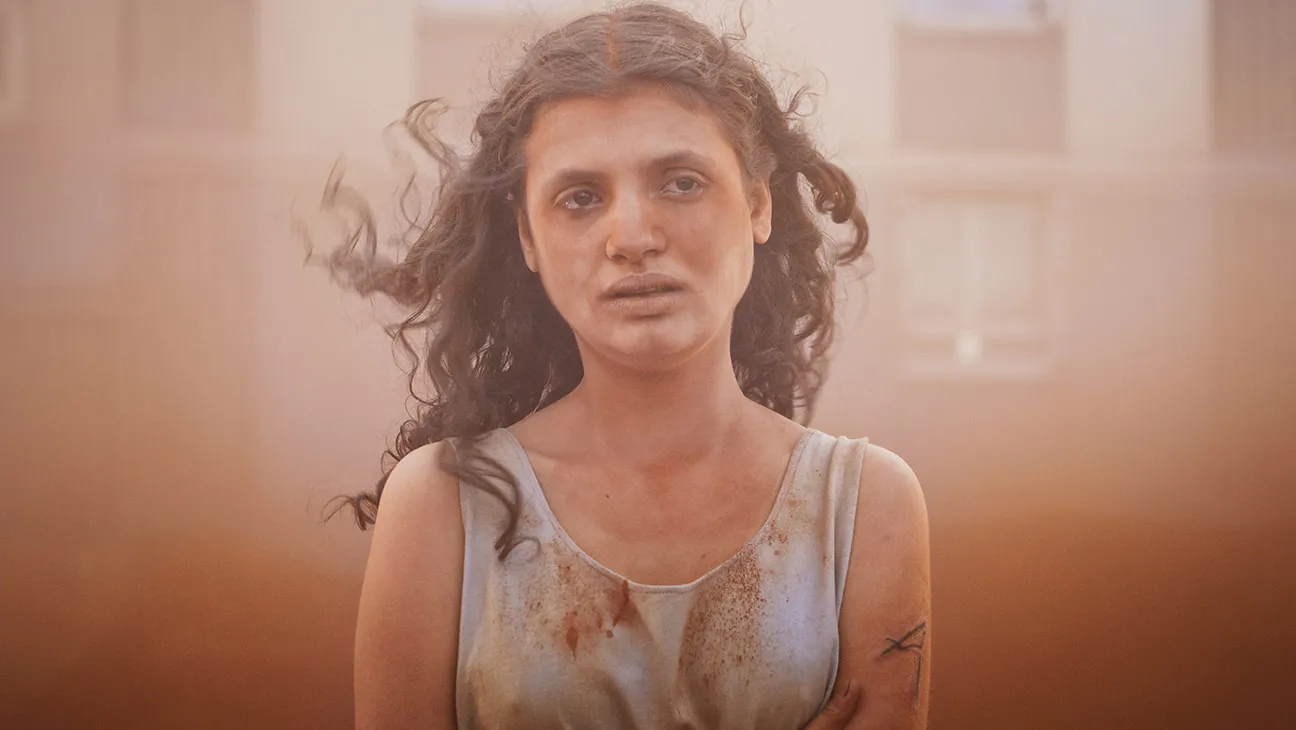
We’re with Alpha (Mélissa Boros), a 13-year-old girl who is coming of age in this maelstrom of unrest. At a party she is unconsciously tattooed with an ‘A’ on her arm like a scarlet letter in a sequence that seems like a brazen allegory for sexual molestation. Her mother (Golshifteh Frahani) is a doctor whose hospital is overwhelmed with cases of the virus. She is rightfully fearful that Alpha will have been infected through this incident with unwashed needles, and so the tests begin. This coincides with the sudden arrival of Alpha’s heroin addict uncle Amin (Tahar Rahim), whose habit has clearly exposed him to the disease which initially manifests in uncontrollable shaking. Alpha is wary of Amin’s scary presence at first. But, as her classmates turn against her, the girl comes to see a kindred spirit in him.
Alpha doesn’t make viewing enjoyable in any traditional sense. This is a dour, grungy film, bruised and tender. In that tenderness, however, is some of Ducournau’s most emotionally astute and available work to date, particularly whenever she has the opportunity to show moments of captivating motherly love. The three leads are all wonderful. Frahani’s mother figure wears her heart on her sleeve, while Rahim gives Amin a strangely liberated energy, as though with infection comes freedom from fear of the inevitable. Boros proves herself quite the find, an anchor to rival Garance Marillier’s vulnerable turn at the centre of Raw, and her relative disappearance from the second half of the film doesn’t go unnoticed as we enter a woozier third act in which time becomes liquid. Is it a memory remembered, or a future anticipated? One comes to feel that Ducournau is guiding us through an expression of dying as an eternal concept, outside of conventional chronology.
But there’s more going on here than just an allegory for AIDs or COVID. Ducournau seems justly concerned with escalations of intolerance, particularly in young people. I’ve heard secondhand accounts of a rise in teen outbursts of misogyny in classrooms, and Alpha suggests that homophobia is just as rife as ever; that perhaps our kids have grown tainted by the stains of fascism that have made media devices unsafe communicators of an ideological virus. Ducournau’s film isn’t wholly pessimistic, however. There’s a moment shared between Alpha and her teacher (Finnegan Oldfield) of unspoken compassion that is among the most economically touching I’ve seen all year.
The marbleising effect of Ducournau’s virus is rendered beautifully by the make-up and effects departments, and the film takes a Cronenbergian view of disease, inviting us – and Alpha – to find it beautiful. That the dead and the dying are calcified in this way is also remarkably haunting. One of the great dissonances of COVID-19 was seeing death toll stats in the abstract. Alpha turns its victims into monuments that inhabit spaces. They clank, move and lurch. Tempestuous sandstorms blow a red mist across car parks and between high-rises. Alpha’s home looks like a housing estate on Mars. It’s our recognisable world, but rendered alien by an inexplicable situation.
Cronenberg’s oeuvre has announced itself in Ducournau’s work in the past, but here the resonances feel their most intellectual. Given the naked subject of grief that consumes much of the film, it feels like a direct companion piece to the Canadian master’s recent offering The Shrouds, but there’s more. When Alpha’s mother becomes convinced that her daughter has the infection, one of her first instincts is to then infect herself. To self-annihilate? Or to acclimate herself to the level of her loved ones, Dead Ringers style? Physical and emotional symbiosis. As she so succinctly puts it to Alpha, “If it happens to you, it happens to me”. It’s beautifully fatalistic.
Alpha opens in a kind of flashback, and we see Ducournau’s protagonist aged 5, joining the dots of track marks on Amin’s arm with a black marker, turning something dark and tragic into something oddly wonderful. A roadmap or star chart for the journey ahead of us. This is an angry, mournful, occasionally fucking livid piece of filmmaking. A seemingly-misunderstood and dour masterpiece from an artist who only seems to be evolving more confidently into herself. It may lack the virtuoso shock moments that previously sent audiences reeling. But, like Cronenberg, this mostly suggests that Ducournau no longer needs such crutches to support her ideas. And the ideas are certainly there. In some ways, this might even be her best work yet.

 The Lost Highway Hotel