

Director: Jafar Panahi
Stars: Mariam Afshari, Vahid Mobasseri, Mohamad Ali Elyasmehr
Jafar Panahi’s work has long held a complex relationship with the circumstances under which the director has been constrained by the Iranian state, and his efforts to persevere around the effortd put upon him have made him an inspirational figurehead in rebel cinema. From filmmaking bans to actual imprisonments, Panahi’s nous has allowed the work to flow on. In May of this year, that spirit and the quality of his work converged at the Cannes Film Festival where his latest, It Was Just An Accident, took away the prestigious Palme d’Or. The award itself – like the Best Picture gong at the Oscars – has its own contentious history (as any competition based on artistic value will), and the winners come loaded with the expectation to justify themselves.
As his renown grows, Panahi seems duty-bound to raise his voice louder and while the making of It Was Just An Accident benefited from relatively wider freedoms than some of his previous work, Panahi continues irrepressibly to push against the regime that holds him in such low regard. The film walks a canny tightrope; designed and constructed to play as an audience-friendly farce, but belying serious critiques and philosophical conundrums that give way to a tensely dramatic third act.
A man (Ebrahim Azizi) and his family run over a dog on a dark road at night and pull in to a nearby garage to assess the damage to their car. The mechanic, Vahid (Vahid Mobasseri), hears the squeak of his customer’s prosthetic leg and becomes obsessed with him. He follows the man through the night and, the next day, attacks and kidnaps him, taking him in his van to the desert to bury him alive. Vahid believes the man to be his former torturer during a three month period of blind-folded detainment, based on the distinctive sound of the squeaking prosthetic. Overcome by sudden doubts, Vahid boxes the man up in the back of his van and begins an increasingly absurd odyssey back through the city in an attempt to find others who can corroborate his suspicions.
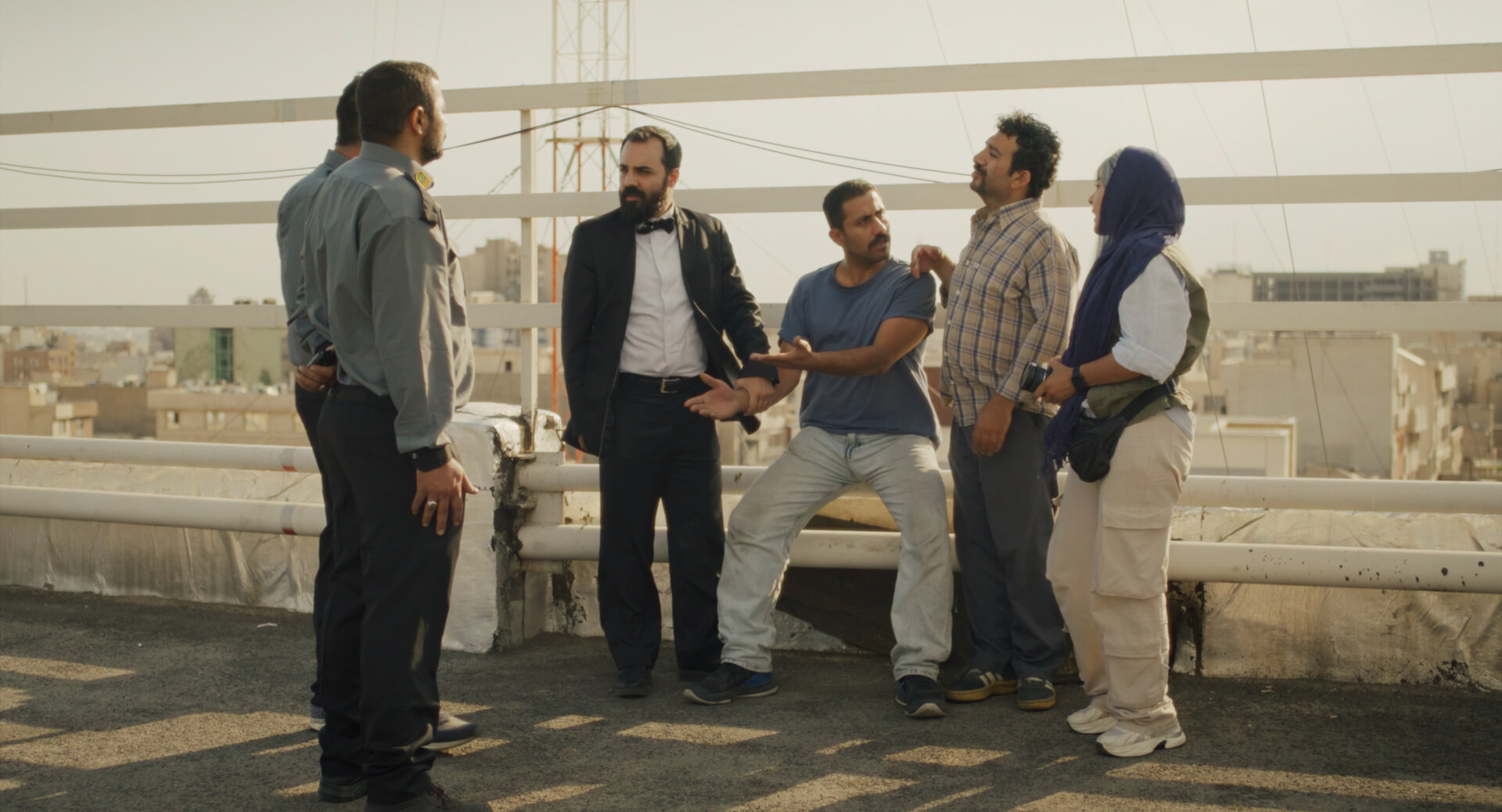
Vahid’s chosen burial spot is marked by a dead tree with two branches, a stark visual for the fork-in-the-road quandary of Vahid’s impulsive, life-changing decision. One suspects, once the haphazard kidnapping has gotten to a certain point, that Vahid will be compelled to go through with his intended crime, but Panahi keeps us from feeling sure. Jovially, each of the people who might confirm his suspicions can only vouch for further sensory details. Wedding photographer Shiva (Mariam Afshari) can only go so far as to say the man’s sweat smells the same. While hotheaded Hamid (Mohamad Ali Elyasmehr) only knows the touch of the man’s living leg. Between the three of them they’re a simile for the old fable of the blind men trying to know an elephant by touching it’s various body parts and drawing only piecemeal conclusions.
This story is framed in it’s opening scene in terms of fate and destiny. When the family run over the dog, the mother cries that “God put it in our path for a reason”. Her young daughter sassily claps back that “God has nothing to do with it”. Aside from suggesting a generational change in attitude to religious piousness, the daughter’s challenge becomes a challenge to us. As coincidences and contrivances in the story deliberately pile up in a way that stretches credulity, we’re provoked to question how we feel about Panahi’s shaggy dog story. Panahi is the god of the picture. It is his creation. He steers the characters. So in a sense, yes, he sent that dog. But he also removes himself from the story. Many of his recent works have been semi-autobiographical and/or have featured the director himself. That is pointedly not the case this time.
The journey is, in the most unlikely way, tremendous fun. Panahi learned from his mentor Abbas Kiarostami the wry joys in watching foolish people squabble, and the wit of circumstances that turn in circles. So he has that going for him. Vahid is such a panicky, bumbling fool. But each of his newfound acquaintances bring something new to the table, creating a rogue’s gallery who can spark off of one another in any given combination. Panahi also clearly appreciates the comedic potential of a well-timed cut. When Vahid’s van suddenly stalls, the immediate time jump – and jump to a rooftop perspective of what follows – is a gem among many. There’s also keen socio-political commentary (of course) engineered to elicit belly laughs. The idea of bribing officials readily equipped with contactless terminals is inherently funny, playing on universal understandings of how technology has come to both help and hinder us with its ubiquity.
But the breezy journey – underpinned throughout with the tension that it is rooted in a very serious crime – inevitably comes to a shattering conclusion, and the gear-shift into intense cathartic crescendo is bracing. There is a long-held static shot toward the end of It Was Just An Accident that feels redolent of an austere Eurocentric horror film, lit only by the hazardous red glow of a vehicle brake light. It feels far removed from the jaunty misadventures that preceded it, but Panahi manages to transition us there without too much of a shock. The scene that plays surely also stands as evidence as to why Afshari ought to be garlanded with every acting award out there this year.
Sometimes you feel as if you can tell when something ought to be a movie’s final shot, then worry when it overreaches. I had that experience here with It Was Just An Accident, but was proven wrong. When it comes, Panahi’s choice on how to end the film is among the more perfect in recent memory. It reinforces many of the film’s indictments of the oppressive Iranian regime and asks us again to question the varying qualities of vengeance and mercy.
It isn’t often you see a work and feel confident that, yes, this will become part of the perceived canon. An immediate classic of its time. It Was Just An Accident feels like just such a movie. You can practically hear the Criterion Collection people knocking at Panahi’s door.

 The Lost Highway Hotel
1 thought on “Review: It Was Just An Accident”