
Director: Joshua Erkman
Stars: Sarah Lind, David Yow, Zachary Ray Sherman
The urge to capture and contain vacant spaces persists in various fields, from photography to archaeology, and even the act/art of filmmaking invokes multiple creative departments to chronicle a story told at a particular time and place. We want to box up the past so we can revisit it. The movies are, in a real sense, a form of time travel. But the past has a habit of permeating the present, and even the forgotten might not be gone.
LA photographer Alex Clark (Kai Lennox) is in search of places lost in time, touring anonymous American deserts for blown-out towns, derelict cinemas, vandalised and abandoned warehouses. In an effort to connect to these solitary places he has left his cell phone at home. His GPS is off. Disconnected and alone, he joins them outside of time. But his perception of the vacant and lost is incomplete and inaccurate, and this comes forward to bite him.
Overhearing an altercation at the cheap motel he’s staying in, Alex crosses paths with volatile ‘siblings’ Renny (Zachary Ray Sherman) and Susie Q (Ashley B. Smith), though Renny acts more like a pimp than a brother. Sherman’s skeaze is a grotesque redolent of Willem Dafoe’s Bobby Peru in Wild at Heart. With some circumspect moonshine flowin’, Alex’s inhibitions are quickly eroded and the borders of his comfort zones redrawn. The next day, Renny plays on Alex’s curiosity and goodwill, luring him further into the desert with the promise of a truly off-the-grid locale; the supposed place of his squalid birth.
There’s a strong sense that Alex misunderstands and exploits the places he visits. A kind of poverty tourist that engenders uneasy class tensions. And that what starts happening is, in a way, just desserts. The ol’ “fuck around and find out” routine. The poor fringes of the country – alive and present – start fucking back. The stranger-in-a-strange-land vibe (combined with the locales and alcohol) bring to mind Ted Kotcheff’s outback belter Wake in Fright.
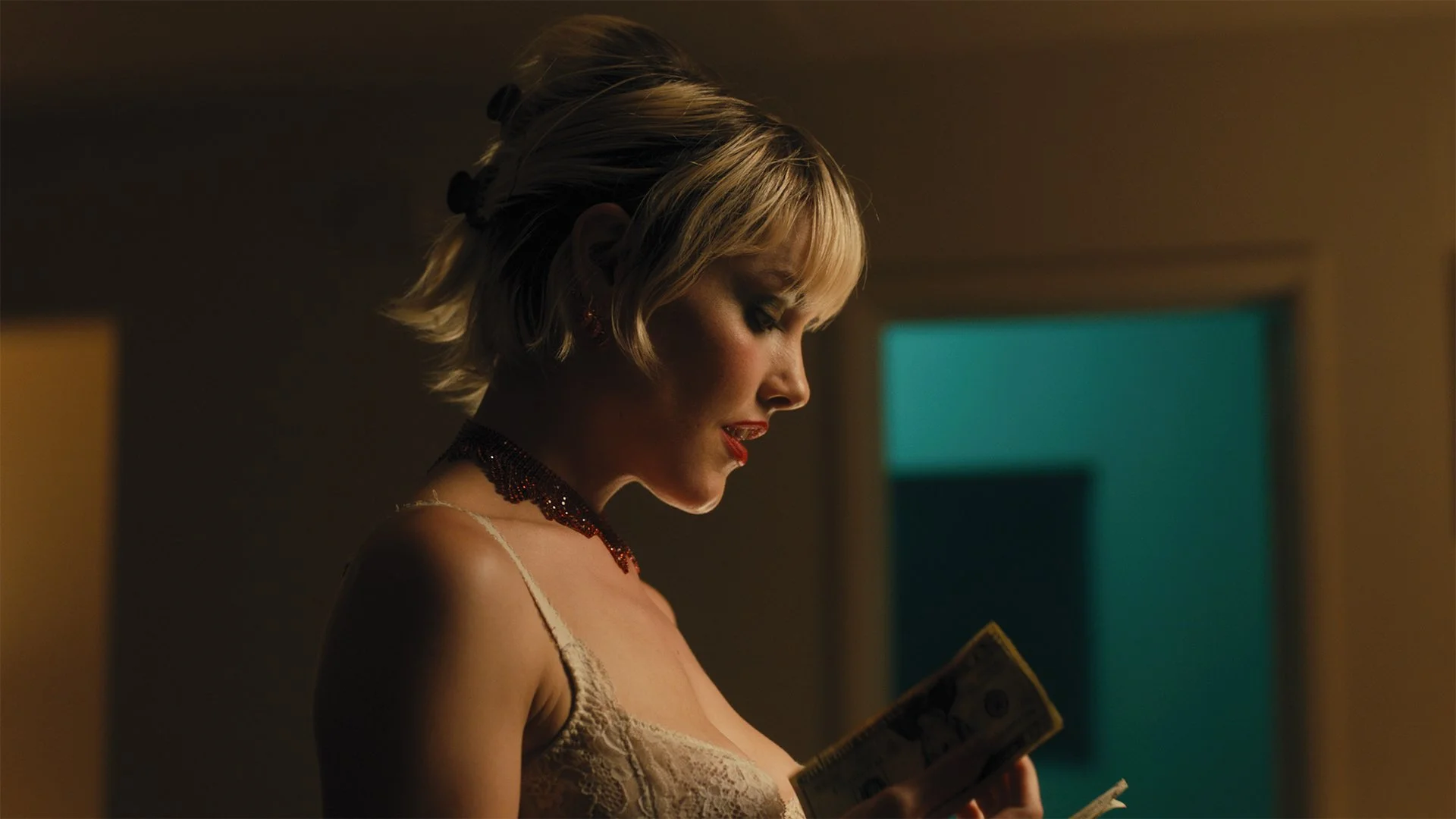
Director Joshua Erkman’s tale lands squarely in the horror genre, but he and cinematographer Jay Keitel don’t compose it as such, avoiding many of the aesthetic associations and playing the movie straight for an extended amount of time. It’s opening stretch is very much a malcontent character piece-cum-suspense thriller, one that favours a handsome composition just as much as Alex does. The first act’s finale punctures this veneer, bathed in the lurid red light of a photo lab, or the sticky prog aesthetics of Jean Rollin.
Then we reset and are introduced to Alex’s wife Sam (Sarah Lind) and private eye Harold Palladino (David Yow) looking into his disappearance. A Desert reframes as a shaggy, shuffling gumshoe movie, except that we are privy to a little more information than Yow’s gravelly-voiced investigator. Yow has the appealing no-nonsense sensibilities redolent of Jonathan Banks as Mike in Breaking Bad/Better Call Saul. Time with him is fine. We follow Palladino to the same places Alex already travelled. He takes photos, too (it may be a quietly cruel joke that Palladino seems to be a better photographer than Alex…), but the intent is different, and this reframing of old paths helps infer a sense that nothing is frozen in time. Even the static, tethered or stationary is always a part of the moment. As the pragmatic motel clerk (William Bookston) states, “gotta move with the times”.
That Palladino is so likeable makes his portion of the movie all the more uneasy, seeing as we have a better sense than he does of the trouble he is moving toward. A Desert indulges this anxiety. It doesn’t hurry. But, ultimately, it bends to horror expectations which means the need for a potential Final Girl. Sarah Lind steps gamely forward. Contrivances creep in a little and there’s an amorphous sense that this all could have been just a little tighter, but we’re talking about gradations here. In the main this is an effective wrong turn off the beaten path, even if the final destination can’t quite beat the sense of anticipation, one which broadly – and disappointingly – demonises sex work. We wind up staring at a blank screen (not the one you’re thinking of), pondering the dangerous potential of the recorded image. The living past.
This is a fine debut from Erkman. Fine in the sense of perceptively calibrated, confidently orchestrated, corralling his departments to achieve his intent; a noir-ish excursion to the edges of a hell so degradingly ordinary they don’t even mark it on the map.

 The Lost Highway Hotel