
Year: 1971
Director: Elaine May
Stars: Walter Matthau, Elaine May, George Rose
Of the four narrative features that bear Elaine May’s name as director, it is her debut, A New Leaf that I adore the most. Which is not to besmirch The Heartbreak Kid, Mikey and Nicky or even notorious ‘failure’ Ishtar. But rather to single out this ingenious effort as the timeless classic of American comedy that it is; a thorough lambasting of the country’s idle rich that has only gained currency (pun intended) as financial divides and the grotesque monopoly of billionaires has intensified. At the centre of it all are the film’s dual prizes – comedy legend and Hollywood’s go-to grouch Walter Matthau, and May herself, firing on all cylinders as she wears three hats at once. Writer, director and deceptively formidable co-star.
Henry Graham (Matthau) is a pompous and talentless playboy who has, over the course of many years, slowly welched on his portion of the family fortune. Loathe to give up the lifestyle to which he has grown accustomed and reluctant to commit suicide as would be the accepted and acceptable alternative, Henry pursues an alternative suggested by this doting butler Harold (George Rose); marry rich, and quickly.
In order to keep up appearances, Henry beseeches his hateful uncle Harry (James Coco) for a $50,000 dollar loan. Harry requests a $500,000 return should Harry fail, exemplifying a petty rivalry redolent of their social class, one of many examples through which May paints her portrait of rich men (particularly) as absurd, callous and useless people. Henry’s initial efforts provide a wry montage of failures, but when he sets his sights on socially inept botanist Henrietta Lowell (May), things really take flight. Of course, he plans to murder her as soon as they’re wed, but first he must earn her hand…
A New Leaf sits in that precious bracket of early ’70s American comedies that promised a new future for the genre where auteurism was as valuable as in the dramas and thrillers that were likewise overhauling Hollywood. I’m thinking particularly of Hal Ashby’s Harold and Maude, Mike Nichols’ undervalued adaptation of Catch-22 or Robert Altman’s M*A*S*H. Of these it’s nearest companion is Ashby’s Harold and Maude, which similarly takes apart the assumption that money = happiness. Both films take a view that the end goal of the American dream is the realm of empty delusion and emotional vacuity. Indeed, the rich as characterised by May here are an acerbically useless breed.
Both Henry and Henrietta are ridiculous in different ways. The idea of working for a living is too distasteful for Henry to even contemplate (something so comfortably established in his relationship with his butler that Harold has no qualms chiding him for it). Henrietta, meanwhile, is clumsy to the degree that it appears she has no muscles in her forearms whatsoever, or lacks the basic acumen to keep a cup steady in her hands. These people are nursed by their Help; patient folk who don’t assume there’s any hope in seeing their employers fend for themselves. The country club where Henry and Henrietta meet might as well be a ward for the mentally infirm.
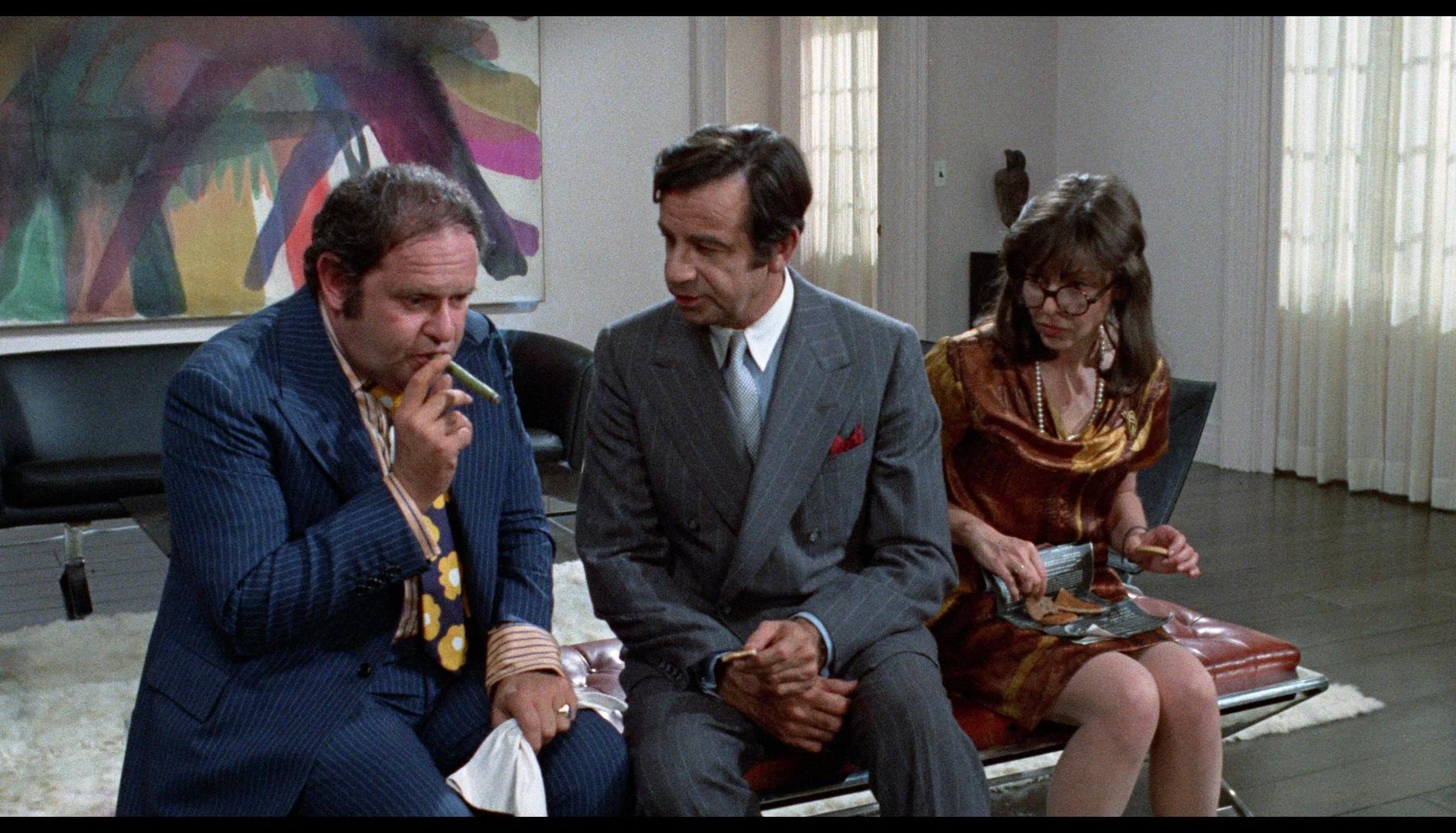
May’s writing is a dream matched perfectly by the cast’s uniform deadpan deliveries. From cannily repeated lines (“Carbon in the valves”), to acts of shade merrily tossed away by basically every member of the male cast surrounding May’s utterly benign Henrietta (“She’s not engaged?” “No, she’s a botanist”). A New Leaf is as quotable as it is rapid-fire. In his review of the new The Naked Gun film for Little White Lies, Charles Bramesco observed, quite correctly, that its style of comedy “is a volume business”, and that’s an ethos which equally applies here. Every scene is stuffed with opportunities – capitalised upon – to mock Henry and Henrietta alike. While there are ample examples of gleefully executed physical comedy routines – Henrietta dangling precariously from a cliff behind a blasé Henry; his confounded efforts to rearrange a garment that she’s gotten herself tangled in – these are always complimented by May’s impeccable dialogue and the ways in which it is communicated.
The ‘new leaf’ of the title is of dual significance. When asked of her hopes and dreams, Henrietta responds that both would be to discover a previously unheard of fern, sporting fronds never seen before. Henry astutely suggests that this notoriety would be a form of immortality. Just as Henry is about to complete his dastardly plan and off his new bride, leaving Henrietta to drown after some improbable boating misadventures over a river’s tumultuous rapids, he spies a fern that makes him think twice and, in the film’s final moments, May manages to redeem him.
Holding onto Henrietta in a clinch that is reluctantly romantic, Henry concedes that a life together would be conceivable, in his eyes. From a man this craven and averse to anything approaching a work ethic, seeing the potential in an academic life with Henrietta is a revelation. But it is not one so out of leftfield to feel like a cheat. The acidic acknowledgement, throughout, of the uselessness of the upper classes by the upper classes evidences a wry self-deprecation. Enough for a life of worth and work to be, ultimately, desirable. In this eleventh hour, Henry turns over his new leaf. His tacit commitment to a working life with Henrietta belies her true importance to him. In that moment Henry himself becomes that rarefied botanical curio that has long eluded Henrietta; he is a new breed, and – as unlikely as it may have seemed for the prior 95 minutes – her prize. They stumble toward the setting sun together as the credits arrive, heading off toward a shared immortality.
Immortality exists for Elaine May through her works. Each film has its champions. Occasionally, when an artist’s body of work is so small, that relative scarcity buoys up their significance, and this can even eclipse their worth. Not so in May’s case. Comedy is a mightily undervalued genre, often frowned upon critically for being ‘base’ or ‘low’ (like horror in that regard, though horror has benefited from a more widespread renaissance in recent years). But the idea of an artistically great comedy seems baffling to some, even an oxymoron. It shouldn’t, and May’s work would be my Exhibit A in this case. That she was a woman tearing up the rulebook and defying assumptions in early ’70s Hollywood makes it even more exemplary. A New Leaf makes its wit and intelligence so self-evident as to be undeniable. A bonafide classic for cynics and, come the end, romantics alike. The art and artistry is in the idea and in the execution. And that it is this enjoyable just makes receiving it all the sweeter.
 The Lost Highway Hotel