
Director: Luca Guadagnino
Stars: Ayo Edebiri, Julia Roberts, Michael Stuhlbarg
Circumlocution is the act – or art – of talking around something. It’s one of my favourite words, wryly, because it’s a pretentious way of saying ‘verbosity’; a word that comes with it’s own sense of irony. And it’s a word that feels apt when considering Luca Guaganino’s latest. After the Hunt is his third feature to hit UK cinemas in 18 months, following sporting three-way Challengers and his ode to Burroughs Queer. The latter stands out among the three as the flinty, risky, quixotic one. Watching After the Hunt makes me wonder how much of that comes from its subject, and whether Guadagnino is simply approaching burnout?
There’s trouble afoot in the psychology department at Yale, where professors Alma Imhoff (Julia Roberts) and Hank Gibson (Andrew Garfield) are in good natured competition over the possibility of attaining tenure, that most privileged institution. Both within grasp of a position in which accountability is assuaged. At a soiree held by Alma, the two of them heap praise on prodigal student Maggie (Ayo Edeberi) while Alma’s psychotherapist husband Frederick (Michael Stuhlbarg) looks on. Maggie leaves with Hank, but the next day comes to Alma desperate for help, claiming he assaulted her. Alma, steely from an entire career battling for status in the boys’ club, isn’t quite as sympathetic as she might’ve been. Hank, all charismatic arrogance and largess, denies it vehemently, but in our cultural landscape of performative outrage, he (rightly) assumes his career is over regardless.
You can sense Guadagnino wrestling, at times, for ways to make what follows visually interesting, perhaps to compensate for the overwrought detritus that is Nora Garrett’s blowhard screenplay. What manifests are a set of nervous ticks in an otherwise mannered staging of the material. But editorial stutters, deliberately awkward frames and the impertinent blurts of Trent Reznor and Atticus Ross’ misfiring score can’t make up for the staid, contrived and pompous tome that roots After the Hunt in inertia.
The ensemble are all interesting. Roberts seems eager to get her teeth into a Lydia Tár-esque character. Garfield – featured the least – brings some much-needed energy. Edebiri makes Maggie an enigmatic, possibly-brilliant entity in spite of the dearth of character presented for her. And Stuhlbarg sashays through scenes stealing them without a pause. But their combined efforts can’t patch over what a self-satisfied bore this all is. After the Hunt postulates that it has much to say about cancel culture, academia power dynamics and philosophy itself, but gets tangled up in its own performative inclinations. Garrett dances around tackling her subjects head on, seemingly for suspense, but increasingly to imply that the text is too clever for the audience. It turns topics with genuine, impactful realities for people into rambling intellectual exercises.
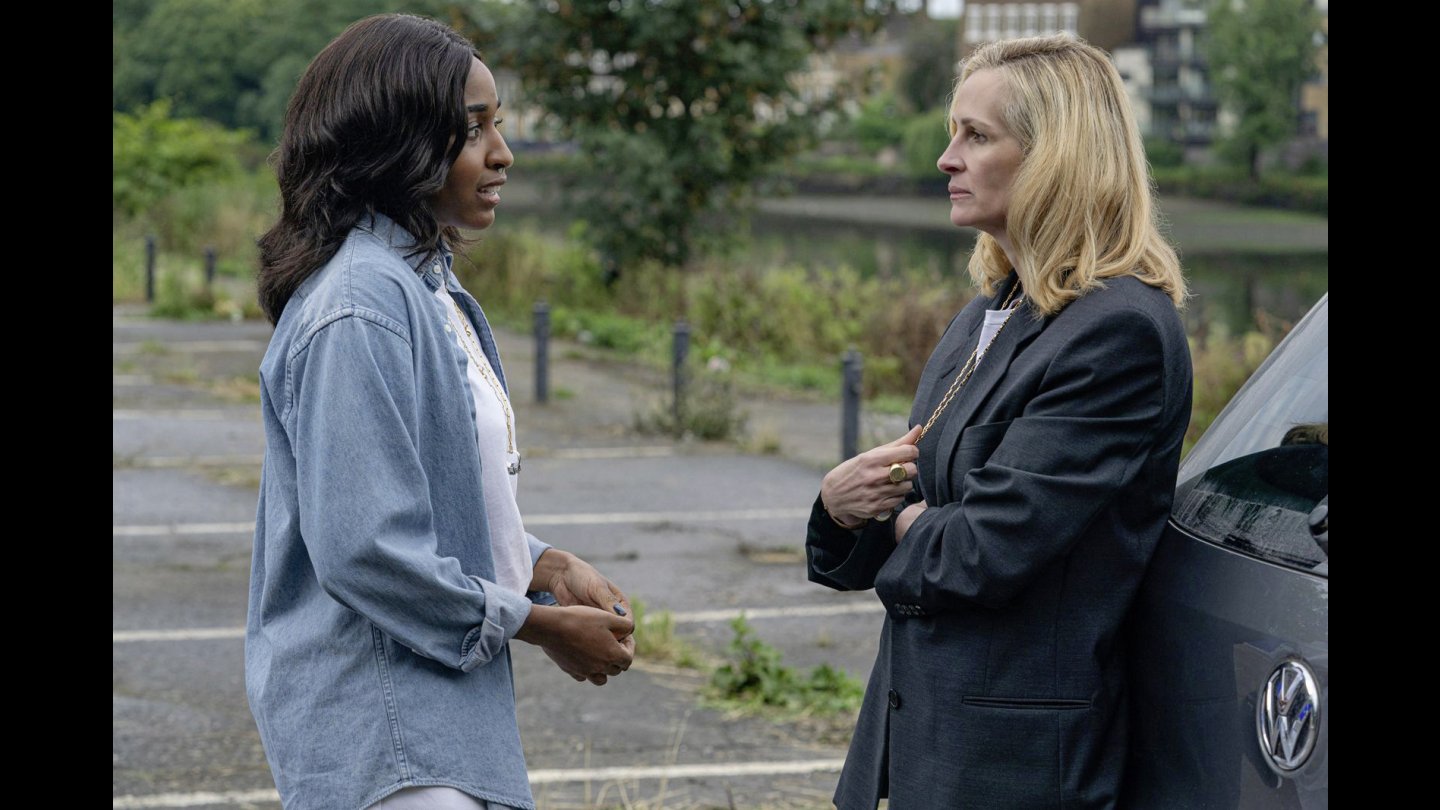
Much as After the Hunt tries to walk a haughty tightrope of inscrutability, the text inevitably belies a bias. It is the long-suffering stalwarts of academia who are rendered with the most sympathy, even if Alma and Hank are far from angels. The student body – given voice almost exclusively by Maggie and her non-binary partner Alex (Lio Mehiel) – are a coddled, whiny constituency whose ‘snowflake’ morality is perpetually sneered at. There are deep generational resentments rooted into Garrett’s script that she has Hank vocalise in that opening party scene, but one quickly comes to sense on which side of the picket lines the author stands, and Guadagnino seems keen to play devil’s advocate and join her. The decision to frame all of this within opening and closing titles that borrow the Woody Allen typeface is Guadagnino’s own try-hard effort to court pre-parceled offense. Inevitably, however, it just gives us The Ick.
Whenever After the Hunt comes close to an interesting, humanistic observation, it becomes a better movie. The drawing of Alma and Fredrick’s marriage, for instance, is desperately sad, and does much without articulation (until the script inevitably vomits it out for us anyway). But more often the mode is cruel and unfeeling (I don’t think anyone, at any point, asks Maggie how she’s doing, whether they believe her or not), keen to revel in the meanness of an institution that seems less interested in cultivating a relationship with the next generation as it is waging a war against them.
It’s all too plodding, carried with a misguided confidence that it’s interesting. Alma’s ulcerous pains that double her over are, actually, a hoary old bit of metaphor. Her berating of her students feels lifted directly out of TÁR (an unflattering comparison and ironic given the plagiarism subplot), and the ‘five years later’ coda assumes a level of involvement two hours into this thing that has long since waned (this portion seems to exist, primarily, to prove another of Hank’s edgelord proclamations correct).
Perhaps After the Hunt will be looked back on as an example of post-truth cinema, dissecting a moment in which what happened isn’t nearly as important as the PR campaign one wages to package a position in the aftermath. A cynical movie for cynical times, that gloats unpleasantly at the audience like, well, a Woody Allen picture.

 The Lost Highway Hotel