

Director: Neo Sora
Stars: Kirara Inori, Hayato Kurihara, Yukito Hidaka
There’s a preamble of on-screen text at the beginning of Neo Sora’s Happyend that one might argue is completely superfluous, establishing for the viewer that this coming-of-age movie takes place in a near future. But one only has to look at Sora’s vision of an authoritarian surveillance state that disrupts social gatherings while taking away liberties under the watchful umbrella of safety to realise that this is a situation many countries are finding themselves in right now. Happyend has taken a year to roll out to UK shores following its festival debut in 2024, but it already feels as though the world has caught up with and possibly even eclipsed Sora’s worrisome soothsaying.
His Tokyo story focuses on a happy-go-lucky quintet of youths in their final year of high school, who enjoy flaunting the rules almost as much as they like EDM. The core of the group are lifelong pals Yūta (Hayato Kurihara) and Kō (Yukito Hidaka), tacitly aware that as graduation grows closer they are somewhat inevitably fated to go their separate ways. This is one of many big ‘endings’ on the horizon, and is gloomily eclipsed throughout by the government’s insistence that the nation prepare for an unavoidable earthquake that is destined to decimate the country.
Why think about your future when you’re told it doesn’t exist? This sense of impending cataclysm is intended as a paralysing tactic to push through a mandate of intrusive surveillance, but it generates in Kō something akin to nihilistic freedom. If the world’s already ended – as he sees it – why not just party? The two lads are established at the top of the picture as inseparable. They can’t even beat one another at Rock Paper Scissors because they share such an uncanny wavelength, but Happyend charts a growing schism. Where Kō is happy to dance the pain away, Yūta is inspired by the proto-Marxist convictions of activist pupil Fumi (Kirara Inori) into fighting against the system changes that the kids are encouraged to think are inevitable.
The school becomes a pointed microcosm of the country at large when a prank performed by both boys on the principal’s car causes him to install an AI-controlled CCTV system on campus which, using facial recognition technology, can track the students and even fine them ‘points’ for indiscretions like littering or smoking. Brought in, again, under the assurance that it provides ‘safety’, the system gradually starts chalking up errors as swiftly as it does political agitation in the student body. Fumi ultimately leads a sit-in at the principal’s office in an effort to draw a line in the sand.
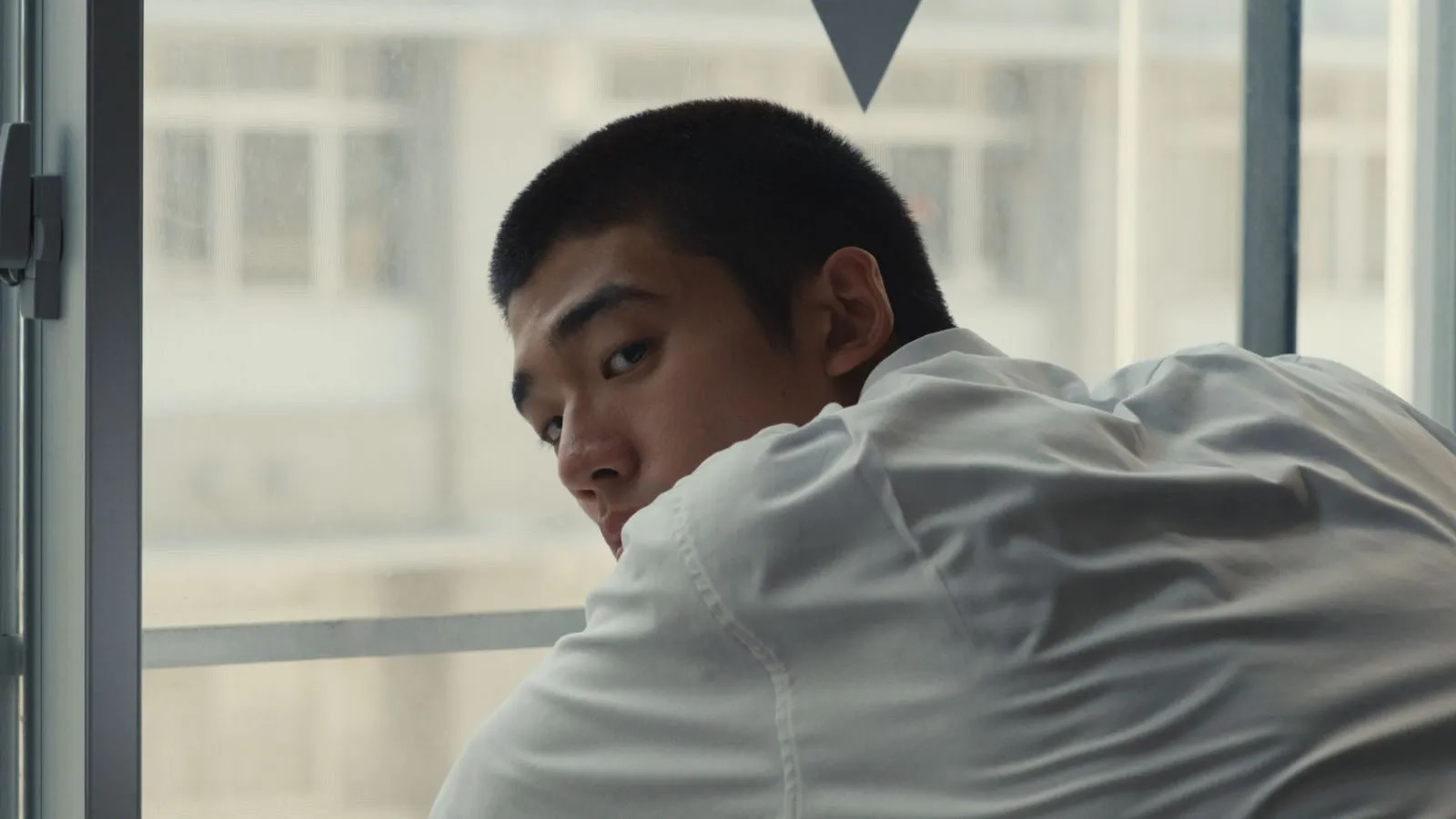
Happyend makes smart studies of its central characters, understanding the anxiety of ending high school with an uncertain, unmapped future ahead. The film is, perhaps, a little too in-keeping with this sensibility, as it can feel slightly directionless at times, lacking in momentum during the mid-section. Yet there’s always something of interest happening, even if it’s just smartly drawn character work that’s being handled expertly by the young cast. The trio of Fumi, Yūta and even the easy-going Kō present – over the course of the film’s near two-hours – a recognisable reflection of growing pains. They’re flanked by the more affable, spirited presence of Ata-chan (Yuta Hayashi), Ming (Shina Peng) and Tomu (ARAZI).
That the latter-two are not of purely Japanese descent allows Sora to pinpoint a further element of concern that will resonate globally, as kneejerk nationalism infiltrates school policy and ultimately segregates students. Sora seems keen to address a sense of government trying to deliberately divide groups in a further effort to stoke a depressed, isolationist worldview. The regime in Happyend wants citizens alone and afraid. The biggest threat to this is community, friendship and collectivism. These are ultimately the tools chosen by the students to rebel against the measures that they feel are oppressing and restricting them.
Happyend is a film trying to do double-duty; create a circle of lived-in, naturalistic young friends that the viewer cares for and address a litany of socio-political concerns from their perspective. It’s a lot to take on and, with this in mind, perhaps the drifting sense of space in the narrative is necessary to ensure this doesn’t all feel too condensed, crowded or over-ambitious. In retrospect Sora actually works small wonders, and this feels like the kind of film that’ll grow in estimation as the days/weeks/months pass and it is given space to expand in recollection. The presentation is clean and elegant, detached and contemplative, showing a fondness for the classicalism of Japanese cinema, but the messaging is concerned, urgent but eventually optimistic. Even if the ‘end’ is closer to bittersweet.

 The Lost Highway Hotel