

Director: Eva Victor
Stars: Eva Victor, Naomi Ackie, John Carroll Lynch
There’s a sexual assault at the centre of Sorry, Baby but we don’t see a second of it. Director Eva Victor plays the event (referred to throughout as “the Bad Thing” because the words we’ve elected to define such things are, simply, unspeakable) in a series of increasingly disquieting exterior shots. Passively we look at a statuesque detached house on an unassuming street, cutting from day, to evening, to night. People walk by. There’s nothing to note. But behind closed doors a life is irrevocably altered.
After we watch Victor’s lead character Agnes flee the scene and drive home, the details are shakily reported to their best friend Lydie (Naomi Ackie). While evocative, this bathtub report also underscores how the mind seeks to protect us from trauma, clouding the worst, buffering like a band aid. Later in the film, an attorney schools potential jurors (Agnes included) in the difference between circumstantial evidence and witness testimony. We’ve heard Agnes’ testimony. We have no doubt in them. But what’s unwaveringly conveyed – by the scene, by Victor – is a sense that what’s happened to Agnes has become circumstantial. Unprosecutable. Agnes wouldn’t want to go there anyway, but the system wouldn’t support it.
Sorry, Baby – which Victor also writes, exchanging multiple hats – looks from the outside to fit the mould of an interchangeable, cosily autumnal New York State indie dramedy. The kind we receive year in, year out. But, like that singular house on that ordinary street, looks can be deceiving. Presented a-chronologically and starting with “The Year with the Baby”, it initially leans toward the expectation. Lydie comes to visit Agnes – who we amorphously gather is not doing well – and the pair fall into a patter of chat that seems regressive and childlike. Affectionate but babbling and close to grating. It is only as the context becomes clearer that these interactions become more understandable. Heightened comfort. The security of Not Dealing. Of distraction and nostalgia for The Before Times.
We then zip back down the timeline to “The Year with the Bad Thing” and the above drama plays out, shorn of the opening stretch’s stereotypical kooky witticism. It’s a sobering tonal change, but one handled with a deft confidence evidenced all over Sorry, Baby. Afterwards, we move episodically through the years as Victor paints a portrait of Agnes at various stages of response to the rape. If we’re not moving toward recovery – because what would that word even mean in this context – then at least some semblance of peace.
In the wake of #MeToo we’ve received many artistic responses to the higher-profile outcry for better behaviour and consequences. Everything from Maria Schrader’s level reconstruction of the news story itself to Madeleine Sims-Fewer’s unblinking study of a rape-revenge fantasy, with Kitty Green’s hunched The Assistant sat pensively in between. Sorry, Baby shows that responses to such crimes can be as varied as the people involved, and takes a warm, humanistic approach. Agnes is a preternaturally ‘nice’ person, a gifted student-cum-professor who doesn’t wish ill on anyone, and who struggles in the aftermath to find places for the myriad new feelings she’s experiencing. As much as anything, Sorry, Baby forefronts the importance of other people in the healing process. In surrounding oneself with the right support network.
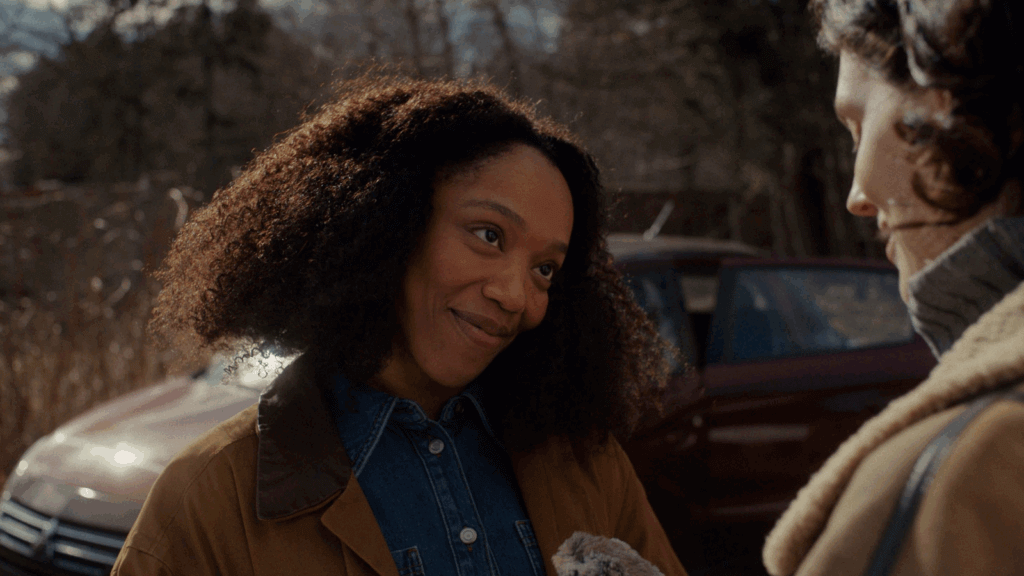
Ackie is wonderful as bestie Lydie, understanding and supportive in all the right ways, further proof of the actor’s charisma and generosity. But she’s not alone. Lucas Hedges puts it some equally appealing work as Agnes’ kindly neighbour Gavin, and a bathroom scene between the two of them is among the movie’s most giving. He comes to represent a safe space and normalisation in the company of men, something also supplied by the ever-great John Carroll Lynch, who only has one sequence in ‘The Year with the Good Sandwich’, but whose efforts enhance the entire picture.
But (while I’m reticent to assume autobiography) this is Victor’s story. While its formally dissimilar (no asides to camera etc), there’s tonal kinship with Phoebe Waller-Bridge’s Fleabag, if only in the acknowledgement that lives get messy and the world consistently renews its ability to both baffle and charm. Victor’s background includes stand-up, and Sorry, Baby applies learned nous re building smart narratives to the landscape of filmmaking. They’re an engaging presence from beginning to end, subtly and slyly rejecting binary responses in a world more commonly presented in shades of grey.
It’s occasionally too-cute in a manner that an American indie dramedy can be, and there’s some questionable kitten continuity when an adorable feline is introduced, but these are very minor quibbles in the face of a movie that manages to thoroughly exceed the assumption that we’ve seen this all before.
Indeed, the finale reckons with this. A monologue presented to a blissfully indifferent third party that sadly resigns itself to the realities of life. That pain and suffering are part of it. This in no way excuses the horrific behaviour of others, but acknowledges that such incidents exists and sometimes there’s no way around them. Sorry, Baby contends with such grotesqueness by prioritising the little things that make salvage worth the effort.

 The Lost Highway Hotel