
Director: Michael Shanks
Stars: Alison Brie, Dave Franco, Damon Herriman
In Jean-Paul Sartre’s one act play “No Exit”, hell is – quite literally – being stuck with other people. Writing as an introvert, there are absolutely times I feel the need to withdraw and recharge, when the world feels as though it’s become just a little too peopley. I get where Sartre’s coming from on this one. New Zealand filmmaker Michael Shanks’ incredibly inviting feature debut makes juicy, gloopy, crunchy horror out of the prospect of becoming irrevocably fused to another, while mining the idea to test the bonds between a co-dependent couple.
Meet Millie (Alison Brie) and Tim (Dave Franco). They’ve been together for a decade and have entered a kind of holding pattern. Sex has dried up, and there’s a barely hidden tension regarding the future. Millie’s just scored a teaching job in the country two hours outside the city, so they’re leaving their cloister of hipster pals to take up residence in the cottage where Tim’s parents used to live, up until a nasty tragedy the year previous which has left Tim rattled and distant.
One day, while exploring the woodland surroundings, the pair get lost and fall into a kind of heathenous sinkhole peppered with cultish iconography. As we’ve already been made aware by the film’s cold open, there are dark consequences to drinking the water – drinking the Kool-Aid, even – from this murky cave. A stormy night passes and they’re able to escape, but Tim particularly suffers after effects of their escapade, finding himself physically drawn to Millie; their bodies compelled to somehow merge. In part due to this stressor, the closer they get, the more fraught their failing relationship becomes…
This isn’t exactly new territory, so there’s no real sense that Shanks has cracked an egg here. Elements of the story strongly recall a Junji Ito one-shot horror manga called “The Spirit Flow of Aokigahara”. As for cinematic reference points, Lars Von Trier took Willem Dafoe and Charlotte Gainsbourg to task in his weird, miserabilist cabin fable Antichrist, while all manner of body horror classics have dared to dream of bodies entwined in perversely deformed ways (Society, The Thing, a bunch of Cronenberg, obviously). There’s even a sorry creature featured here that recalls the freakish Monstro Elisasue from last year’s crude hit The Substance.
But if Shanks loses a couple of marks for arriving slightly late to the party, he makes up for his tardiness with energy and a welcome entourage. That he has drafted in real-life husband and wife Brie and Franco for this experiment really sweetens the deal. Where the aforementioned auteurs were out to bully viewers into submission, Shanks would rather have a little fun. His stars (also producers) are eminently likeable, bringing appeal from previous roles to the table. They also have evident chemistry and are incredibly game. This opportunity to play together seems to have brought the best out of both of them.
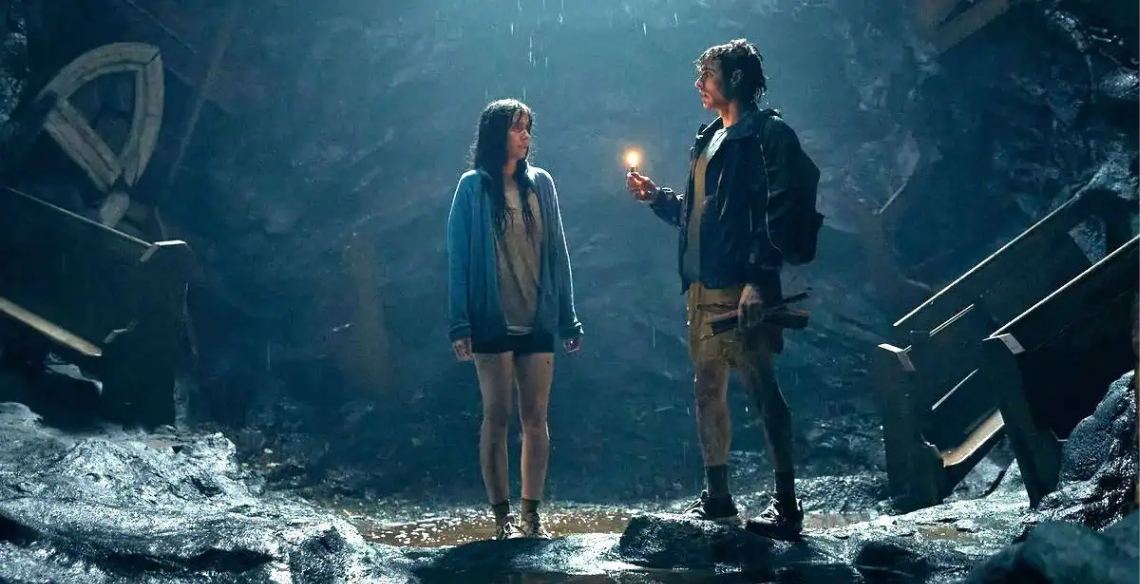
And the material is testing. Long-gestating resentments bubble up to the surface. Millie is frustrated that Tim still pursues adolescent dreams of making it as a musician. Tim is terrified that he’s inherited some of his mum’s crazy. Early on his male friends chide him for being under Millie’s thumb, but he’s both desperate not to let her down and resentful of this subservient position; his anxiety helps engender a vicious circle. These two characters clearly love each other but are weighed down by life’s accumulative baggage. What they need, one senses, is some catharsis.
What unfolds – quite slowly – might perversely be just what they need. Shanks organises a cruel, hellish therapy from the wilds of his imagination. Together has just enough lore feathered in around the edges to make all of this interesting and intriguing, although he positions a wolf-in-sheep’s-clothing third party presence a little too conspicuously. While the mid section could use a bit more urgency on occasion, Brie and Franco guide us through. And, even here, Shanks pocks the domestic drama with episodes of sticky fantasia.
The third act ups the ante, delivering with a renewed sense of twisted humour. Together can be wickedly funny, even inappropriately so (a high-point involves the frantic popping of muscle relaxant pills; this in a movie with an underlying suicide theme). And while The Turtles’ anthemic earworm “Happy Together” – used so effectively to promo the movie – doesn’t feature in the finished film, Shanks finds an even more appropriate needle drop for the effects-heavy finale.
There’s a sense of slightly confused thesis from time to time. That Shanks isn’t quite sure if he finds the bond between Tim and Millie healthy or not, so he plays the stakes in both directions. But that’s also honestly reflective of the nature of relationships. Binary simplicity is often hard to come by. There’s also the stigmatisation of mental illness, which again can be taken as both an example thereof or as a reflection of extant biases.
This also feels – just a little – like an idea that could have grown and complicated itself further (maybe an imagined sequel could throw in a polyamorous conundrum), but Together is also pleasing scaled and focused on these two. Ultimately, most of Shanks’ decisions feel like the right ones for a debut feature.
It’s a lot of fun. And maybe the mid-section could have been more fun, but it would have been at the expense of the dramatic fulcrum between Brie and Franco. While some of the familiarity here prevents Together from punching through as an enterprising contender for Horror of the Year, it represents high quality work from everyone involved and gives Shanks a memorable platform from which to launch whatever’s next. This is probably the closest I’ve come to slapping a ‘Seal of Approval’ on a 7 out of 10. And, yes, it’s a far better romcom than Materialists (also out in the UK this weekend).
Get stuck in.

 The Lost Highway Hotel
1 thought on “Review: Together (2025)”