
Year: 1972
Director: Emilio P. Miraglia
Stars: Barbara Bouchet, Marina Malfatti, Pia Giancaro
Last spring at the multiplex, watching the spritely but minor Sydney Sweeney horror vehicle Immaculate, there was a moment that made me sit bolt upright in my cinema seat, overjoyed at one of the year’s most welcome needle drops; Bruno Nicolai’s incomparably ornate and poppy title theme from La dama rossa uccide sette volte, better known in English-speaking countries as Emilio P. Miraglia’s The Red Queen Kills Seven Times.
Part of the irrepressible giallo cycle that typified Italian genre cinema in the early 1970s, Miraglia’s offering is among my comfort movie staples and, to these eyes, one of the best that the subgenre has to offer. In part for Nicolai’s rousing musical accompaniment – which so delighted me during Sweeney’s novitiate montages – but mainly for how it manages to encompass many staples of the giallo while also bending the formula a little.
There are many ways in which The Red Queen Kills Seven Times is perfectly typical; a mysterious, black-gloved killer; a cast of socialite suspects; a rather bumbling, ineffectual police inspector character (Marino Masé). If you subscribe to the idea that these movies split into masculine and feminine counterparts (M-gialli and F-gialli), then Red Queen is decidedly ‘F’, boasting a number of the era’s iconic leading women, led by Don’t Torture a Duckling star (and former Star Trek guest player) Barbara Bouchet as the pin-wheeling, perma-victimised Kitty.
A cold open with young girls sets up the rivalry between affluent sisters Kitty and Evelyn, chastised by their rich father (Rudolf Schündler) for misbehaving before being told a bizarre tale of murderous vengeance between two mythic queens – Black and Red – immortalised in a grand painting that pops then decides, arbitrarily, to have burned. Supposedly the Red Queen returns from the grave every 100 years for a spree of seven murders. Fourteen years later, on the fated anniversary, a rash of murders starts up again by a female assassin in a red cape, targeting the high-end fashion house where Kitty works as a photographer.
Situating a giallo in the fashion industry is practically de rigueur for the genre, second only to the art world. These venues afford us a window into an imagined enclave of rich decadence and moral corruption in which the undeserving would get their just desserts via their torment and killing. It’s a darkly voyeuristic milieu. Usually the exception to the rule would be a hero or heroine whose relative purity or naivety would set them apart from the disreputable indulgences of their peers, and Bouchet fills that role here as Kitty, her soft alabaster features marking her out as separate from her more debauched and jaded contemporaries (among them future B-movie ice queen Cybil Danning).

But Red Queen also sets itself apart with it’s looming gothic tendencies, from the decaying German mansion in which the film begins to the layer of fantastique that falls over proceedings like a death shroud thanks to the elaborate myth that we’re told at the start. Flashbacks reveal a terrible accident(?) between the sisters in which Evelyn was killed on the mansion’s grounds, her bloodied body floating in a pond like Ophelia, broken and murdered. A little later, in the film’s present, Kitty discovers Evelyn’s rotting corpse in the catacombs beneath the estate in a sequence that openly brings to mind Poe’s The Black Cat (itself the inspiration behind more than one giallo classic).
Kitty is joined by her inquisitive cousin Franziska (fellow giallo royalty Marina Malfatti) and the pair attempt to riddle out the killer among them with far more gumption than the aforementioned inspector. Miraglia keeps us on our toes with twists, turns, appreciably silly melodrama and gaudy death scenes as the Red Queen takes her toll.
Miraglia is something of an outlier in giallo terms; a director of few films before his death in 1982 (Red Queen was his last picture), and only one other effort in the genre (the prior year’s dark and hokey The Night Evelyn – another Evelyn – Came Out of the Grave). His shooting here is handsome, efficient, sometimes gravely stylish, bolstered in no small way by the often overcast German skies that backdrop the drama. Nicolai’s aforementioned score has a gorgeously prancing, quasi-classical affectation to it, with folkish allusions laid in thanks to the prominent use of harpsichord. It enhances the gothic atmosphere no end. Visual spectres of the Red Queen enhance this haunted quality, so that Miraglia’s film presents like some kind of modern fairy tale, connected – however thinly – to the rise of folk horror in European cinema around this time.
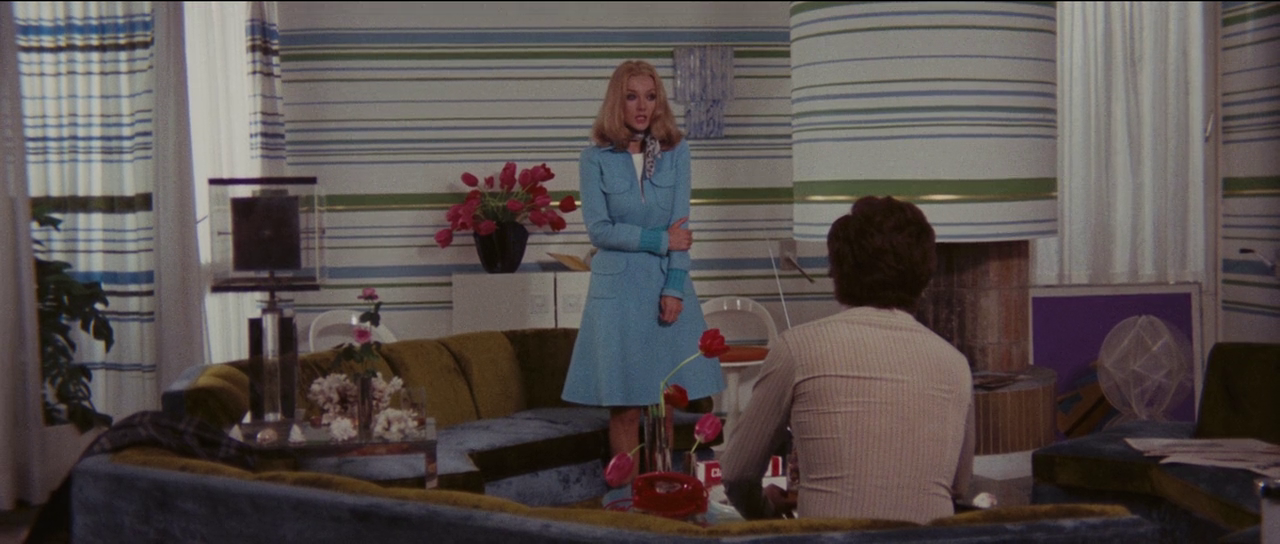
In it’s more modern settings, giallo fans might warmly recognise the striking apartment occupied by Kitty’s lover (and boss) Martin Hoffman (Ugo Pagliai). It’s daring, horizontally-striped decor and curved fireplace make it an unmistakable and flamboyantly gaudy bachelor pad, one that also appeared prominently in Sergio Martino’s equally excellent The Strange Vice of Mrs Wardh (Rachel Nisbet writes informatively on the unique property here). Keep an eye out for the ubiquitous bottle of J&B among the coffee table clutter.
There are other arresting visual episodes in the film that seals its fate as a firm favourite. The masked Red Queen running toward camera in a vast, modern concourse like a mall or an airport is both ghostly and iconic (part of one of Kitty’s vividly realised nightmares that see the Red Queen appear over her in bed like a ghost), furthering the film’s recurring sense of past and present converging. The antiquated or archaic running roughshod over the contemporary.
Then there’s the rather elaborate and loopy third act, which swirls rising hysteria with crazy reveals and technically ambitious set pieces to riveting effect. Kitty – half mad from being chased about by the Red Queen at the family mansion – searches for Franziska and Herbert (Nino Korda) in the catacombs. She discovers the identity of the killer and then fends off a barrage of bats, rats and finally a torrential flood in an effort to escape. The crescendo of flood water gushing from the tombs beneath the mansion, carrying Kitty and the family secrets with it, shows a level of bravura rarely achieved in the genre’s more run-of-the-mill entries.
Suitably for a giallo framed around the fashion industry, all of the clothes are the epitome of Italian ’70s chic, particularly the suits passed to Bouchet to parade around in. The aesthetic pleasures of films such as this one shouldn’t be written off; they’re part and parcel of the overall feeling of indulgence one is treated to with every revisit. The Red Queen Kills Seven Times and its sister films may draw us in with lurid tales of the rich eating one another alive, but there’s an equally shameless appeal in watching them go at it in gorgeous locales and spectacular outfits. Miraglia’s film might be about the dirty underbelly of such beautiful veneers, but the beauty itself is too alluring to deny.
Camp, conniving and crammed with dotty familial intrigue, there’s no reason to deny oneself The Red Queen Kills Seven Times.
 The Lost Highway Hotel