

Director: Jia Zhang-ke
Stars: Zhao Tao, Zhubin Li, Pan Jianlin
“Every decent director has only one subject, and finally only makes the same film over and over again,” announced German maverick Rainer Werner Fassbinder, and its a statement that certainly seems true of Jia Zhang-ke, whose recent run of films follow conspicuous repetitions, as though the auteur is honing in on some measure of perfection with a specific and narrowing set of qualities. Jia takes the idea of remaking work to new extremes here, repurposing footage shot for 2002’s Unknown Pleasures and 2006’s Still Life and sketching a new narrative around them with a mixture of documentary footage, intertitles and a newly shot coda.
Opening – as his last two features did – in the early years of the new millennium, we’re again steeped in a journey of personal evolution flanked by China’s mutating rural industries and communities. The déjà vu continues as we’re introduced to Zhao Tao’s dancer/runway model Qiao Qiao, moving to energetic pop music; an echo of the introductions of her both of her last two characters for Jia. Youth and exuberance communicated through movement and a relationship to music.
Just before this, a documentary section dwells on a group of women comparing their singing voices; a close and joyful circle allowing one another a temporary spotlight for self-expression. Soon after we’re confronted with an array of male workers sitting and smoking on the steps outside a factory. Old and young alike; a different, more contained sense of masculine community by comparison. We see they’re sitting for a photograph but the photographer is absent. They’re waiting stoically for attention. Maybe ours. Maybe the country’s. Maybe the world’s. Caught by the Tides furthers a sense of the forgotten.
The comparison and interweave between female and male groups feeds into the laconic tale that unfolds, as Jia collages a tapestry of Chinese life tethered repeatedly to moments of song. An overarching tale gradually emerges, but in a reduced, expressionistic style. Qiao Qiao is abandoned by her boyfriend Guo Bin (Zhubin Li), who leaves her in the rural northern province of Datong with a promise to bring her to the bustle of the big city; a promise on which he heartbreakingly reneges. Qiao Qiao, too, has been left waiting. Their separation is wordlessly conveyed in an emotionally agitated scene in which Guo Bin won’t allow Qiao Qiao to leave a dilapidated bus. They crash against one another over and over as Qiao Qiao bursts into tears. We jump to 2006 and Qiao Qiao is done waiting. Flanked by news broadcasts charting rising river levels, we follow as she searches for Guo Bin.
As with Ash is Purest White, and in a large part thanks to the unique method of it’s construction, Caught by the Tides is expressed via the technologies of its disparate time periods. Thus the opening stretches are typified by rough video and DV episodes, reflecting the experiments happening in the early ’00s. Later, as we propel closer to the present, the framing and aspect ratios grow cleaner, sharper, wider, mirroring the sense of clarity within Qiao Qiao as she matures and crystalises. Caught by the Tides often feels like a kind of temporal travelogue.
Notwithstanding the documentary sections, Jia largely dispenses with dialogue, and often uses intertitles to express Qiao Qiao’s thoughts. Combined with the sense of formal collaging, it feels like a quasi-conscious nod to late-period Godard (albeit without the French auteur’s frustrating obtuseness) or the wandering film poetry of Chris Marker. Still, there’s a feeling that Jia is searching to abandon the norms of conventional storytelling. A yearning to remain just as articulate, but through other means. Song lyrics, disparate musical genres and these onscreen snippets channelled direct from his focal character’s mind carry us on a decidedly unconventional but coherent journey.
I wasn’t aware that this film was (in part) an act of salvage when I went into it, so Caught by the Tides isn’t the film I expected it to be, but is no worse for those surprises. While the shape of the movie is familiar as an echo of prior Jia cuts, the presentation feels like an artist wriggling to free themselves from a strait-jacket. Just as he documents shirtless workers sledgehammering in unison to bring down a derelict building, so Jia deconstructs the old so as to rebuild with new materials. His film is a mirror of the progress and processes that have occurred all over China in the last quarter century.
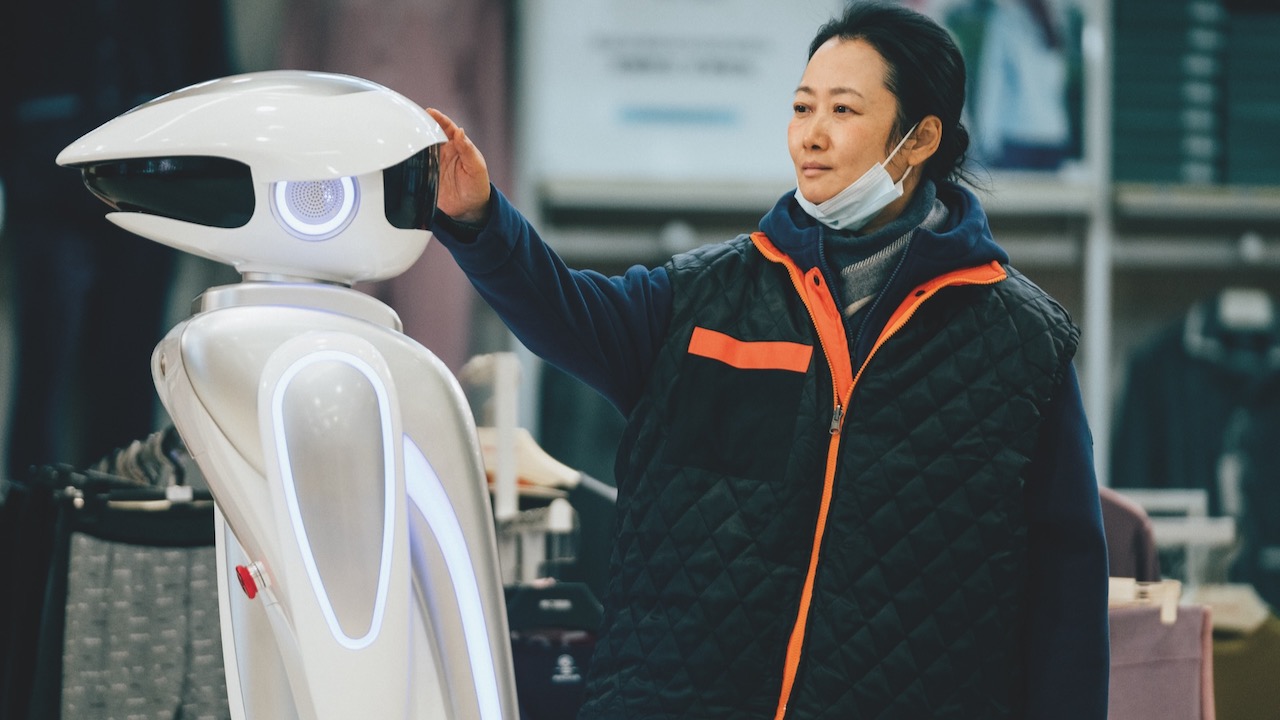
The cut from Jia’s harvested reveries to his COVID-era 2022 third act is deliberately jarring, like awakening from a dream. Here the passage of actual time afforded by the reused footage scores an emotional punch as we reconvene with Zhao Tao and Zhubin Li and see the lines of their middle-aged faces. The weathering of experience that is usually written into the screenplay of Jia films now expressed naturalistically as elegant bags beneath eyes and handsome wrinkles across his actors’ foreheads. There’s a sense of graceful toll that even the most expert of make-up prosthetics couldn’t hope to capture.
Some detours and deviations in this last segment feel unexpectedly disjointed, or perhaps simply could have used a little more context for western audiences. But the calm, the elegance and the power in Zhao Tao’s eyes more than make up for any eleventh hour disconnect or disorientation. Here, at the end of time, Jia’s lost souls are reunited amid an ongoing communal dance, one that suggests the future to come will be dictated by a choreography as surprising as Jia’s reinvention here. A powerful work that propels forward.

 The Lost Highway Hotel